
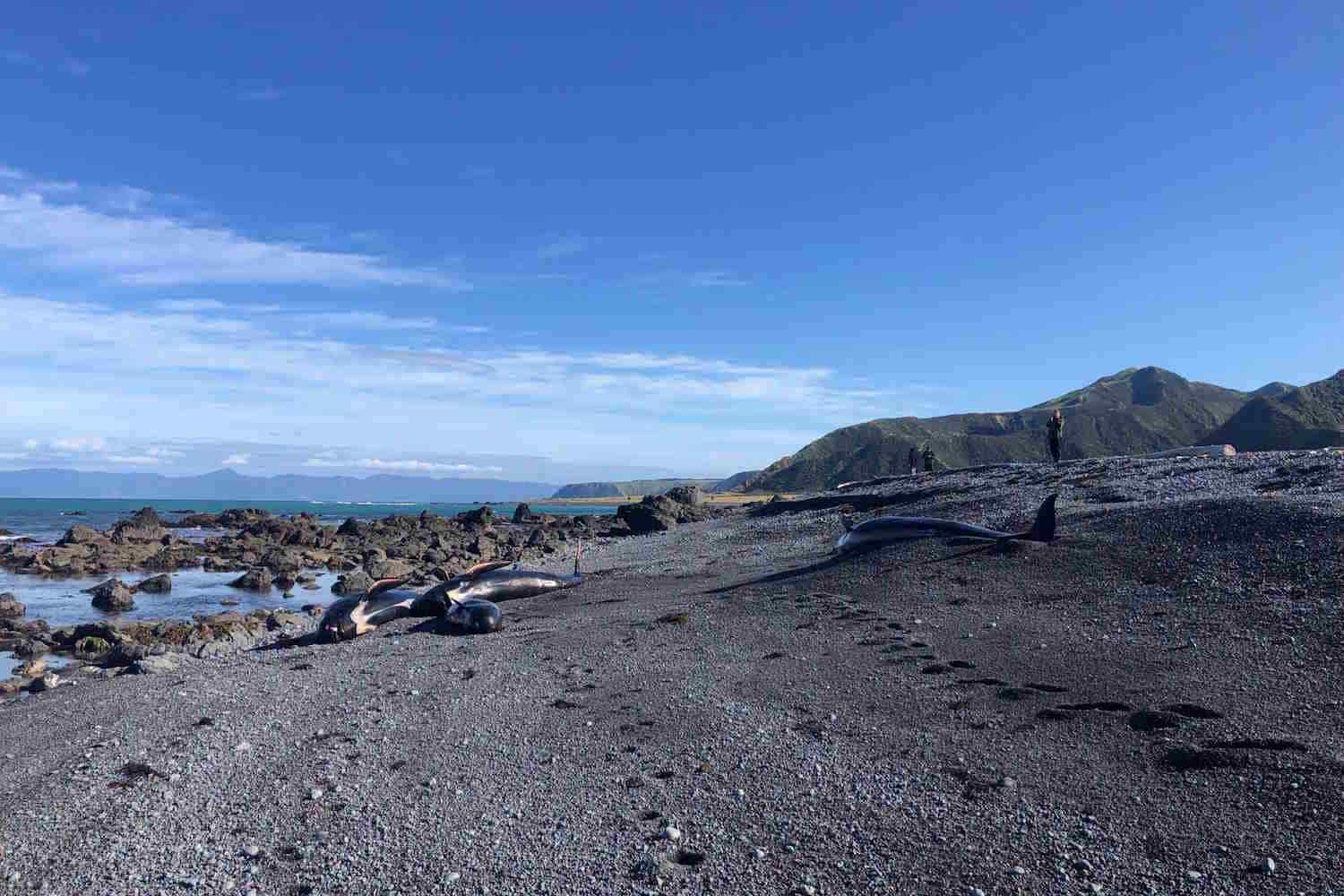
The race against time along the coasts of New Zealand has ended in the most dramatic way. Despite desperate efforts by Department of Conservation (DOC) rangers, Project Jonah biologists, and local residents, none of the approximately 50 pilot whales (Globicephala melasalso known as pilot whales) that stranded between 5 and 6 November along the Ngawi coast managed to survive. What happened near Cape Palliser, at the southernmost point of the North Island, was not just an environmental tragedy, but a loss experienced as a family experience by an entire community.
The DOC rangers and residents entrusted those giants of the sea to the last, solemn farewell of the iwi, the local Māori tribes. A gesture of profound respect that has its roots in a thousand-year-old spiritual and ecological vision, in which human beings and ocean creatures share the same genealogy.
Cetaceans such as taonga and descendants of Tangaroa
For the Māori people, whales and pilot whales (tohorā) are not simply wild animals: they are taonga, a term that indicates a sacred, cultural and natural treasure to be guarded with devotion. According to traditional cosmology, cetaceans are directly descended from Tangaroathe god of the ocean, and in ancient narratives they are often described as spiritual guides who accompanied Polynesian ancestors across the Pacific to the coasts of Aotearoa (the Māori name for New Zealand).
Precisely because of this kinship bond (expressed by the concept of whakapapathe genealogy that unites all living beings) a mass stranding is never treated as a simple logistical problem of removal. It is the loss of an ancestor or a family member, an event that requires silence, meditation and precise rituals to re-establish the spiritual balance between land and sea.
The karakia and the return to the land
In coordination with the Department of Conservation, the elders (kaumātua) of the local iwi perform a karakia on the beach: an ancient song of prayer and blessing recited in the te reo Māori language. This ritual serves to honor the spirit of the missing animals, to thank them for their presence in the ocean and to accompany their passage from the physical to the spiritual world (wairua), while calling for protection for those who worked on the coast.
Only at the end of the karakia are the bodies buried in protected areas along the coast, letting nature take its course away from the curiosity of passers-by and returning the cetaceans to Papatūānuku, Mother Earth.
The tragedy on the rocky coast of Ngawi
What made the Cape Palliser event even more painful was the impossibility of saving even a single specimen. Unlike the more well-known strandings on the sandy beaches of New Zealand, the two groups of pilot whales stranded on an impervious, remote and rock-strewn stretch of coast, where a similar episode had not occurred since the 1990s.
Most of the cetaceans suffered fatal injuries on the rocks in the first few hours. DOC rescuers, Project Jonah biologists and volunteers struggled throughout the day to keep the last four remaining specimens moist and alive: two of them had even been temporarily returned to the water, but the shock, trauma and thermal collapse caused by the absence of the ocean’s push left them no escape.
The mystery remains as to what drove the herd towards such an inhospitable coast, perhaps a combination of anomalous currents, acoustic disorientation or the illness of a single individual, but above all there remains confirmation of how deep the bond of these animals is: a union so strong that it leads them to never abandon a companion in difficulty, not even when faced with the end and which today finds a mirror in the pity and respect with which the Māori community accompanied them on their last journey.
