
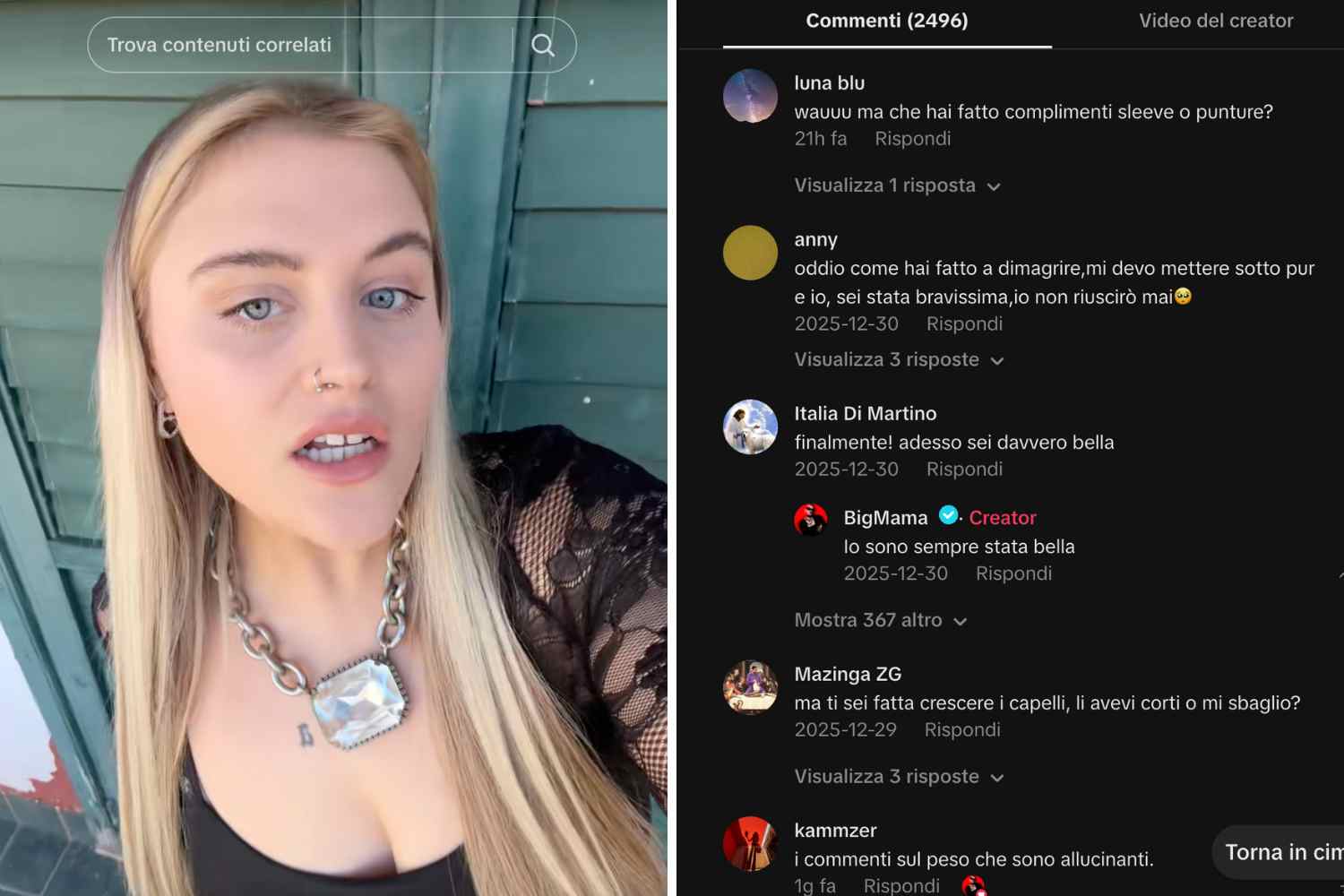
A simple video posted on social media was enough to spark a heated debate online. Big Mama, born Marianna Mammone, found herself at the center of attention not for her music or a new artistic project, but for her physical appearance. The video, which showed her in the foreground, immediately attracted comments from followers, many of whom noticed and highlighted a clear change in her physical shape.
“But how much weight have you lost” was the recurring observation among the comments, with hundreds of users who completely shifted the focus from the content of the video to the rapper’s aesthetic appearance. A dynamic that, once again, raises questions about how the public perceives and judges women’s bodies, especially when they are public figures.
“I have always been beautiful”: the rapper’s response
“Now you’re beautiful” a woman comments to her, and Big Mama’s response was not long in coming and arrived with the same frankness that has always characterized her communication: “I have always been beautiful” declared the singer. A simple but powerful phrase, which contains years of personal battles and the conquest of one’s self-esteem.
Marianna Mammone has long been considered a symbolic voice of body positivity in Italy. His artistic career was in fact intertwined with a message of acceptance and self-love, born from painful personal experiences. On several occasions, the rapper has spoken publicly about her difficult past, marked by episodes of bullying during adolescence that left deep scars.
They told her ‘Fat girl, you suck, go hide’ and she was convinced that she deserved those words, cruel words that had undermined her self-esteem and her relationship with her own body, leading her to internalize other people’s judgments as absolute truths. The path to healing and acceptance went through music and writing.
The contradictions of society on social media
The debate sparked by the video highlights an evident contradiction in contemporary society. On the one hand, acceptance of all bodies is promoted and negative comments on the physical appearance of others are condemned. On the other hand, any change in a public person’s body immediately becomes a subject of discussion and judgment, whether positive or negative.
Many fans defended the singer in the comments, underlining how her value has never been linked to her weight or physical appearance, but to her talent and the message she carries forward. Others instead reflected on how even compliments about losing weight can be problematic, because they implicitly suggest that the previous body was less valid or less beautiful.
The issue raises broader questions about the right to privacy and respect, including for public figures. The fact that someone decides to share aspects of their life on social media should not automatically authorize unsolicited comments about their body. Big Mama, with her response, reiterated a fundamental concept: beauty is not an achievement that comes with a certain weight or a certain physical shape, but it is something that you carry inside, regardless of external changes.
The story also represents an opportunity to reflect on how much there is still to do in terms of digital education and respect. Behind every photo, every video, every public appearance there is a person with his story, his fragility, his battles. And perhaps, before commenting on someone’s body, we should ask ourselves if it is really necessary, if it is requested, and above all what message we are conveying with our words.
Big Mama continues to push forward her music and her message of authenticity and acceptance. Her response, “I have always been beautiful”, is an important reminder for everyone: beauty is not something that is gained or lost with weight, but it is an intrinsic quality that deserves to be recognized and respected at all times and in every form.
@bigmamaalmic Too much vrenzolell
♬ original sound –
Desilva
