
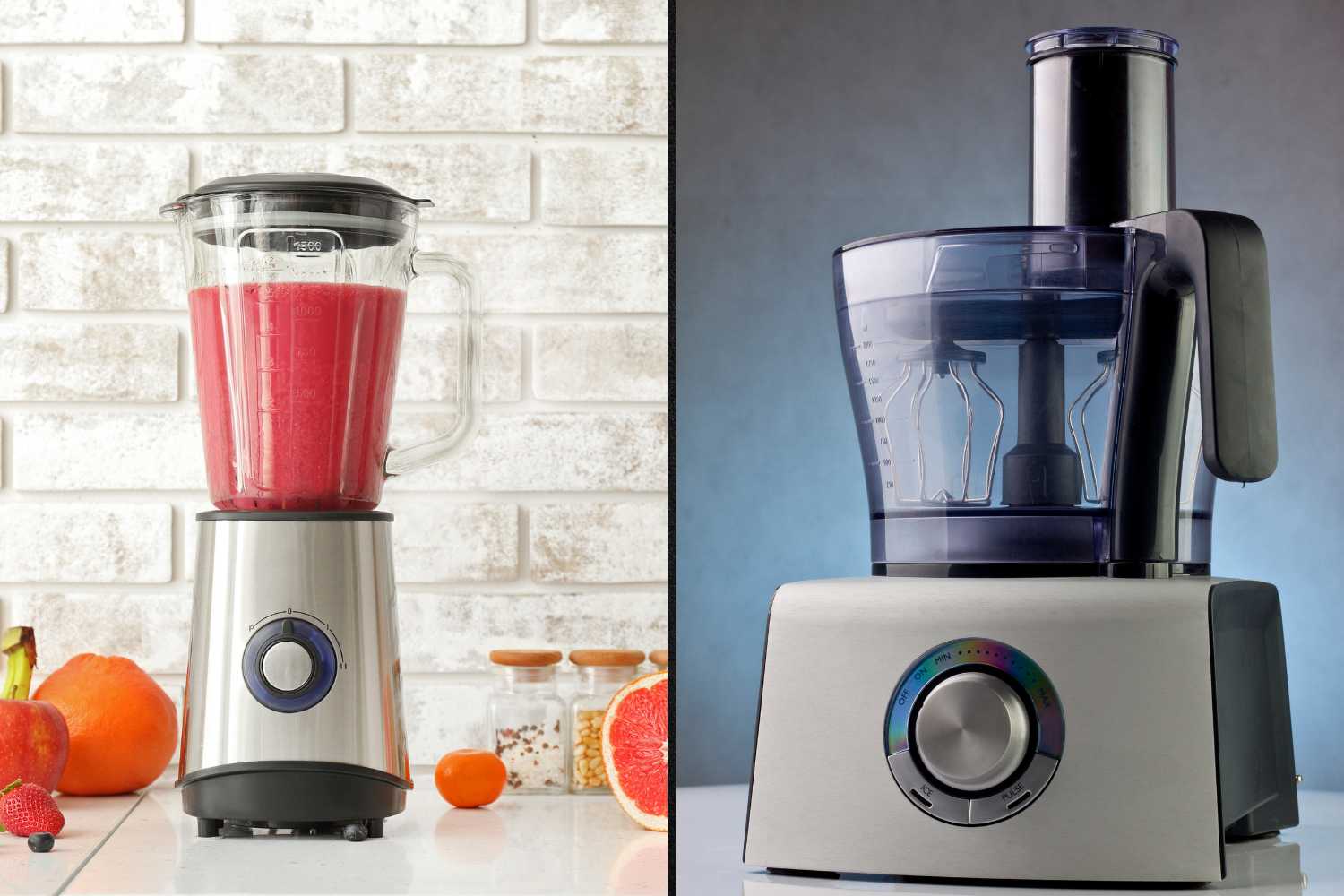
In the kitchen you need ingenuity, passion and knowledge, but also the right tools. When you find yourself in front of an articulated recipe, made of long passages and different processes, the question arises spontaneously: better a blender or a food processor? At first glance they seem similar, almost interchangeable, and instead, as often happens, the difference lies in detail and understanding it at its best can make the difference between a successful dinner and a mixture succeeded only in half.
Two tools, two worlds
The blender is the speed tool. A rotating and powerful blade that transforms into seconds vegetables, fruit, legumes and ice into creams, soups, smoothies and sauces. It is intuitive, almost primitive in its simplicity: just insert the ingredients, press a button and observe the vortex transform what you see in what you enjoy.
The food processor, on the other hand, is a more complex machine. He has blades, records, arms, mixers, sometimes even an integrated scale, and does not limit his action to the mere whisk, since he can also chop, knead, slice, grate and emulsify. An adaptive tool, which transforms and which sometimes almost seems to think about us.
When you need one, when the other is needed

Let’s make a concrete example, concerning the preparation of a pumpkin velvety with spiced croutons. The blender enters the scene after cooking: pumpkin, onion, hot broth, maybe a tip of ginger, and with a couple of quick blows you can get a smooth and fragrant cream. And that’s enough.
What would happen if the dish were to complicate? If you want to add a homemade focaccia next to the velvety, or or a salty cheese mousse with chopped hazelnuts? In this case, the food processor would come into play: you would use it to knead precisely, to chop the dried fruit in a few seconds and to mount and mix effortlessly.
The real difference? Versatility

The food processor is, without too many laps of words, the Swiss knife of the work surface, only one device that contains the functions of multiple tools. And let’s not only talk about quantity, but of the quality of the result: do you want a homogeneous dough for fresh pasta, a frothy cream for desserts, or a regular cut for grill vegetables? You could make everything with just one click. It requires more space, of course, but in return it offers an extra gear for those who love the most complex preparations.
The blender remains more slender, more immediate. It is the sample of liquid and creamy preparations, which, however, you will not be able to ask for more: it does not knead, not slice and not grated. It is like a racing bicycle: fast, efficient, but suitable for a single type of soil.
And the costs?

Here the difference makes itself felt, and basically a good blender costs less than an mid -range food processor.
The prices of food robots have a starting point between 50 and 100 euros, with the most advanced models that can cost even more than 1000 euros.
The blenders are decidedly cheaper, with prices that start from around 20 euros for immersion models – to be understood, we are talking about the minipimer – and which can reach several hundred euros for traditional models, equipped with the glass or plastic container.
For those who cook little and only want a tool for smoethie and past vegetables, the blender is the most logical choice. On the contrary, if you love testing with cakes, risotto, removal, gnocchi and more articulated preparations, the food processor will be able to repay the investment over time.
Watch out for maintenance

Another aspect not to be underestimated concerns cleaning. The blender, in most cases, washes in a few seconds: a passage of water, a little detergent and go. The food processor, with all its accessories, requires more attention. Not all components go to the dishwasher, some need some care to last long.
This does not mean that it is a limit, but you need to know in advance. Using a food processor is not limited to the pressure of some button alone, since it requires a minimum of familiarity and a few minutes more for maintenance.
Final choice

There are those who love direct contact with the ingredients, the hands in the flour, the knife that slowly slices, and those who instead seek silent but tireless allies: choosing between a blender and a food processor also means to define their style among the stove. So which one to choose? It depends on you, on the space you have, on the time you dedicate to the kitchen, on the type of dishes you love to prepare
Are you looking for simplicity and speed? Don’t you venture too much beyond the soup of the day? The blender will be a reliable companion. If, on the other hand, you like to experiment, if the kitchen for you is a small creative laboratory, the food processor becomes almost indispensable: once you learn to use it really, you will hardly go back.
Don’t you want to lose our news?
