
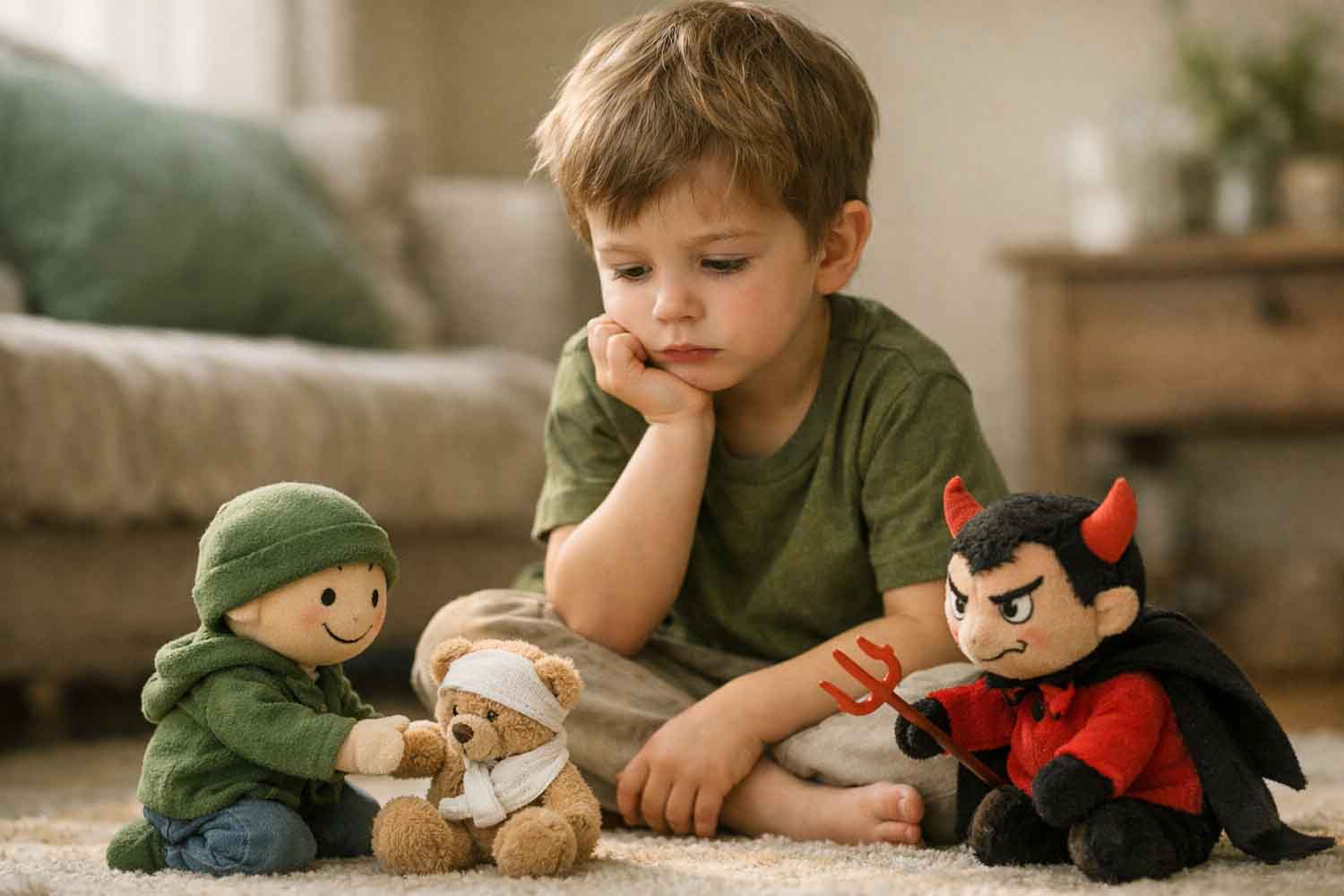
There is a precise moment in which we realize that children are not at all “little selfish people” who need to be trained in civil coexistence. It happens when, faced with an injustice, they become indignant. Even if they are five years old. Even if the “defendant” is a robot. In 2025, some researchers showed short videos to kindergarten children: a companion – or a machine programmed to do so – took something that did not belong to him or refused to share. The question was simple: is it right or wrong?
The answer was clear: it’s wrong. Always. It doesn’t matter if it’s a child or a robot who misbehaves. And not only that: many children have attributed a sort of moral responsibility to the robot, as if it “should have known” that it was doing something incorrect. According to developmental psychologist Antonella Marchetti, morality is present from childhood and is surprisingly powerful. And then the question changes: if at five years of age you recognize the wrong with this clarity, when does it all begin?
From newborns choosing who they help to the first ideas of justice
The biggest surprise comes from the first months of life. Already at six months, newborns show that they can distinguish between those who help and those who hinder. In a now classic experiment, a puppet tried to climb a hill: one character helped him, another pushed him down. When children were given the choice, the vast majority reached out to the “helper.”
A study published in 2025 in the journal Human Nature (Springer) reviewed numerous experimental research to understand whether a sense of fairness exists in newborns. The results are fascinating: even before speaking, children show expectations about how resources should be distributed and react differently when faced with a fair or unfair situation. These are not “whims” or simple reflexes. Researchers talk about basic moral concepts: impartiality, agency, even an embryo of moral obligatoriness. In other words, a primitive but already recognizable form of justice.
Even more interesting is the fact that children evaluate not only the outcome, but the intention. In another experiment, a character tried to distribute strawberries equally but was unable to do so; another, however, always tried to favor the same recipient. Even though the end result was identical – an unfair distribution – the children preferred those who had tried to be fair. Even before words, there seems to be a compass.
Neuroscience confirms this scenario. In a 2018 study, images of people in pain triggered a stronger brain response in children than neutral images. When their parents invited them to reflect on the pain of others, the response became less immediate but more profound and prolonged. As if the sensitivity was already there, waiting to be accompanied.
Clinical psychologist Roma Kumar describes this dimension as an innate sensitivity to the emotions of others: the ability to tune into discomfort and seek harmony.
No child grows up alone
If the “seeds” of morality are present from the beginning, it does not mean that they can grow in any soil. A systematic review published in 2022 on Frontiers in Psychology highlighted how crucial parental style, relationships and social context are in the development of the moral sense. Without care, even the most promising seed can weaken.
The Chinese philosopher Mencius spoke of “moral shoots” to be cultivated. An ancient image that is surprisingly relevant today. Because those sprouts need warm relationships, coherent adults, an environment in which empathy is not a textbook word but a daily gesture. According to Kristján Kristjánsson, a scholar of character education, the moral compass must be stimulated from the early years and must occupy a central place in educational policies, from primary school to university. It is not an accessory detail: it is the heart of training.
Children raised in emotionally attuned environments develop greater self-esteem and resilience. They learn to regulate emotions, to avoid aggression, to take care of others without canceling themselves. A study published in Developmental Psychology shows that when parents explain the reasons for the rules, instead of simply imposing them, they foster self-control and more stable prosocial behaviors.
The difference is subtle but decisive. Saying “you’re bad” builds obedience. Saying “I understand you were angry, but this hurts” builds awareness. When morality becomes just a way to avoid punishment or to please an adult, it works as long as someone is watching. However, when it arises from an internal understanding, it remains even in the absence of witnesses. Ultimately, those children who harshly judge a misbehaving robot remember something disarming: we come into the world with a surprising sensitivity towards right and wrong.
The real challenge is not to teach morality from scratch, but not to stifle it. It is to protect it from harshness, from indifference, from haste. Because raising children capable of empathy and a sense of justice does not just mean raising “good children”. It means building emotionally healthy adults, responsible citizens, more human communities.
You might also be interested in:
