
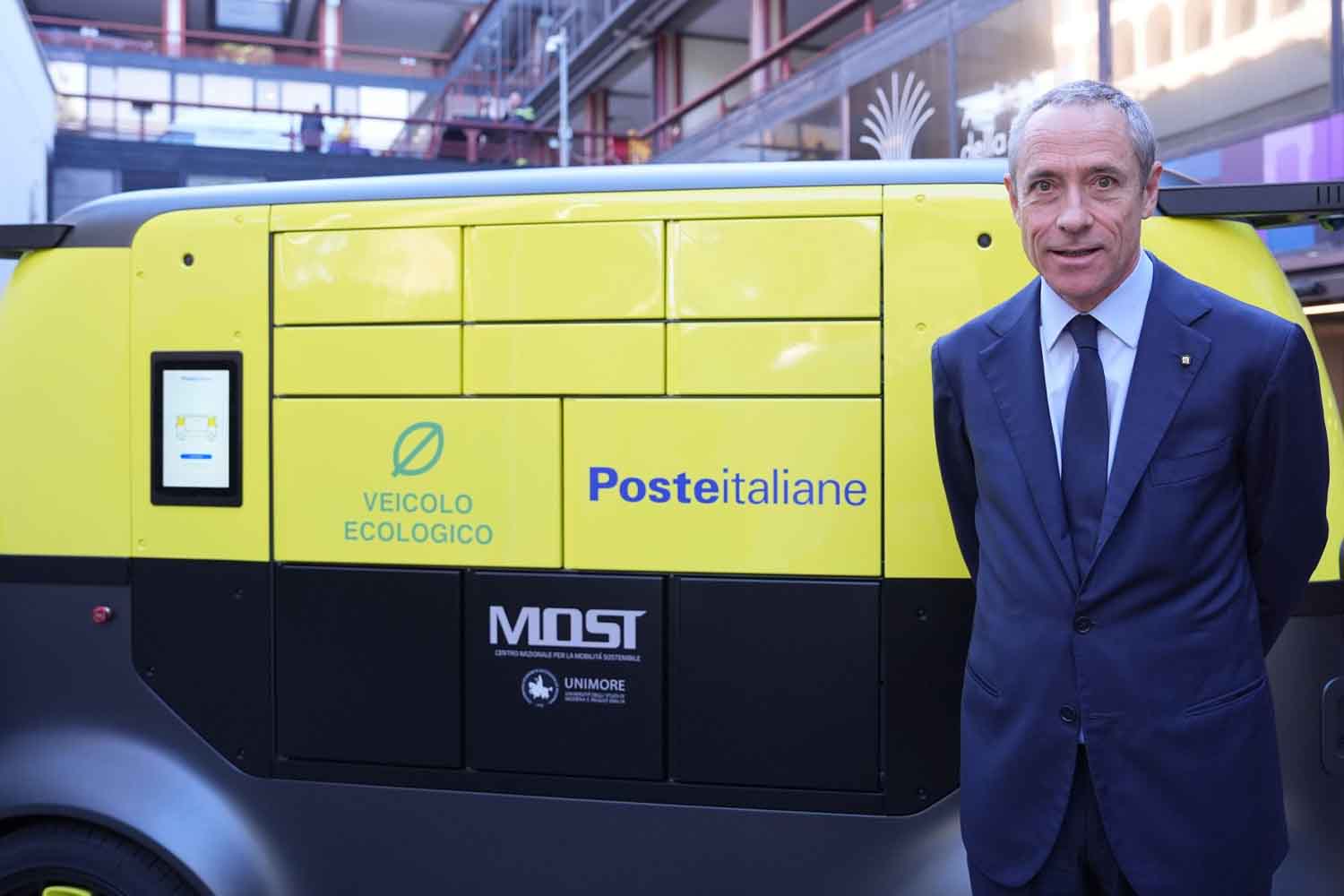
Replacing postmen with robots is no longer just a futuristic hypothesis. Poste Italiane has started testing BOXian autonomous electric vehicle designed to move in the most complex urban contexts, from historic centers to areas with high traffic density. The project opens a concrete scenario on the future of city logistics, where technology and automation begin to coexist with traditional services.
BOXi is a four-wheeled electric vehiclecompletely autonomous, designed to operate safely within cities. There Maximum speed is limited to 25 kilometers per houra threshold chosen to reduce risks in urban areas and ensure safer coexistence with pedestrians, bicycles and cars. This is not a simple laboratory prototype, but a means developed to deal with narrow streets, intersections, pedestrian crossings and sudden obstaclestypical of Italian historical contexts.
The project was carried out thanks to the collaboration with theUniversity of Modena and Reggio Emiliawho took care of the mechanical part, and the Polytechnic of Milanresponsible for software development and control systems. An academic-industrial synergy that aims to bring innovation outside the campuses and into the cities.
Advanced sensors, LiDAR and artificial intelligence
To move without a driver, BOXi uses advanced technological equipment. The heart of the system is represented by the LiDAR sensorsbased on laser technology, capable of detect vehicles, people and obstacles and to reconstruct the surrounding environment in real time. These are accompanied by cameras, radar and satellite localization systems, which allow the vehicle to orient itself precisely even in complex spaces.
Delivery management takes place via dedicated boxes integrated into the vehicledesigned to hold letters and parcels. Each compartment can be unlocked via QR codeallowing recipients to collect the shipment safely, without direct contact and without the physical presence of a postman.
From controlled tests to the streets: the experimentation starts from Modena
The testing phase started from Modena Innovation Hubwhere BOXi underwent extensive testing on sensor calibration, speed management and safety systems. Once this first phase has been overcome, the postman robot will face a real urban route of approximately 600 metresdesigned to simulate everyday situations: pedestrian crossings, intersections, traffic and unexpected events.
Poste Italiane’s declared objective is to evaluate whether this technology can support, and potentially replace, a part of traditional deliveriesespecially in areas where access by conventional means is more difficult or inefficient. A model already adopted in several countries, where delivery robots have permanently entered urban logistics systems.
