
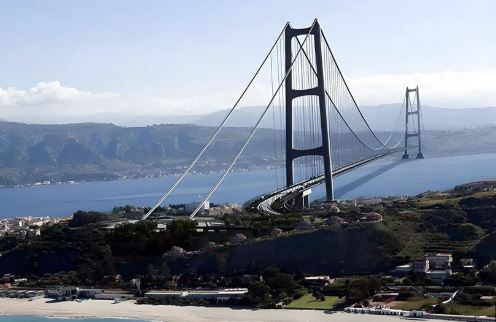
The feeling could be that of a defeat for environmentalists. But it is enough to delve into the intricacies of the Lazio Regional Administrative Court ruling to realize that the reality is more nuanced. The appeal against the Messina Strait Bridge was not rejected on the merits: it was judged “premature”. A distinction that changes a lot, especially on a legal and strategic level.
Not rejected, but inadmissible
The key point lies in the nature of the contested act. The associations – Legambiente, Lipu and WWF Italia – had contested the favorable opinion of the Environmental Impact Assessment (EIA). But for the TAR that opinion is not yet a definitive act.
This is an internal step in the procedure, an “endoprocedural” act which, on its own, does not produce concrete effects. In other words, it does not yet affect rights or interests and therefore cannot be appealed. It’s not a question of content, but of timing.
Because the game is still open
The consequence is clear: the TAR did not say that the environmental criticisms are unfounded. He hasn’t looked at them at all. He determined that the time to do so has not yet arrived. The procedure, in fact, ends only with the resolution of the Cipess (Interministerial Committee for Economic Planning and Sustainable Development), the final step that will give or deny the green light to the work. It is there that the project takes on complete legal form, and it is there that it can possibly be challenged.
The strategy of the associations
Environmental organizations claim they chose to have acted early. The appeal, they explain, was also presented out of caution, for fear that the special rules on the bridge could limit the possibility of intervening at a later stage. A fear that the TAR did not dismiss as unfounded. Indeed, the judges recognize that the defense strategy is not objectionable, precisely in light of the regulatory uncertainty also introduced by Legislative Decree 35 of 2023, which redefined the times and methods of approval of the work.
The crux of motivation
Then there is a passage destined to have an impact in the coming weeks. The TAR explicitly recalls the need for the final decision of the Cipess to be supported by rigorous reasoning. Not a technical detail, but a substantial requirement. For an infrastructure of this scale, which affects delicate ecosystems and European constraints, every choice will have to be justified in a timely and transparent way.
Environment and public interest
All the issues raised by the associations remain on the table: from environmental impacts to compatibility with European law, up to the use of the so-called “imperative reasons of significant public interest”. This is a tool that allows even significant exceptions to environmental protections, but only in the presence of stringent conditions. And it is precisely on this balance that the most delicate comparison will be played out, also in light of the Iropi report already approved by the Presidency of the Council in April 2025.
A heavy postponement
More than a closure, that of the TAR is a pause. The litigation simply moves forward, when the picture is complete and the decisions are final. Strengthening this scenario is also the fact that the appeals declared inadmissible did not only concern environmental associations, but also local authorities such as the Municipality of Villa San Giovanni and the Metropolitan City of Reggio Calabria, a sign of a broad and transversal critical front.
