
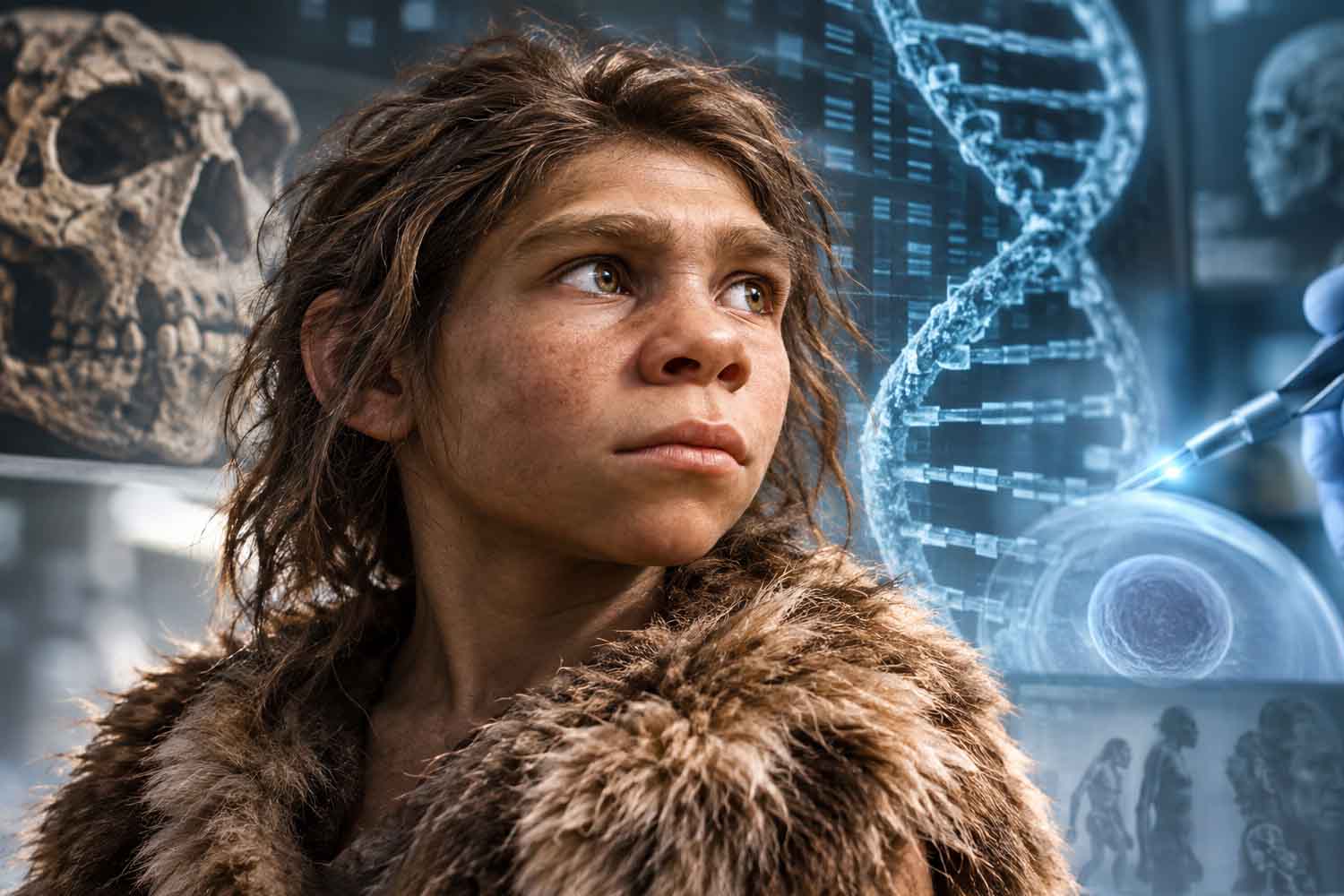
A child with a completely Neanderthal genome could be born alive within twenty years. The estimate comes from Hank Greely, professor of law and genetics and director of the Center for Law and the Biosciences at Stanford University. There is no project announced today to do this. Greely is looking at the speed with which gene editing, sequencing and techniques capable of modifying DNA are advancing, and considers it plausible that within two decades the tools will get there.
It’s a curious boundary: for millennia we have been able to learn about Neanderthals through bones, tools and a few teeth. Since 2010 we have also had their genome. Now we are starting to have the tools to intervene on ours. Putting the two together, at least on paper, the idea of genetically reconstructing one of our extinct relatives begins to emerge from science fiction. The problem is everything that comes after.
We have the DNA, the cell to clone is missing
When it was published in 2010 on Science the first draft of the Neanderthal genome, the work also changed the way we looked at these extinct humans. Comparison with modern DNA showed that Neanderthals and ancestors of some Homo sapiens populations had interbred. In fact, a small part of that genetic history continues to circulate within millions of people alive today. Having the sequence, however, is not the same as having a Neanderthal ready to be cloned.
The cloning used for Dolly requires a cell from which to take an intact nucleus. There are no living Neanderthal cells left: we are talking about populations that disappeared tens of thousands of years ago. An organism found in exceptional conditions could one day yield tissues better preserved than those available today, but at the moment that path is closed.
The alternative therefore passes fromgene editing. We would start from modern human cells and intervene on the DNA to progressively bring it closer to the Neanderthal genome reconstructed from ancient remains. The leap here is notable.
CRISPR allows you to cut and modify precise portions of DNA; base editing can change individual letters of the genetic code without completely cutting the double helix. Greely estimates that dozens of contemporary modifications can already be imagined today. To arrive at an entire Neanderthal genome, an immensely greater quantity would be needed, with a level of precision that we do not possess today. Twenty years, in his prediction, serve precisely to bridge that gap.
The “dire wolves” show how quickly the industry is moving
A glimpse of this acceleration came from animal de-extinction. In 2025 Colossal Biosciences presented three canids obtained by modifying gray wolf cells to introduce genetic characteristics identified in the extinct’s DNA Aenocyon dirusthe so-called dire wolf.
According to documentation published by the company, the researchers performed 20 targeted changes spread across 14 genesworking on characteristics such as body size, skull and coat. The modified cells were then used to create embryos through nuclear transfer and implanted into surrogate mothers.
Colossal talks about “functional de-extinction”: the goal is to recreate fundamental traits of the missing animal through a living relative. Twenty genetic changes are a lot compared to what was possible a few years ago. Compared to the reconstruction of an entire archaic human being, however, they are still a handful.
Even theartificial intelligence enters into this work, especially where it is necessary to compare enormous quantities of genetic data, reconstruct degraded sequences and identify the variants on which to intervene. The algorithm can help figure out which letters to change. Then you have to really change them, inside living cells, without transforming the experiment into a collection of genetic errors.
Then someone would have to carry on the pregnancy
Even obtaining a cell with a complete Neanderthal genome would require an embryo and a pregnancy. Here we have at least one certainty left directly by our ancestors: Homo sapiens and Neanderthals were biologically close enough to have children together. Their DNA has reached us thanks to those crossings.
This doesn’t mean those pregnancies were simple or always compatible. In 2016, a study on the Neanderthal Y chromosome identified differences in genes linked to HY antigens, capable of being recognized by the maternal immune system. The authors hypothesized that some incompatibilities may have contributed to the reproductive difficulties between the two groups.
Another element arrived in 2021 from the analysis of the blood groups of three Neanderthals and a Denisovan. The study published on PLOS One identified variants of the Rh systems that, in modern humans, may be associated with an elevated risk of hemolytic disease of the fetus and newborn.
They are fragments of a reproductive history tens of thousands of years old and do not allow us to know what would happen today during such a pregnancy. However, they are enough to show how little we know about what would happen between an embryo with that genetic heritage and a Homo sapiens uterus. With a detail that is anything but secondary: the result of the experiment would be a person.
He would be born without Neanderthal parents, grandparents or peers
If everything worked out, that child would likely be the only living Neanderthal on Earth. Jennifer Raff, a biological anthropologist at the University of Kansas, raised this very problem: it would grow without a previous generation of its population, without Neanderthal peers and without a Neanderthal culture in which to learn to live.
Rebecca Wragg Sykes, an archaeologist specializing in the study of Neanderthals, adds another complication. A person born in the 21st century would live in a completely different environment from that of the populations from which his genome comes. She would learn a contemporary language, eat contemporary foods, and grow up surrounded by Homo sapiens culture. Its existence would say something about the biology tied to that genome. Much less about the life of Neanderthals 60 thousand years ago.
Nor could it represent them all. Neanderthals occupied enormous territories for hundreds of thousands of years, forming diverse populations. They had different material traditions, diets and probably languages or communication systems. A single individual recreated today would make a rather challenging specimen to transform into the spokesperson for an entire extinct humanity.
Technology can arrive before the rules
The bioethicist Arthur Caplan of New York University had raised the problem already in 2025 in an article published in PLOS Biology. Technologies developed to bring characteristics of extinct species back into living animals, he wrote, could sooner or later be applied to human ancestors as well.
Caplan therefore called for international control, independent risk assessments and a public debate before the experiment. The concern also arises from the structure of the sector: many of the most advanced de-extinction technologies are developed by private companies with sufficient resources to rapidly move the technical frontier.
Colossal, at least as far as Neanderthals are concerned, has already distanced itself from the idea. Beth Shapiro, the company’s chief science officer and a paleogeneticist, explained that Neanderthals were people and that working on people requires informed consent that is impossible to obtain from someone who has yet to be brought back into existence. However, the problem goes beyond a single company.
The World Health Organization considers heritable human genome editing to be an area requiring particularly rigorous governance. In 2021 it published an international framework of recommendations on human genome editing that also addresses unregistered research, risky trials and possible shifts of activities to countries with weaker controls. In twenty years the tools could be different. Legal borders will probably continue to be much less orderly.
A frozen body would probably teach us more
Finally, there is a rather elegant scientific paradox. After all this technology, the dream of many Neanderthal scientists remains something much simpler: finding a corpse.
Ötzi has preserved skin, tattoos, clothes, intestinal contents and even traces of his last meal for more than five thousand years. The body of the Tollund Man, which remained in a Danish peat bog for around 2,400 years, made it possible to reconstruct details that no skeleton could have revealed. An exceptionally preserved Neanderthal in permafrost could yield soft tissue, microbes, hair, stomach contents and perhaps a wealth of information that is simply lost today.
Giving birth to one would instead require reconstructing a genome, creating cells, producing an embryo, finding a biologically compatible pregnancy, overcoming safety problems and addressing a huge legal and ethical issue. Then we would have to raise that person in our world and try to understand what in their life belongs to the Neanderthals and what to the 21st century. Technology, in twenty years, might even succeed. A piece of Neanderthal frozen for 50 thousand years would probably continue to have many more things to tell.
