
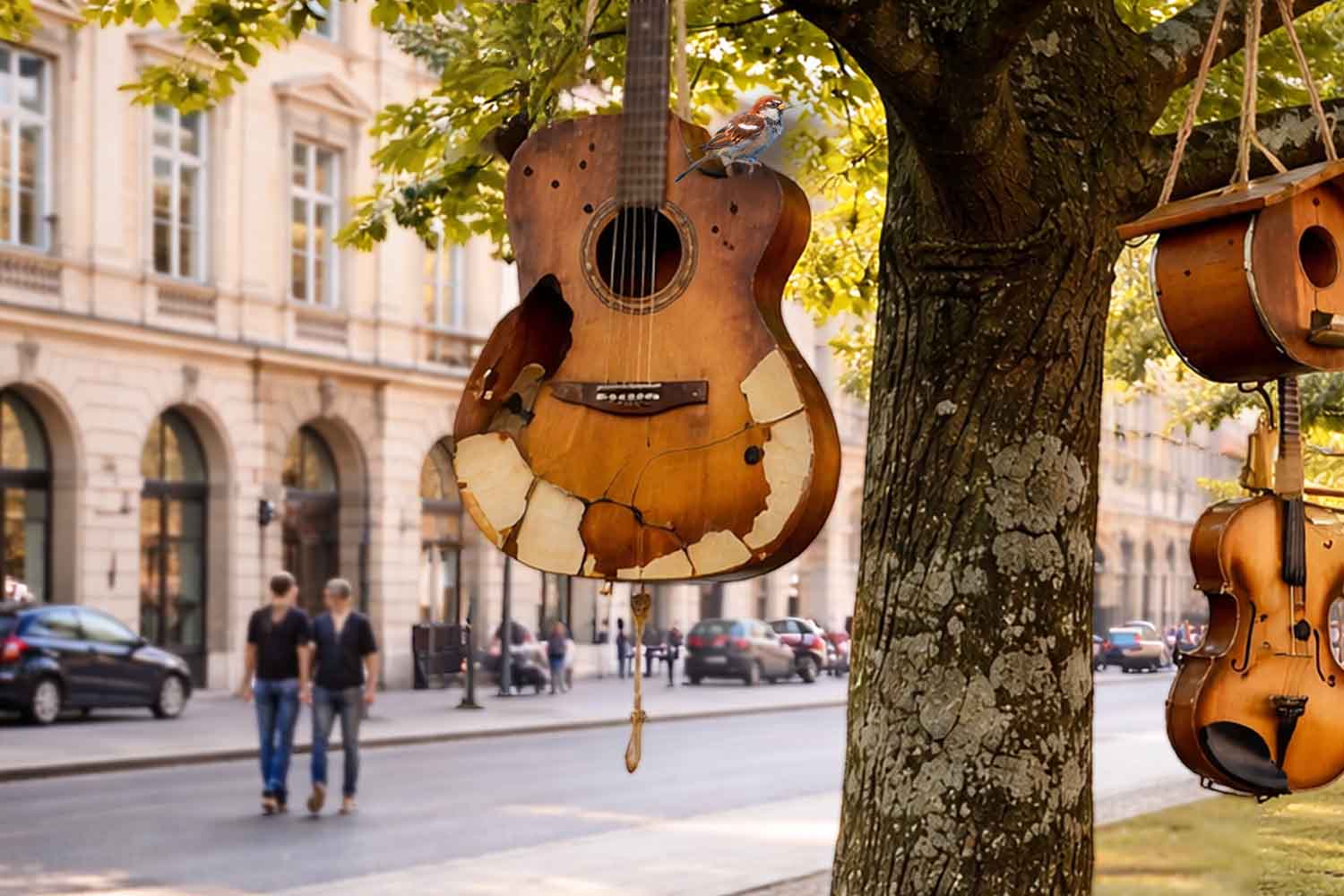
Guitars hanging from trunks, violins that no longer play but house small nests, trumpets suspended between branches transformed into shelters for sparrows. The images of musical instruments transformed into birdhouses are persistently circulating on social networks, almost always accompanied by the same caption: “It happens in the Czech Republic”. A story that seduces, excites, conquers. But how much is verified?
Typing the key phrase “musical instruments transformed into birdhouses” brings up dozens of posts on Instagram, Facebook and Pinterest. The photographs show guitars with the sound hole becoming an entrance for small birds, violins adapted to suspended shelters, trumpet bells transformed into concave shelters. The visual impact is powerful, almost cinematic.
The most widespread narrative places these installations in urban parks in the Czech Republic, often citing Prague. In some versions there even appears a reference to a presumed local artist, but never accompanied by clear personal data or a verifiable portfolio.
Deepening the research, a significant element emerges: there are no articles published by Czech newspapers, nor reports from recognized art magazines, nor official press releases documenting the project in a structured way. There is no reference to a promoting body, to a public exhibition, to a precise inauguration date or to photographic documentation attributed to an identifiable author.
The information available, at least for now, travels almost exclusively through social pages and sites that relaunch viral content without citing primary sources.
Because the idea works so well
Beyond the geographical location, the concept of musical instruments transformed into birdhouses is perfectly consistent with contemporary practices of eco-design and creative reuse. There is nothing technically impossible about these transformations.
The center hole of a guitar can become a natural entrance. The sound box offers a space protected from the elements. A trumpet bell creates an ideal concave shelter for small birds. The wooden structure of a violin, appropriately modified, can be adapted to a suspended nest. From a construction point of view, the operation is plausible.
In many European cities, and beyond, artists and collectives have been working for years on the reuse of damaged objects to create urban installations with low environmental impact. Giving function to musical instruments that are no longer repairable fits perfectly into the principles of sustainability: not eliminate, but transform.
And it is precisely this symbolic dimension that makes the images viral. Stories capable of evoking rebirth and harmony between man and nature run fast. The musical instruments transformed into birdhouses speak of second chances, of balance, of respect for the environment. It is natural that they gain millions of shares.
One clear fact remains: sustainability also depends on imagination. And if someone, somewhere, really hung a broken guitar from a tree to transform it into a nest, that gesture – verified or not – tells of a concrete way of looking at objects, and perhaps even at things that seem finished, with less cynicism and more responsibility.
You might also be interested in:
