
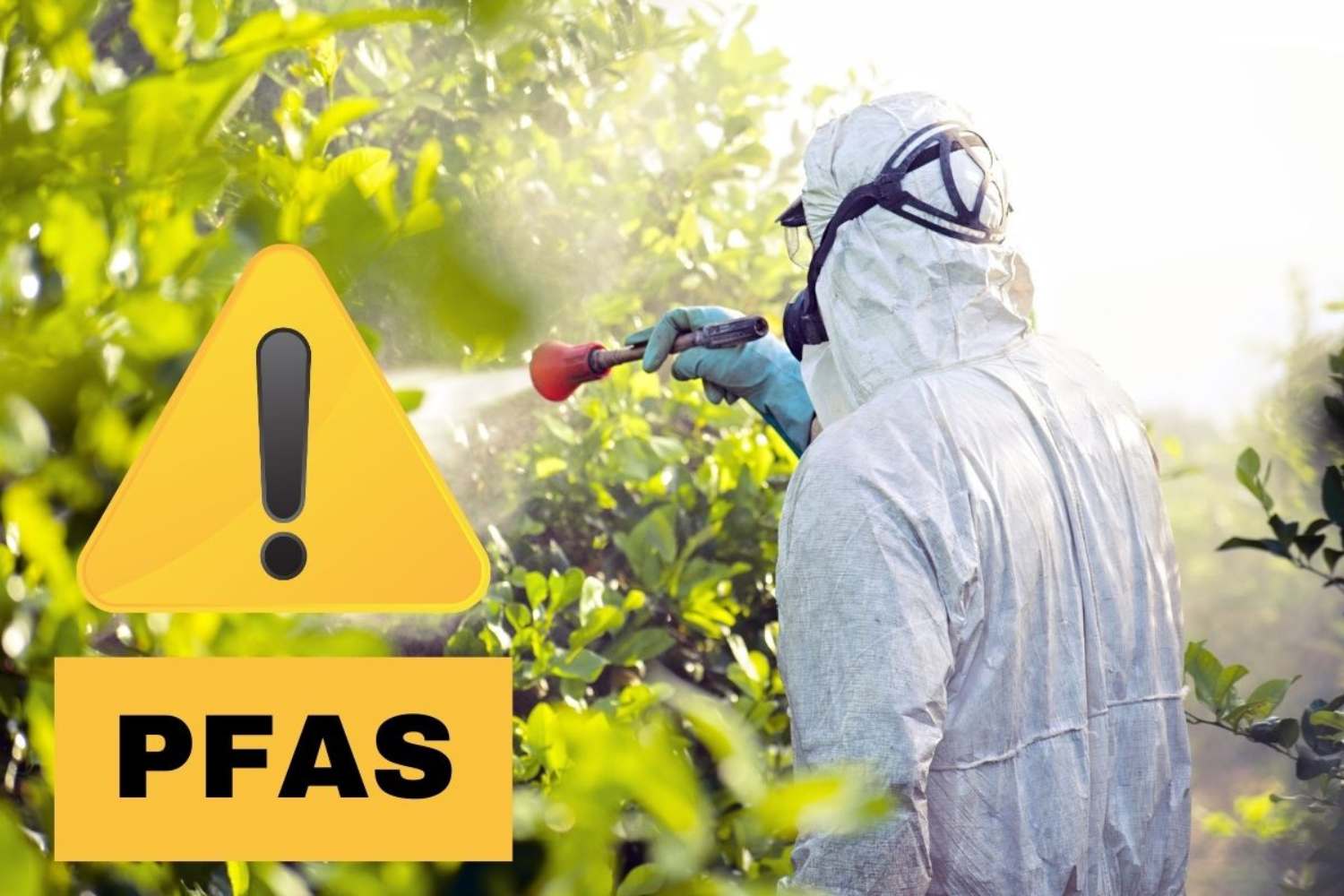
Pesticides containing PFAS, the so-calledforever chemicals”, are slowly contaminating soil, water and food all over the world, and their presence is being talked about more and more.
Now a new report from the Environmental Working Group (EWG) reveals alarming data about California, where an average of 2.5 million pounds (about 1.13 million kilograms) of these pesticides are sprayed on crop fields every year. It’s a staggering figure, reminding us how these persistent chemicals are leaching not only into agricultural soils, but also into the food chain and water supplies.
EWG examined the use of 66 active pesticide ingredients containing PFAS, reported in a peer-reviewed article by scientists from EWG, the Center for Biological Diversity, and public officials for environmental responsibility, published in July 2024. Since then, the EPA has approved one additional PFAS pesticide and proposed four others for use in the United States.
From this analysis, EWG created an interactive map showing how 52 federally approved PFAS pesticides were used in 58 California counties between 2018 and 2023, including the crops most exposed to these chemicals.
According to data from the California Department of Pesticide Regulation, nearly 15 million pounds (about 6.8 million kilograms) of pesticides with PFAS were used on agricultural land across the state between 2018 and 2023.
Fresno County recorded the highest values, with over 950,000 kilograms, followed by Kern (726,000 kilograms), San Joaquin (417,000 kilograms) and Imperial (401,000 kilograms). Monterey, Riverside and Sonoma counties also show significant amounts.
The consequences are quite inevitable: the massive use of fungicides, herbicides and insecticides containing PFAS introduces highly dangerous chemicals into cultivated land, which accumulate in fruit, vegetables and animal feed, with potentially harmful effects along the entire food chain.
The risks of PFAS
PFAS are known for their high environmental persistence, they do not decompose easily and can accumulate in living organisms. Exposing yourself to these substances means running serious risks, they are in fact associated with cancer, damage to the immune system, harmful effects on reproduction and development, as well as a possible increase in cholesterol and a reduction in the effectiveness of vaccines.
Furthermore, over time, some PFAS pesticides can degrade into other “eternal” compounds, such as trifluoroacetic acid (TFA), which is now increasingly present in the environment, wildlife and humans.
As Jared Hayes, EWG senior policy analyst and co-author of the report, points out:
Every pound of chemicals used on farmland represents a risk of contamination of our food, our water and our soil – and adds – It makes no sense when many non-PFAS pesticides are readily available.
PFAS are used in pesticides both as active ingredients, to eliminate fungi, insects or weeds, and as inert ingredients, i.e. which improve their effectiveness without acting directly on the parasites. The presence of inert PFAS, however, is not mandatory declared by manufacturers, which makes it difficult to assess real exposure.
The crops on which the most PFAS pesticides are used
EWG analysis shows that some of the most widely used PFAS pesticides target California’s particularly lucrative and iconic crops: almonds, pistachios, wine grapes, alfalfa and tomatoes. These crops, especially those rich in water, risk absorbing higher levels of PFAS, because water “attracts” these substances.
Additionally, the EWG estimate highlights that 85% of PFAS pesticides used in the state are for agriculture, while the remaining 15% are for structural practices (such as termite control or landscape maintenance). In some counties, like Imperial, use for agricultural production alone is as high as 98%.
Among the most frequently applied active ingredients are the herbicide oxifluorfen, the insecticide bifenthrin, the herbicide trifluralin, the insecticide lambda-cyhalothrin and the fungicide pentiopyrad. Two of these (bifenthrin and trifluralin) have already been banned by the European Union for health and environmental reasons, but continue to be used on a large scale in California.
The problem of regulation in the USA
Despite the obvious risk, the EPA (the US environmental agency) has not yet banned pesticides containing PFAS. It is precisely this lack of regulation that worries the EWG, which reports that exposure to these substances remains “significant but overlooked” for millions of Californians.
Only Maine leads the way, as it will be the first American state to ban the intentional addition of PFAS in pesticides, starting from 2030.
