
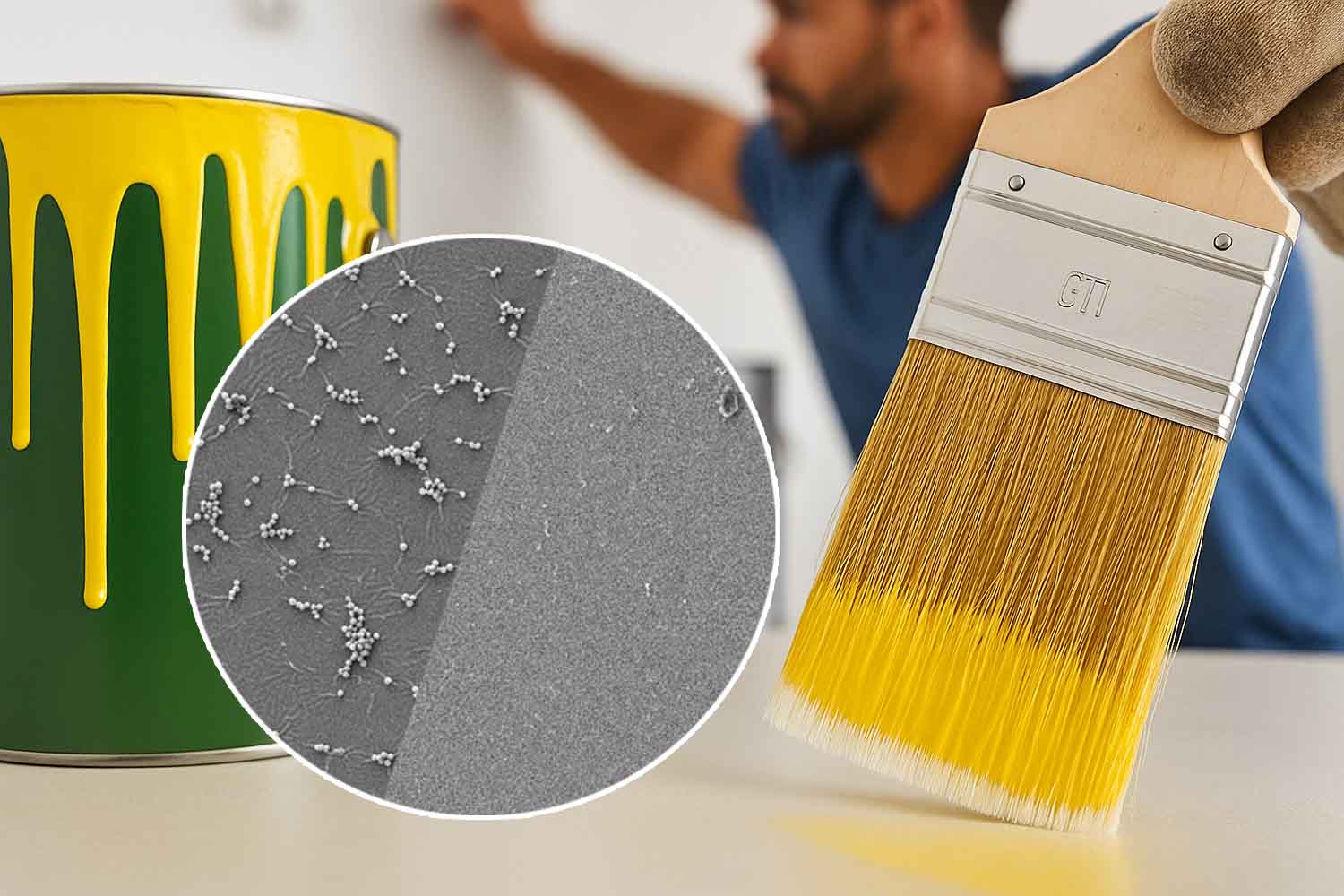
A antimicrobial paint Able to eliminate viruses and bacteria from the surfaces, even without exposure to light and without the need for disinfectants. This is the surprising innovation developed by researchers of Center de Recherche Sur Les Matériaux Avancés (Cerma) of the Laval University, in Québec, Canada. A project that could soon revolutionize the management of hygiene in schools, hospitals, public transport and other high -attending places.
This paint contains chemically modified ceramic microparticlesable to act with a purely physical mechanism: once you come into contact with bacteria and viruses, they pierce their membranes and destroy them irreversible. A highly effective action, already tested in the laboratory on dangerous pathogens such as Escherichia coli, Staphylococcus aureus And also the Sars-Cov-2, head of Covid-19.
To make this paint even more interesting is the fact that its effectiveness does not depend on external factors like ultraviolet light, nor from aggressive chemicals: it continues to work too in the dark and in frequented environmentskeeping your antimicrobial capacity intact.
It also works in the dark, is stable over time and does not release toxic substances: because it is different from the others
Unlike other antimicrobial coatings, which are activated only in light or degrade quickly, this painting has been designed for maintain its effectiveness over time. The ceramic microparticles They do not consume or release harmful agents in the environment, making it safe also for people who live or work in treated environments.
Another fundamental advantage is the speed of action: according to the data that emerged from the laboratory tests, already after 20 minutes from the exhibitionmost microorganisms are inactivated. And within an hour you reach a elimination equal to 99.9%.
Naturally does not replace daily hygiene practices – as the scientists themselves specify – but can represent one important additional barrierespecially in risk environments such as healthcare facilities, schools, airports or subway.
The patent is coming
The team led by Professor Frédéric-Georges Fontaineprofessor of chemistry at the Laval University, has already started the procedures for patent the invention and collaborates with some industrial partners to evaluate the large -scale production. The goal is to make this available antimicrobial paint globally, contributing to limit the spread of pathogens In shared spaces, without damaging the environment or human health.
An innovation that could prove to be crucial in preventing future epidemics and hospital infections, with a view to sustainable hygiene and collective protection, as Fontaine explained:
There is no need to replace daily cleaning: we simply want to offer more protection, continuous and invisible. This technology is not invasive, it is not dangerous and can really help us live in safer environments.
