
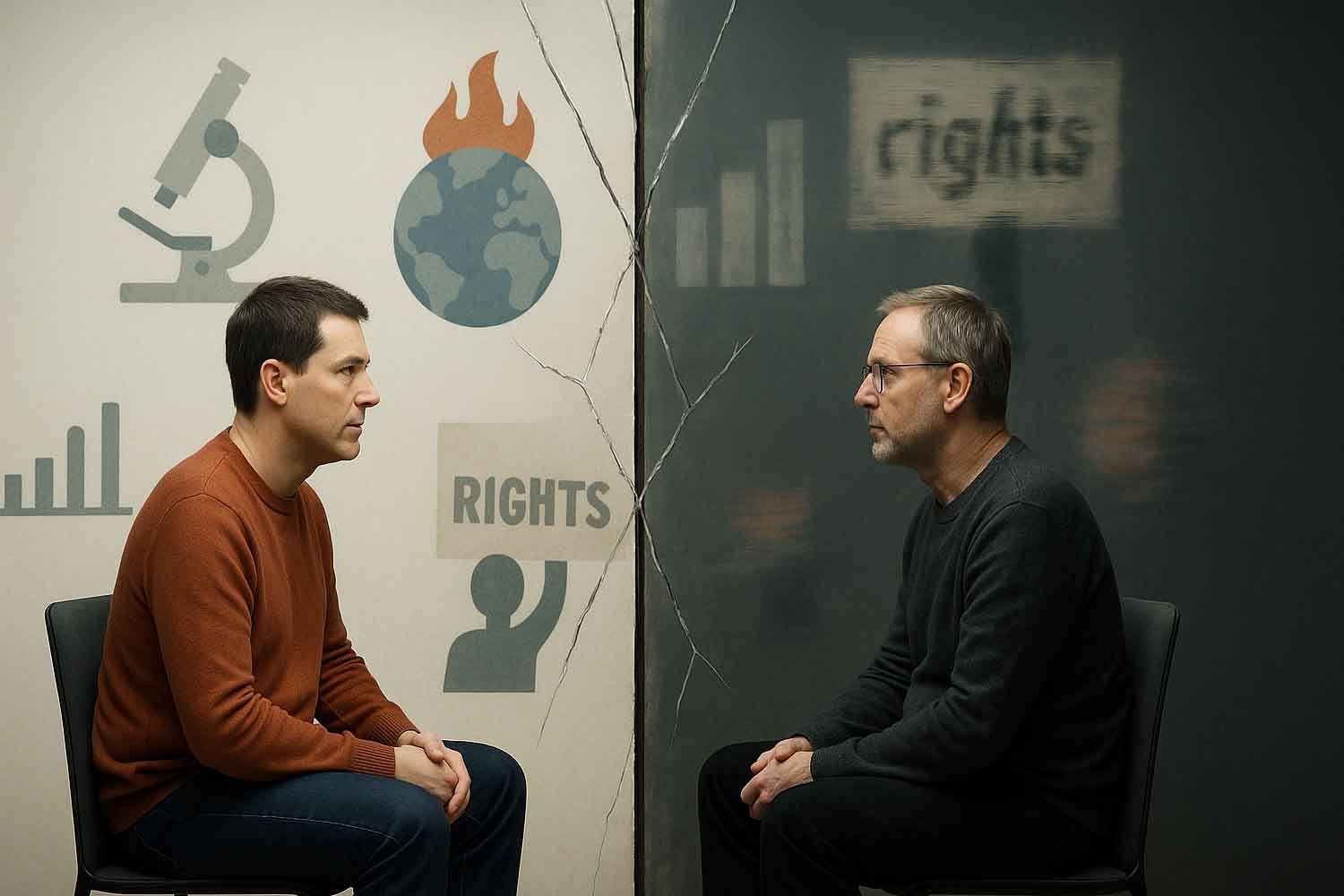
Why, in front of the same data, do some people choose to believe it and others refuse them? It is a phenomenon that repeats itself in many contexts: from climate change to Covid, to the conflict of Gaza. A part of the population is mobilized, supports humanitarian causes or follows the indications of science. Another part minimizes, questioned or interprets facts as propaganda.
Social psychology explains these divisions with two central concepts: cognitive dissonance and confirmation bias.
When the values come into conflict with the facts: cognitive dissonance
Many people declare universal values: environmental protection, defense of public health, respect for human rights. But when news emerge that seem to contradict them – scientific relationships on the climate, epidemiological data, images of civil massacres – an inner conflict is born.
On the one hand there are the values: “These principles are fundamental”. On the other there are the facts: “I see that they are not respected”. This tension generates cognitive dissonance, a discomfort that everyone tries to reduce.
As? Some react with empathy and solidarity, others choose the path of denial or minimization. In both cases it is not a question of “malice” or “naivety”, but of common psychological strategies to reduce discomfort.
Confirmation bias: how we choose the news that give us reason
To strengthen this division intervenes the confirmation bias, studied systematically by Kanders and colleagues in a research published on Elife (2022).
The study showed that humans are not looking for information to reduce uncertainty, but to strengthen their initial beliefs. The researchers have shown that when we have already made a choice, we tend to sample more evidence in favor of that choice rather than against. The more we are sure of our opinion, the more the phenomenon intensifies.
In other words, even when we find ourselves in front of objective data, we are led to filter reality to confirm what we already think. It is not a mechanism that concerns “others”, but a characteristic common to all of us.
The phenomenon is clear if we look at three cases close to all of us.
On climate change, those who believe relies on the scientific studies of the IPCC and supports the need to reduce emissions to contain global warming. Those who deny, on the other hand, prefer sources that speak of natural cycles of the planet and consider the alarms of excessive or instrumental scientists.
In the case of the conflict of Gaza, whoever believes gives weight to the relationships of the United Nations and the NGOs who document violence against civilians, coming to speak openly about genocide. Those who denote, on the contrary, interpret numbers as manipulated or partial and refuse the very use of the term “genocide”, reducing the scope of the available testimonies.
The same scheme was repeated with Covid: those who believe accepted the epidemiological data, followed the scientific recommendations and recognized the severity of the pandemic. Those who deny considered inflated data, have entrusted themselves to alternative sources and described the virus as just over a flu.
These examples show how the same event can produce opposite narratives, supported by different selections of the sources.
It is not just a matter of ideas: the psychological consequences
The reactions to cognitive dissonance are varied:
All these responses have the same function: to reduce the inner conflict that arises when the declared values do not coincide with what we see.
How to live with those who don’t think like us
Cognitive dissonance does not only concern “others”: it concerns all of us. For this reason, in the face of those who interpret the same events differently, the challenge is not to “win” a debate, but to recognize that everyone reads reality through their own beliefs and sources they choose.
Cohabitation does not mean accepting every opinion, but understanding that behind opposite visions there are common psychological processes. Being aware of these mechanisms is the first step for more constructive and less polarizing dialogues.
You may also be interested in:
