
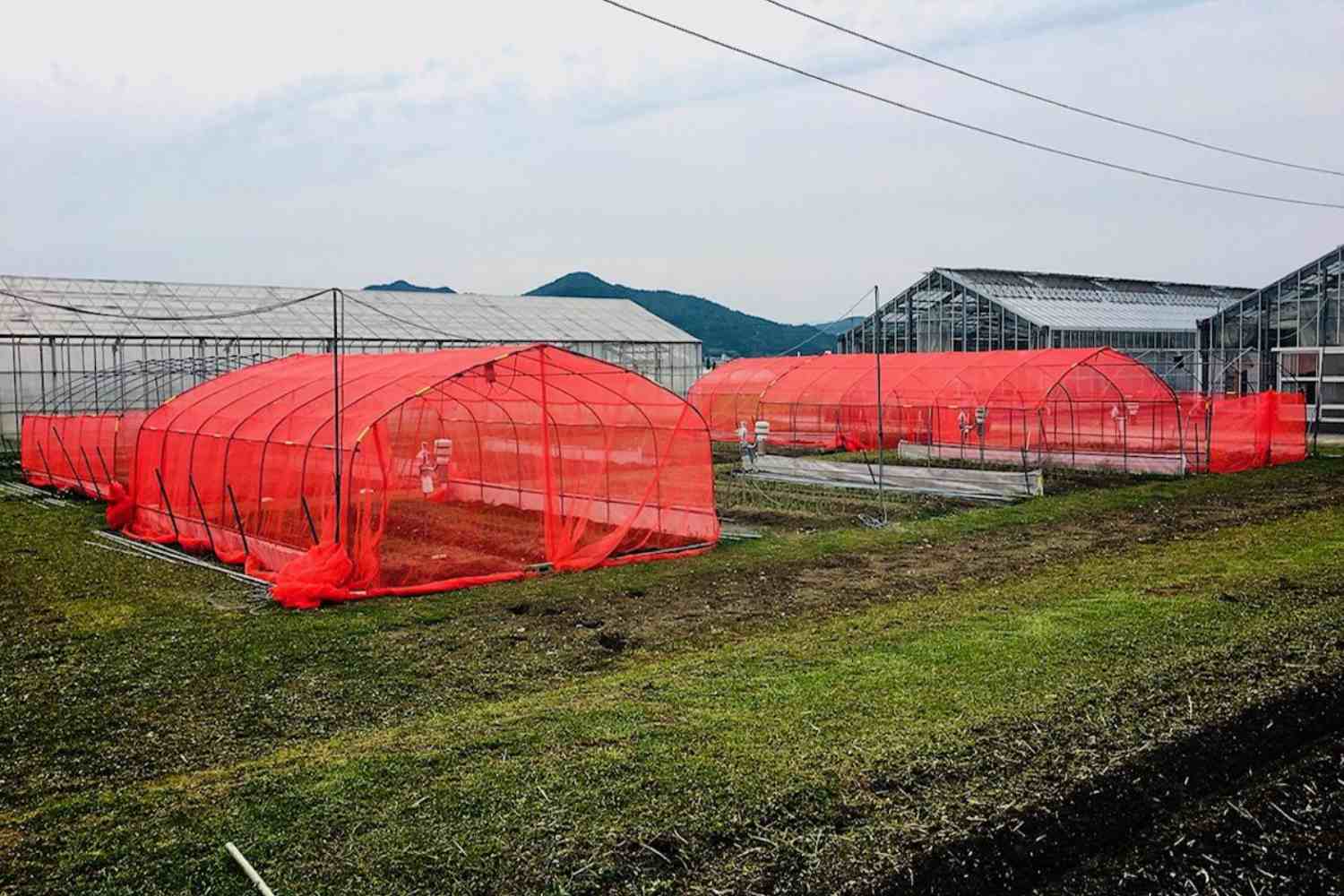
In Japan, a simple innovation could change the future of agriculture: the use of red networks to protect crops such as the Kujo Leek (the Welsh onion typical of Kyoto). These covers do not just act as a physical barrier, but exploit the visual perception of insects to reduce the damage to the crops. The study, conducted by the University of Tokyo together with the Kyoto Prefectural Agriculture Center, has shown that the nets with red threads reject more effectively the Thrips Tobaci, An insect known to devastate vegetables and transmit diseases, compared to traditional white or black networks.
How the chromatic defense works
The discovery arises from a curious detail: many insects do not have visual receptors for the red color. This means that they find themselves “disoriented” in front of a red network, even if they could physically cross it. The researchers speak of optical parasites control, a strategy that uses the biology of insects itself.
In the field tests, the crops partially or totally covered by these networks have requested from 25% to 50% less pesticides. Not only that: vegetables have maintained a high commercial quality, showing that the effectiveness also translates into economic value.
The advantages beyond protection
The use of colored networks does not bring benefits only against parasites. Since the holes can be wider than traditional networks, the air circulates better and problems such as excessive humidity or mushroom formation are reduced. This creates a favorable microclimate that improves the growth of plants and reduces thermal stress for those who work in the greenhouse.
In addition, the networks filter sunlight and attenuate the impact of intense rains, offering additional protection to delicate crops. For a country like Japan, where every square meter of agricultural land is precious, this solution represents a strategic resource.
A model for sustainable agriculture
Experts point out that red networks do not completely replace pesticides, but represent an important step towards a significant reduction in their use. With the growing resistance of insects to chemicals, alternative methods become increasingly urgent. If this technology manages to adapt to other climates and crops, it could have a global impact. The idea of transforming color into a protection tool opens new roads for more sustainable agriculture, less dependent on chemistry and more attentive to the environment.
You may also be interested in:
