
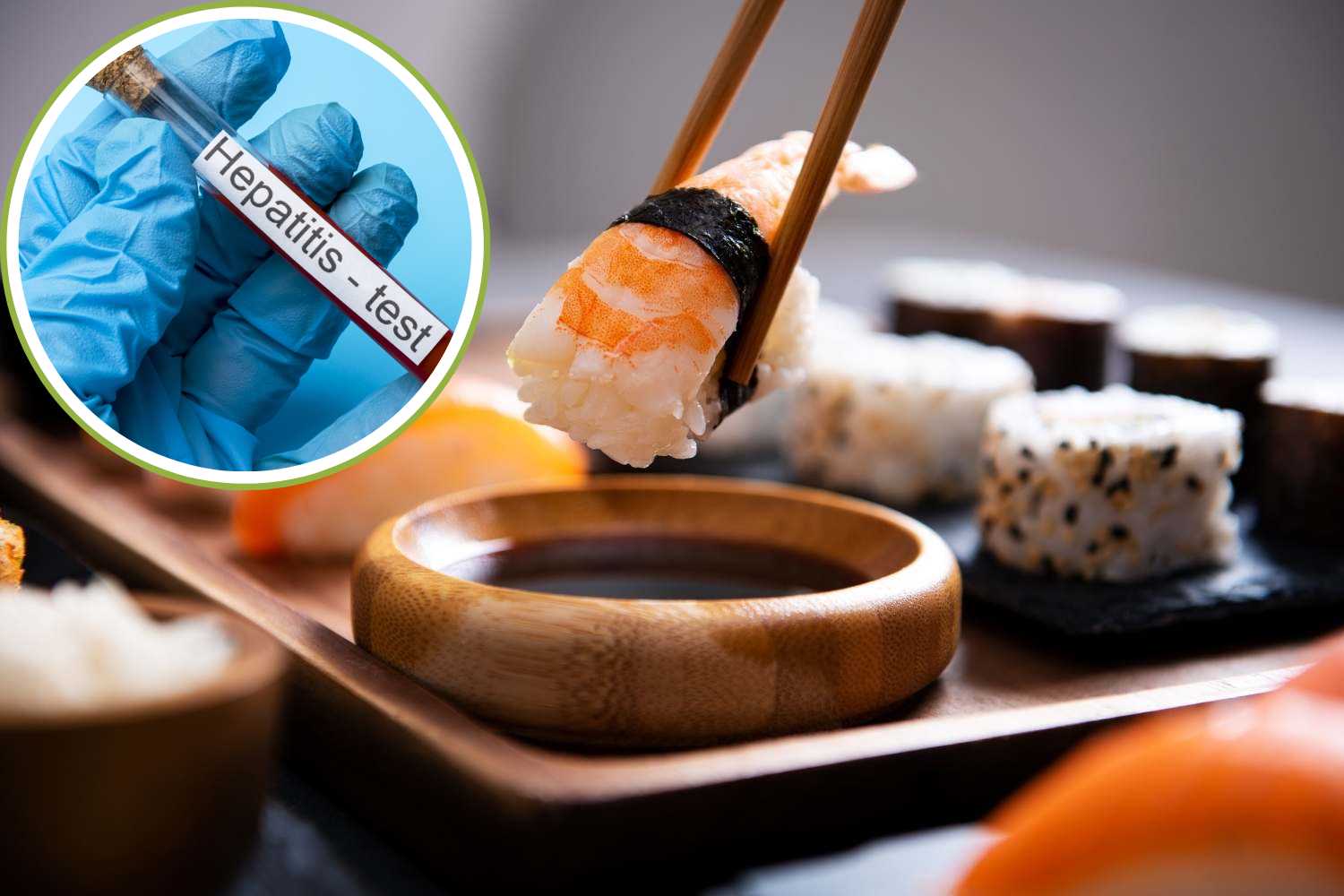
A quiet dinner in a Japanese restaurant eating sushi. A few rolls, some sashimi, maybe a Temaki. Then, a week later, high fever, rust-colored urine, tiredness that makes it impossible to get out of bed. This is what Brandon Matteo Ascenzi, thirty years old, originally from Anagni, neuroscientist and biologist, experienced, emergency hospitalized at the Spallanzani hospital in Rome with severe acute hepatitis.
A personal story that has made the rounds on social media, becoming a case that forces us to deal with a risk that many still ignore, that of eating raw fish.
Ascenzi recounted his experience directly from the hospital bed, through social networks. The first symptoms resembled a banal seasonal flu: fever around 38 degrees, a bit of general malaise. Then a momentary improvement — that deceptive stage that leads many to think the worst is over. But no. The conditions worsened: the urine took on a dark orange colour, an unmistakable sign of liver disease, and the tiredness became debilitating.
What has been diagnosed is hepatitis which, due to its characteristics, is contracted by consuming fish that is not treated correctly.
Blood tests revealed transaminase values of 3500 units per liter. For those who are not familiar with these parameters: normal values are between 20 and 40. A number that does not need further comments to understand the seriousness of the situation. Transferred to Spallanzani, the Roman institute that has become a symbol of excellence in the management of infectious diseases, Ascenzi was placed under continuous monitoring.
The causal link between that sushi dinner and hepatitis has not yet been officially certified by the health authorities, but the hygiene office of the local ASL immediately started checks, contacting the patient to reconstruct the food chain and verify the restaurant’s hygiene procedures. Among the hypotheses under consideration: failure to comply with the procedures for blast chilling raw fish or health regulations for the administration of high-risk foods.
Immunologist Mauro Minelli, professor of human nutrition at Lum, spoke to Adnkronos on the case, explaining that hepatitis arising after consuming raw fish can have various possible causes. The first hypothesis concerns viruses with fecal-oral transmission such as Hepatitis A or E: in these cases the fish is not the natural source of the virus, but a simple vehicle contaminated during the supply chain or handling in the kitchen.
Rarer, but possible, is the “ectopic” form of anisakis, in which the larva migrates beyond the digestive system causing an inflammatory response also at the liver level. Finally, there is an allergic scenario linked to the tropomyosin of the parasite, which can trigger reactions even with correctly killed fish, but which does not in itself justify a marked increase in transaminases. According to the expert, therefore, in the presence of acute liver damage it is necessary to distinguish between viral infection and parasitic migration, remembering that safety does not only depend on culling, but also on rigorous compliance with hygiene conditions throughout the entire supply chain.
What is culling and why is it mandatory
In Italy, the commercial consumption of raw or marinated fish is subject to precise hygiene and health regulations. EC Regulation 853/2004 requires that fish intended for raw consumption be subjected to thermal blast chilling: a procedure which involves bringing the product to very low temperatures (at least -20°C for at least 24 hours) to eliminate parasites such as Anisakis and drastically reduce the bacterial and viral load.
The most common pathogens in raw untreated fish
When it comes to raw fish not treated correctly, the risk is not just theoretical. In fact, there are several pathogens that can be transmitted through sushi, carpaccio, tartare and seafood consumed without adequate safety procedures.
Among these is the Hepatitis A virus, which can be carried by contaminated fish and shellfish and cause acute, sometimes severe, liver inflammation. The infection does not manifest itself immediately: symptoms can appear after weeks, making it more difficult to link the illness to the food consumed.
Another well-known risk is represented by Anisakis, a parasite that can survive in fish that have not been subjected to heat killing. Once ingested, it can cause acute abdominal pain, nausea, vomiting and, in some cases, even significant allergic reactions.
Marine bacteria such as Vibrio parahaemolyticus, responsible for acute gastroenteritis often associated with the consumption of raw shellfish and seafood, may also be present in raw fish products. Added to these are Salmonella and Listeria, microorganisms that proliferate especially in poor hygiene conditions during preparation and storage. They are particularly dangerous for immunocompromised people, the elderly and pregnant women.
Finally, Norovirus should not be forgotten, one of the main causes of violent gastroenteritis. It is easily transmitted through food contaminated by infected workers and can spread rapidly in catering environments if strict hygiene rules are not respected.
It is important to clarify a very common misunderstanding: freshness does not coincide with microbiological safety. A fish can be very fresh, just caught and perfectly preserved from an organoleptic point of view, but still contain parasites or pathogenic microorganisms. This is why culling is not an option, but an essential tool for reducing risks and protecting consumer health.
