
Crunchy and easy to put on the stock exchange, the crackers often accompany fast lunches and flying aperitifs. They fill the shelves in dozens of brands and variants, but how much do they really look like? One response comes from the test made by the Swiss magazine K-Tipp, who compared 12 types of cereal -based crackers. The results emerge promotions, rejection and some facts that raise some questions about our daily choices.
What the test revealed
From the analysis they emerge Marked differences between wholemeal crackers and those prepared with white flour. Full products show a higher content of fiber, less fat and absence of residues risky for health. The white flour -based crackers, on the contrary, are fatter and less rich in nutrients, with the presence in some cases of pesticides and/or potentially harmful substances such as acrylamide.
Only 4 of the 12 products analyzed have received a positive judgment. The product that obtained the best score belongs to the Swiss market: it is the “Bio Original Spelt” Of Dar-Vida Naturaplanrewarded for the high fiber content, the reduced amount of fat and the absence of pesticides. We speak a very relevant aspect, if we consider that an adequate supply of fibers reduces the risk of pathologies such as diabetes, digestive problems and cardiovascular disorders.
Experts advise you introduce at least 30 grams of fiber per day in an adult diet. The whole grains based on whole grains come to contain on average 10% of fiber, a percentage similar to that present in the Avena. The crackers prepared with white flour, on the contrary, reach about a third of this value, comparable to the content of toasted white bread fibers.
Among the products examined, A well -known brand recorded the highest level of acrylamide detected during the test. This substance is considered potentially carcinogenic and some studies suggest possible negative effects also on the nervous system and reproduction.
On the front pesticidesresidues were traced in half of the products examined. The legal limits have not been exceeded, but experts warn that daily use foods, especially if intended for children, should be without these substances.
The worst brands
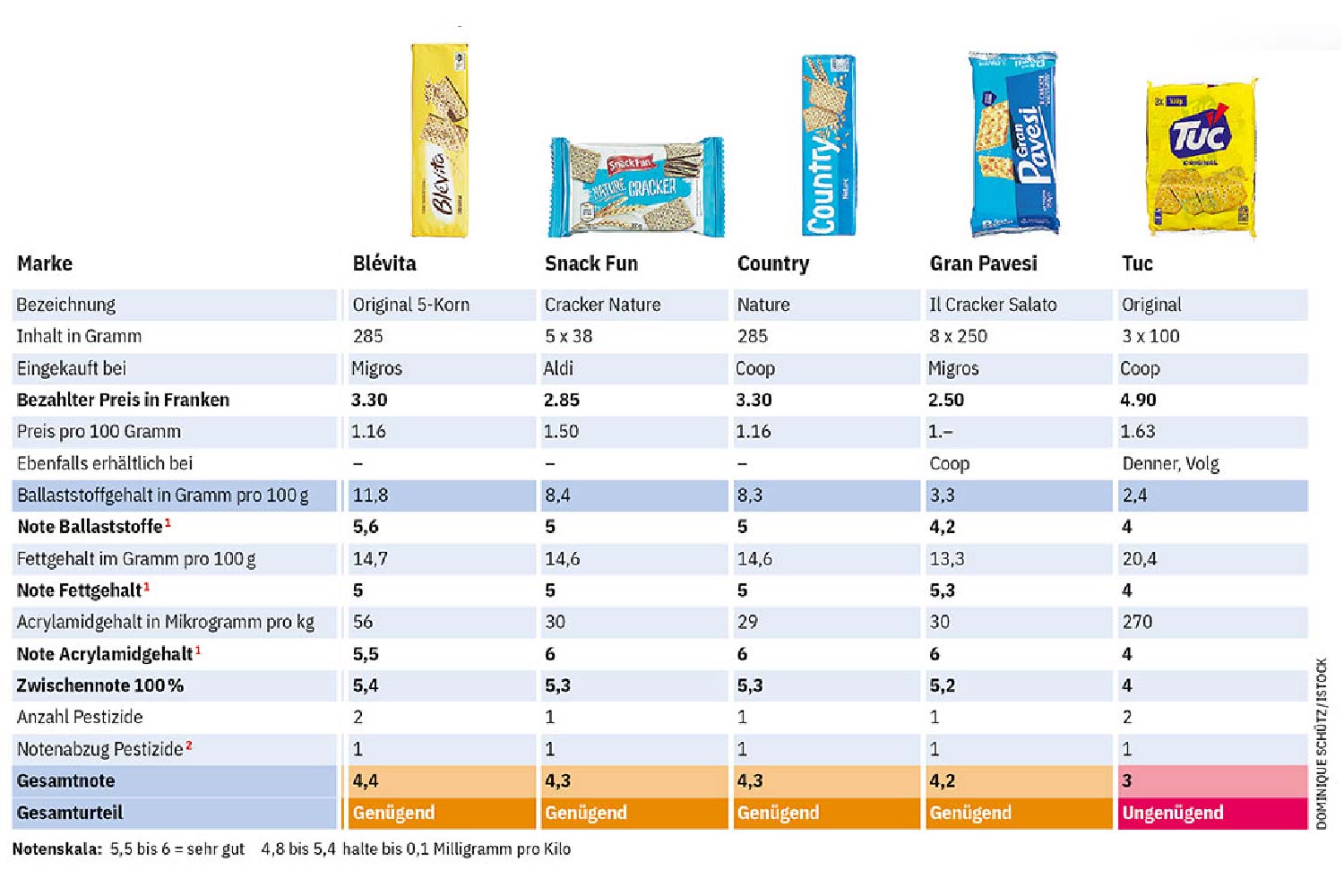
It makes us reflect the positioning in the ranking of some brands also known in Italy. THE Tuc they end up in Last positionpenalized for a high fat content (over 20 grams per 100 grams) and for a significant level of acrylamide.
In Switzerland, the law establishes a maximum limit of 400 micrograms per kilogram (µg/kg) due to the presence of acrylamide in the crackers. This substance is naturally formed during cooking at high temperatures of starch rich in starch. While remaining under the legal limits, The TUCs are positioned as the worst product of the test for the level of acrylamidewhich reaches over half of the maximum allowed.
The analysis shows that reducing the presence of acrylamide in the crackers is possible. Some products, such as “Nature Vollkorn” by Dar-Vida, Country’s “Nature”, Snack Fun “Cracker Nature” and “Salato Cracker” by Gran Pavesi, have very low values, including only 30 µg/kg. The choice of more attentive production processes is therefore revealed to reduce the presence of potentially harmful substances, for the benefit of smaller consumers.
The TUCs also contain traces of deltametrinaa substance suspected of interfering with hormonal balance, and of piperonilbutoxidowhich could involve risks by liver and kidneys.
And i Gran Pavesi? If on the one hand they distinguish themselves for a minimum acrylamide content, on the other hand they still end up in penultimate location. In the Grand Pavesi crackers the laboratory has identified traces of pyrimifosmetilea pesticide that, in the long term, can be harmful to some organs. Also in this case, the fiber content proves to be low, similar to that of white bread.
In two other products analyzed, the presence of Trinexapaca growth regulator used in the cultivation of wheat. The European Agency for chemicals classifies the four substances detected in the crackers – pyrimifosmetile, deltametrine, piperonilbutoxido and trinexapac – as highly toxic to aquatic organisms. The manufacturers said that the quantities found are minimal, but the concern remains.
How the analysis was carried out
To conduct the test, K-Tipp commissioned the Dr. Wirts + Kiel partner laboratory in Germany. The parameters taken into consideration were the following:
