
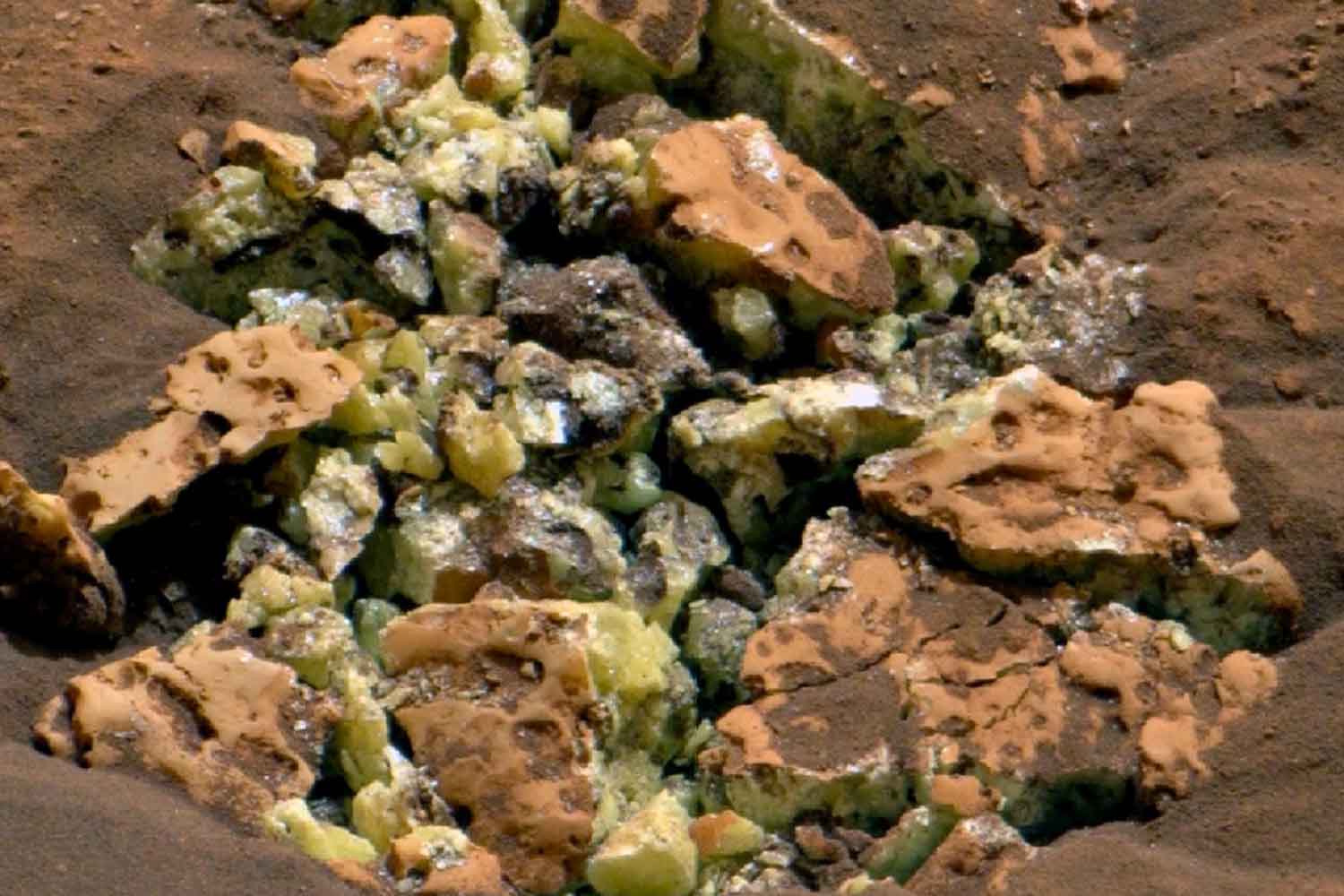
On Mars there are still areas that seem to have decided not to tell their story fully. The Gediz Vallis Channel it is one of these: a landscape that preserves clear traces of ancient water and, at the same time, continues to provide details that do not add up. This is where Curiosity has discovered pure sulfurhidden inside any rock, bringing to light something that does not fit into the schemes with which we have so far interpreted the geology of the red planet.
The discovery arises from an almost random episode, but the consequences are anything but marginal. During its journey, the NASA rover shattered a seemingly insignificant rock. Inside, instead of an ordinary composition, they emerged yellow crystals of elemental sulfura shape that had never been observed on the red planet before.
In the Gediz Vallis Channel pure sulfur emerges among common rocks
The place of discovery has an important specific weight. The Gediz Vallis Channel it tells an ancient story made up of water, sediments and slow transformations, stratified over time. The rocks in this area preserve traces of a river that flowed billions of years ago, when Mars was very different from how we see it today.
In this context, the presence of sulfates it was already known. These are salts that form when sulfur, combined with other elements, interacts with water. When the water evaporates, these minerals remain as a sort of chemical imprint of the past. Scientists have long used them to reconstruct the water history of the planet and understand the alteration processes of its surface.
The appearance of pure sulphurhowever, introduces a completely different variable. This elementary form develops only under very specific conditions, which, according to current knowledge, . It is precisely this gap between theory and observation that makes the discovery so relevant.
Then there is another detail that adds depth to the picture. The surrounding terrain is littered with rocks that, on the outside, appear strikingly similar to the one Curiosity broke. This suggests that the finding is not an isolated case, but that elemental sulfur may be widespread in some areas of the canal. A hypothesis which, if confirmed, would significantly change the geological interpretation of the region.
In July 2024, Ashwin Vasavadaamong the scientific managers of the mission, had summarized the meaning of the discovery with a very concrete image: finding stones made of pure sulfur in that context is equivalent to coming across something that completely breaks expectations. And when it happens, science moves in a precise direction: understanding how it is possible.
Between the chemistry of life and mysteries that are still open
The sulfur It also occupies a central place in the chemistry of life. On Earth it is an essential element, used by organisms in the form of sulfates to build fundamental amino acidsessential for the formation of proteins. This makes its presence on Mars particularly interesting, although it is important to maintain the right balance in the interpretation.
Martian sulfates had already been identified in the past, so in this respect there is nothing completely new. The discovery of elemental sulfur does not introduce direct evidence related to life, and at the moment. What continues to emerge, however, is a coherent set of elements which, put together, describe an environment that in the past could have been compatible with life forms: presence of water, favorable chemical conditions, useful materials.
The most interesting node remains the geological one. If there are indeed significant quantities of pure sulfur on the surface, it means that processes have occurred in the planet’s past that still elude our understanding. It’s as if a chapter was missing in the history of Mars, and this discovery suddenly showed a fragment of it.
There is also an aspect related to the way in which this information emerges. From Earth, Mars remains a distant place, accessible only through instruments and robotic missions. Curiosity, with its weight of 899 kilogramshe simply followed his path when he broke that rock. Without that event, the sulfur would probably have remained hidden for much longer.
Subsequent analysis confirmed the nature of the material, and a photograph taken a few days later showed another very similar rock nearby. This reinforces the idea that the phenomenon is more widespread than initially thought.
To arrive at an explanation, new steps are needed. Scientists are working on more detailed models of the geological evolution of Marstrying to understand what conditions may have led to the formation of sulfur in that form. Meanwhile, Curiosity continues to collect data along the canal, moving slowly between rocks which, at a superficial glance, all seem the same and which instead can hide profound differences.
The rover has already accomplished 42 perforationscollecting samples of pulverized rock thanks to the drill mounted on its robotic arm. Each hole represents an attempt to go beyond the surface, to read what is not immediately visible.
And while Curiosity continues its work, too Perseveranceactive for over five years on the red planet, continues to explore. One of his most recent observations concerns an object that appears out of context, so much so that it could be hypothesized that it may have an origin other than the Martian one.
What emerges, overall, is a story that builds slowly, made up of details that are added one after the other. The discovery of pure sulfur on Mars fits perfectly into this dynamic: a fortuitous episode that opens up new questions and forces us to look at the planet with different eyes.
