
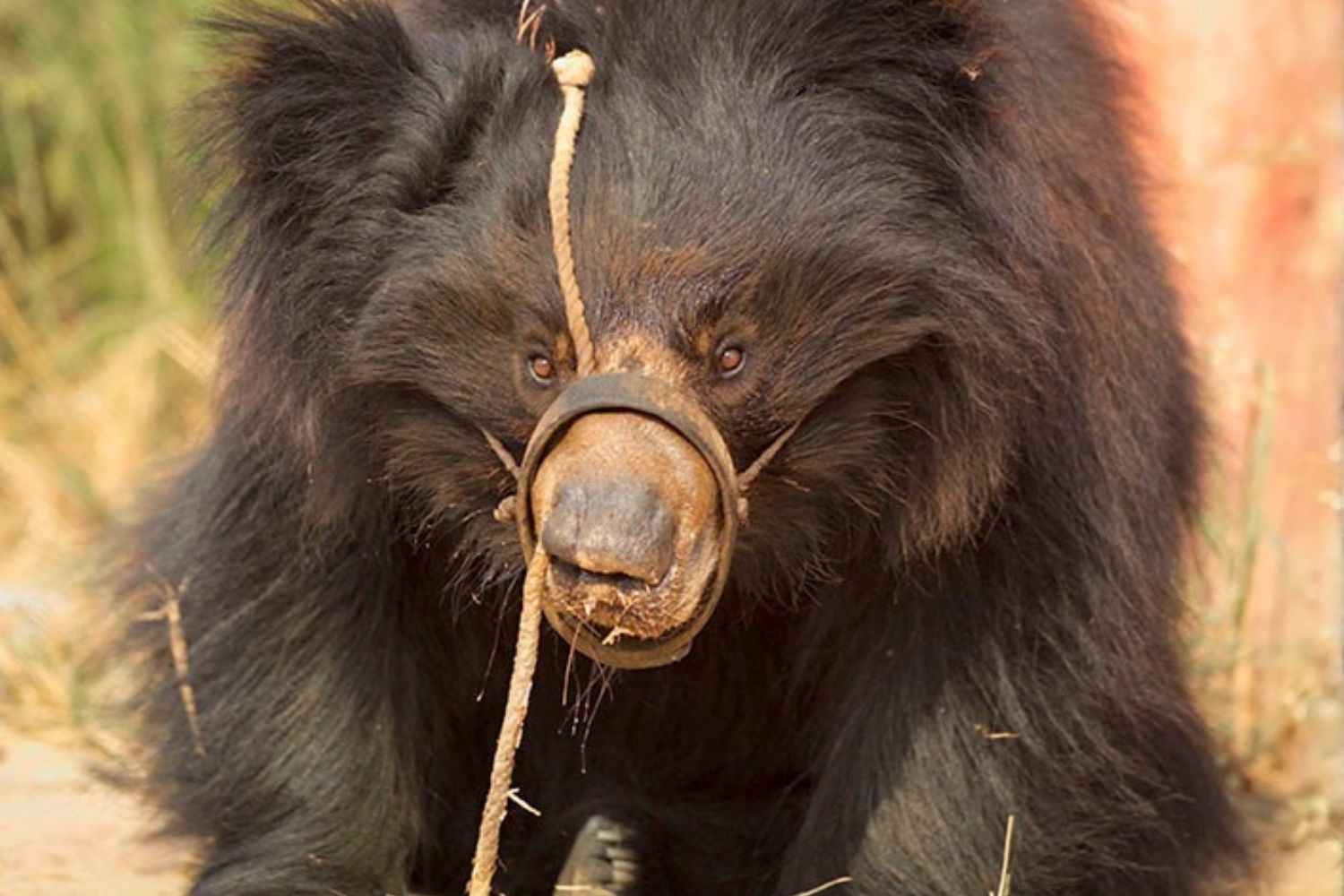
Punctured snout, pulled cord, constant pain. For centuries, sloth bears have been forced to “dance” on the streets of India. Today they live in protected sanctuaries. But the battle is not over.
Rani will never forget. The pain of the rope crossing her face, the terror of the beatings, the years spent “dancing” for tourists along the dusty roads of India. It was 2002 when she was rescued. She was the first, after her another 619 arrived.
For centuries, sloth bears have been victims of a practice as deep-rooted as it is brutal: captured as cubs, their faces were pierced with hot irons. A rope was passed through the wound, becoming a permanent control tool. Each puff caused excruciating pain. Each “dance step” was actually a desperate attempt to escape suffering.
The community behind the tradition
There was a desperate economic reason behind this practice. The impoverished and marginalized nomadic Qalandar community was completely dependent on these spectacles for survival. From village to village, from town to town, bears were their only means of livelihood.
“We couldn’t just ban the practice and leave it at that,” explains the pioneering work of Geeta Seshamani and Kartick Satyanarayan, co-founders of Wildlife SOS.
“We had to understand the people behind this tradition.”
From 1995 to 1997, Geeta and Kartick conducted an in-depth investigation into the practice of dancing bears. But they didn’t stop at reporting: they lived with the Qalandars, visiting 68 villages, listening to their stories, understanding their economic desperation.
The revolutionary approach
The report they presented to the Government of India was revolutionary not only for what it reported, but for the solution it proposed: a holistic approach that did not punish the Qalandars, but offered them a real alternative.
In 2002, the Agra Bear Rescue Facility was established, now the largest sloth bear rescue facility in the world. In the same year, Rani crossed its gates. It was just the beginning.
But Wildlife SOS knew that saving the bears wasn’t enough. In collaboration with the Indian Ministry of Environment and Forests, the organization launched the “Dancing Bear Project”, a program that has revolutionized the approach to animal conservation in India.
Qalandar families received seed funding and assistance to start new businesses. Women had access to professional training and markets to sell their products, gaining economic independence for the first time. But most importantly, children were enrolled in school, with school supplies guaranteed to ensure their retention in the formal education system.
“We wanted to break the cycle,” explain the founders. “So that future generations no longer have to depend on animal abuse to survive.”
The numbers speak clearly. In 2009, Raju was the last dancing bear surrendered by his Qalandar owners. A historical date: after centuries, the practice had been eradicated.
In total, 628 bears were removed from the streets and welcomed into four large wildlife sanctuaries: Agra (2002), Bannerghatta in Karnataka (2005), Van Vihar in Madhya Pradesh (2008), and Purulia in West Bengal (2014).
The success goes beyond the numbers of animals saved. Over 5,000 Qalandar children have received education. More than 3,000 families no longer depend on wildlife crime to support themselves. They have found dignified and legal means of subsistence.
The project was realized thanks to the collaboration with International Animal Rescue, One Voice Association from France, Free The Bears, and Humane Society International from Australia.
The alarm of 2024
But the story doesn’t end there, in 2024 new reports of illegal bear trafficking emerged. An alarm bell that reminds us that vigilance can never be lowered.
“Poaching remains a constant threat,” warns Wildlife SOS. “We need to further tighten control over anti-poaching activities in India.”
The rescued bears now live in sanctuaries, slowly recovering the natural instincts that were stripped from them. Some will never completely forget. Like Rani, who after 22 years still bears the physical and emotional scars of those years.
But they have a second chance. And with them, also the Qalandar families who have chosen a different future.
India’s lesson to the dancing bears is clear: real change does not come from punishment, but from offering concrete alternatives. And animal protection requires a look that goes beyond the animal itself, to understand and transform the entire system that allows abuse.
THE FUNDAMENTAL STAGES
1995-1997: Geeta Seshamani and Kartick Satyanarayan investigate the practice of dancing bears
1996: beginning of the period of coexistence with the Qalandar community (68 villages visited)
2002: Opening of Agra Bear Rescue Facility and rescue of Rani, the first bear
2005: Opening of Bannerghatta Bear Rescue Center (Karnataka)
2008: Opening of the Van Vihar Bear Rescue Facility (Madhya Pradesh)
2009: Raju, the last dancing bear, is delivered. End of practice.
2014: Opening of Purulia Bear Rescue Center (West Bengal)
2024: new illegal trafficking alerts
The numbers
