
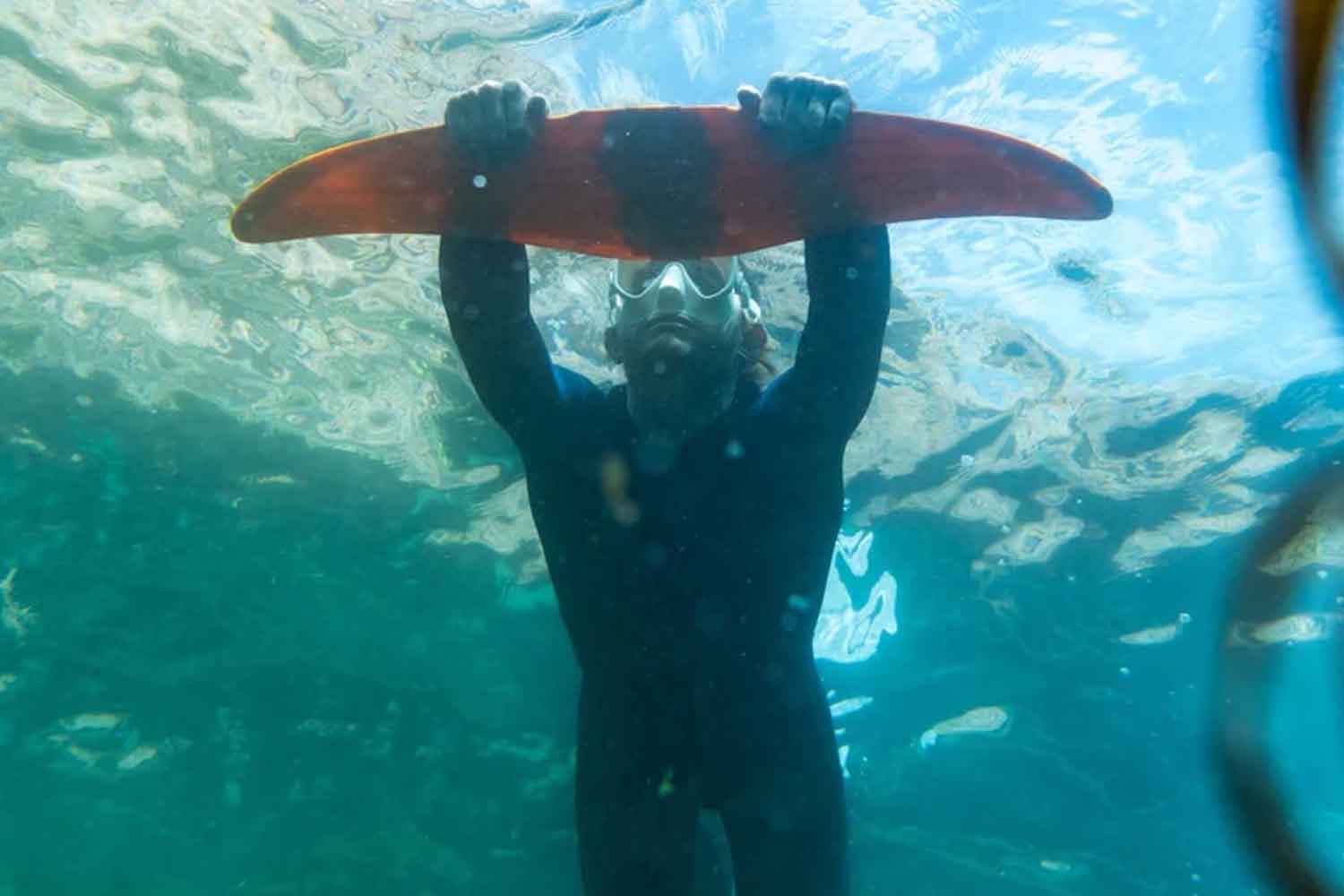
There is a different way of being in the water that is emerging slowly, without noise. It’s not about speed, or performance, or even the idea of pushing yourself. It is rather about the way the body moves, the continuity of gestures, that sensation of sliding that sometimes happens for a few seconds and then escapes. DeepFoil was born within this space, almost as a response to something that already exists but which until now was difficult to retain.
It comes from Brittany and brings with it a simple image: that of a movement that lengthens, relaxes, becomes more fluid. There is nothing invasive, no technology that imposes itself. The object remains essential and lets the body do everything, accompanied by a shape that amplifies what we already know how to do in water.
Behind it are Émilia Perdigon and Paul François, together with the Nereïs Ocean company, but the sensation is that of an intuition that takes shape slowly, almost by subtraction, until it becomes something concrete that can really be used.
Inspiration from whales to restore a more natural continuity to swimming
The idea starts from the observation of marine animals, from that way of moving that always seems to be in balance with the water. Whales, in particular, offer a powerful image: no interruptions, no visible effort, just a continuous trajectory.
DeepFoil translates this intuition into a hydrodynamic wing that integrates with the body. When you kick, the movement changes quality. It lengthens, becomes fuller, more uniform. The sensation that emerges is that of an accompanying slide, without jerks.
Everything remains very simple. There is no need to learn new gestures or complex techniques. The object follows the body and supports it, creating an immediate relationship even for those with little experience. Buoyancy helps to make everything more stable and reassuring, and this also opens up the experience to those who enter the water with less confidence, including the little ones.
From the Serre-Ponçon lake to a concrete object
The story takes shape far from the sea, around Lake Serre-Ponçon, where the idea of exploring a submerged village sparks a first intuition. At the beginning the project follows a more complex path, with a small submarine designed to move beneath the surface. Over time, another, more essential direction emerges. The project becomes lighter, lets go of what is weighing it down and focuses on just one element. The wing remains, everything else disappears. From this choice, DeepFoil was born in the form we know.
The first examples come to life in 3D printing, in a garage, one at a time. Each piece requires time, attention, continuous adjustments. Then comes the request, and with it the need to change pace. Production moves to Vendée, enters an industrial dimension, while maintaining a very recognizable identity.
Even the materials tell something. The standard version uses recyclable HIPS plastic, with colors designed to remain visible in the water. Alongside this, a wooden version takes shape, made in La Trinité-sur-Mer, which brings with it a different, warmer, almost tactile presence.
The price remains in an accessible range, around 95 euros for the plastic version, while the wooden one reaches 245 euros. The first sales exceed one hundred units and accompany an important step: the expected arrival also in Decathlon stores, which opens up to wider distribution. In the meantime, Nereïs Ocean continues to work on the project, with the idea of developing new evolutions without losing this simplicity which represents the heart of the object.
You might also be interested in:
