
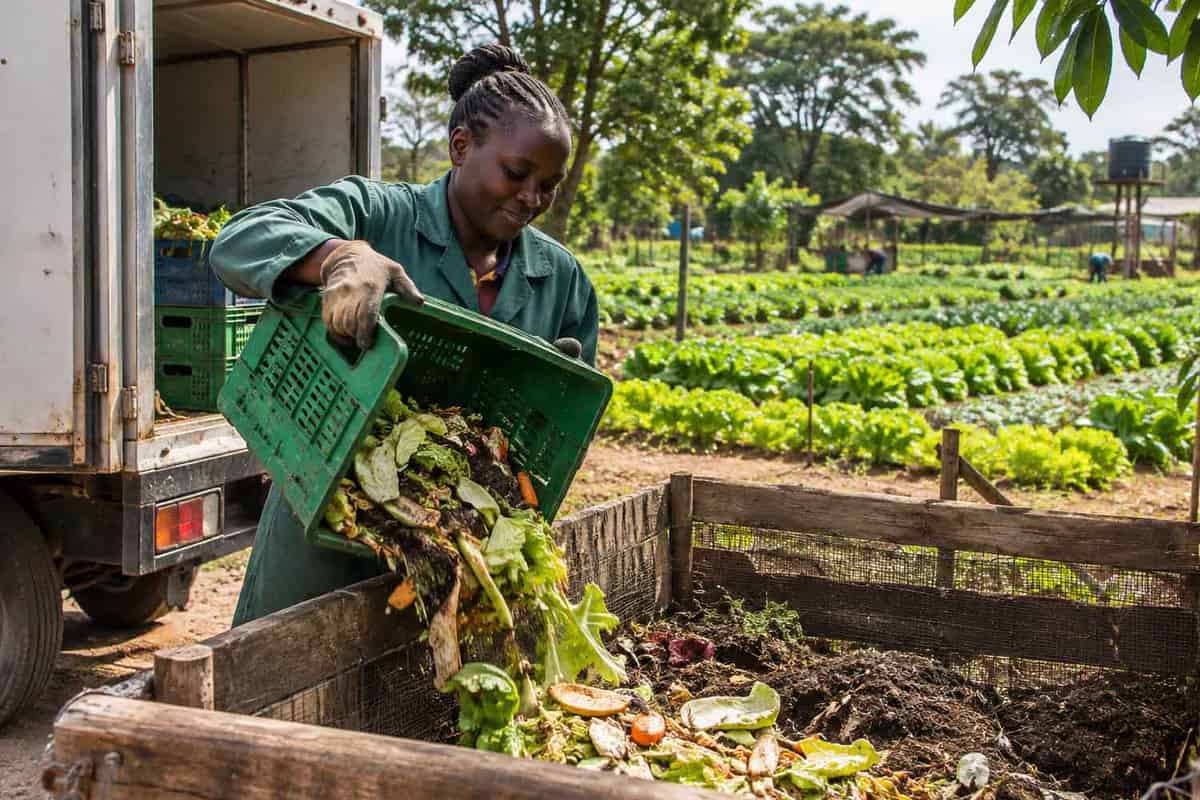
On the outward journey it carries lettuce, cherry tomatoes, asparagus and radishes. On the way back, food waste. On the outskirts of Lusaka, the capital of Zambia, a small farm of ten hectares and twelve employees has found a way to recover even what remains of the preparation of the meals served on planes. It’s called Loctaguna Organics and, thanks to a system that involves vegetables, earthworms and pigs, it has managed to reduce costs for waste management and livestock feeding.
The idea comes from Kanangwa Newlove, an entrepreneur who spent about ten years in the business and marketing sector before turning to agriculture. He invested the severance pay from his previous job on the farm, where today he produces fruit, vegetables and aromatic herbs following the principles of agroecology, without synthetic fertilizers and pesticides. Among its clients is Newrest Zambia, a catering company that prepares meals for airlines.
The vegetables take flight, the waste returns to the fields
Iceberg lettuce, lollo rosso, lollo bianca, cherry tomatoes and asparagus grown by Loctaguna end up in the airport catering kitchens. The collaboration is already documented in the sustainability report of Newrestin which the company reports returning its organic waste to the farm to be used to produce natural fertilizer.
The most interesting part of the agreement lies in its simplicity: Newlove recovers the waste during the return journey from deliveries, avoiding additional transport costs. A single journey thus allows you to sell agricultural products and obtain part of the resources necessary to grow others. Once they arrive on the farm, the waste is put to different uses. Some ends up in the composting system, where earthworms do most of the work. Other food waste is used to feed the pigs.
Earthworms, pigs and fertilizers at almost zero cost
Tea bags, cardboard and organic waste become a natural fertilizer through vermicomposting. Earthworms, together with microorganisms, help decompose organic matter, transforming it into nutrient-rich compost which is then distributed in the fields. Goats and pigs also play a role in Loctaguna’s agricultural system: their manure contributes to the fertilization of the soil, further reducing the need to purchase products from outside.
To combat crop parasites, however, Newlove also uses plant preparations. Among these there is a macerate obtained by leaving comfrey leaves to ferment in water for two weeks (Symphytum officinale), to which he sometimes adds flowers of this kind Tithonia. Soil health is the basis of the entire agricultural activity. Loctaguna integrates cultivation, breeding, agroforestry and recovery of organic matter, ensuring that the different activities of the farm can support each other.
Less waste and lower agricultural costs
According to Newlove, waste recovery has allowed the company to reduce waste collection costs by 35% and pig feeding costs by 45%.
Vegetable cultivation also appears to benefit economically from this approach: a comparison conducted internally by the company found 35% lower costs for growing onions on one hectare of land compared to a conventional agricultural system. Agroecology thus also becomes a tool for economic autonomy. Less fertilizer to purchase, less feed to procure and greater valorisation of the resources already available in the area.
The collaboration with Newrest has also allowed a small agricultural operation to access a commercial market that requires regular supplies and adequate quantities. According to the founder, the revenues obtained from catering and direct sales of products are sufficient to support the farm’s activity.
Agroecology as an opportunity for small farmers
Loctaguna Organics shares its knowledge with other local producers through collaboration with the Kasisi Agricultural Training Centre, an agricultural training center that promotes agroecological practices in Zambia. The farm has also been involved in the activities of Urban Futures, a program dedicated to the development of sustainable food systems, hosting a visit from participants of an international meeting in May 2024.
Newlove’s experience shows how even a small agricultural company can enter a complex commercial chain such as that of air transport, keeping the fertility of the soil and the recovery of resources at the centre. And to think that a good part of this circular economy system arises from a rather elementary commercial intuition: after delivering the vegetables, the vehicle still had to return to the farm. We might as well avoid it coming back empty.
