
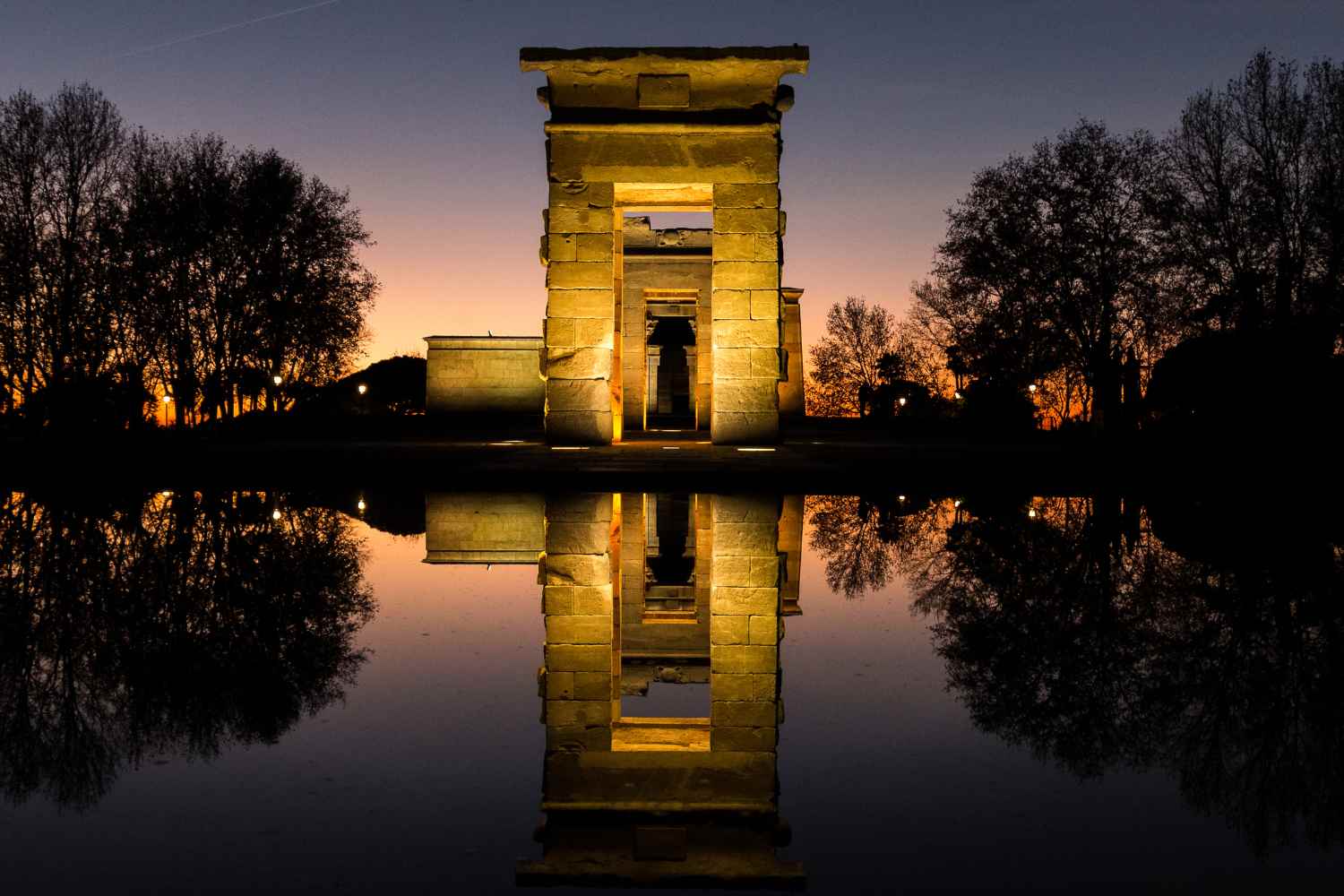
In the center of the Spanish capital, between modern avenues and European architecture, there is an incredible testimony of ancient Egypt: the temple of Debod. This extraordinary monument represents one of the most fascinating stories of archaeological rescue and international cooperation of the twentieth century, where Nubia meets Madrid.
From the banks of the Nile to Madrid
The story of the Debod temple begins over two thousand years ago in the lower Nubia, along the banks of the Nile. Originally dedicated to Ammon and Isis gods, this sanctuary occupied a strategic position in a region full of natural resources, which amplified its religious and cultural importance. His connection with the famous Isis sanctuary in Filae transformed it into an important pilgrimage center, where the faithful raised to invoke fertility and divine protection.
During the Ptolemaic dynasty, the temple experienced a period of great splendor. It was the Nubian King Adjalamani who left his most lasting sign on the structure, expanding it considerably and enriching it with hieroglyphics that still tell his devotion to Ammon and Isis. These interventions transformed the temple into a symbol of power and identity for the entire Nubian region.
The meeting between worlds: the Roman era
With the advent of Roman domination, the Temple of Debod lived a new phase of transformation. Reds such as Augustus, Tiberius and Adriano contributed to its evolution, introducing typically Roman architectural and decorative elements that fought harmoniously with the pre -existing Egyptian iconography. This cultural synthesis created an artistic unicum, where reliefs and sculptures told the dialogue between two great civilizations.
The temple thus became a symbol not only spiritual but also political, representing religious syncretism that characterized the Roman Empire. However, with the affirmation of Christianity in the 6th century, the fate of the sanctuary changed radically.
Abandoned to his destiny, the temple began a slow process of deterioration, victim of time, climate and human neglect.
The dramatic rescue
The twentieth century brought a new threat to the Temple of Debod. The construction of the great Assuan dam in 1970 threatened to submerge numerous archaeological treasures of the Nile Valley forever, including this precious monument. Faced with this unprecedented patrimonial crisis, Unesco launched the Nubia campaign, an extraordinary international initiative that mobilized experts from all over the world to save these monuments from oblivion.
Spain was among the countries that actively participated in this rescue operation. As a recognition for the contribution offered, in 1968 Egypt made an extraordinary gift to the Iberian nation: the entire temple of Debod. Thus began one of the most complex archaeological transfer operations in modern history.
The rebirth of the temple
The transfer of the Temple from Assuan to Madrid represented an unprecedented technical and logistics challenge. Every single block of stone was numbered and cataloged, for a total of 1,724 elements that had to be disassembled, transported by sea and reassembled in their new destination, but only 60% of the original material arrived in sufficiently good conditions to be reused.
The architects and Spanish restorers faced this challenge with great ingenuity, using the anastilosis technique, which involved the integration of the original blocks with new sandstone from Villamayor. This choice was not accidental: the local stone made it possible to maintain the overall aesthetic of the monument, clearly distinguishing the parts restored from the original ones, in full respect of the principles of archaeological conservation.
Mysteries and legends
Despite its urban location, the temple of Debod has not lost its mysterious charm. One of the most suggestive legends says that at sunset, when the shadows stretch on the millennial stone blocks, the silhouette of a cat appears. According to popular tradition, it would be the spirit of the rents kingjalamani, who continues to watch over his temple even thousands of kilometers from his native land.
This legend reflects the profound spiritual connection that the ancient Egyptians nourished towards the felines, considered sacred animals and divine messengers. The presence of this spectral cat symbolizes the continuity between past and present, between ancient Egypt and contemporary Madrid.
The sacred orientation
One aspect that affects the most attentive visitors is the orientation of the temple, perfectly aligned from east to the west. This provision is not accidental, but reflects the deep Egyptian cosmovision, where the path of the sun represented the eternal cycle of life, death and rebirth. Even in its new Madrid location, the Temple maintains this symbolic connection with the Solar Astro, continuing to tell the spirituality of a civilization that saw the manifestation of the divinity in the sun.
A bridge between cultures
Today, the Debod temple is open free of charge to the public from Tuesday to Sunday, from 10:00 to 20:00, without the need for booking. Inside, visitors can explore exhibitions dedicated to Egyptian mythology, discovering the mysteries of Ammon and Isis and rituals that have animated this sacred place for centuries.
The temple of Debod thus continues its millennial mission, no longer as a place of worship, but as a silent witness of the human ability to preserve and pass on beauty, transforming a corner of Madrid into a window on the eternity of ancient Egypt.
