
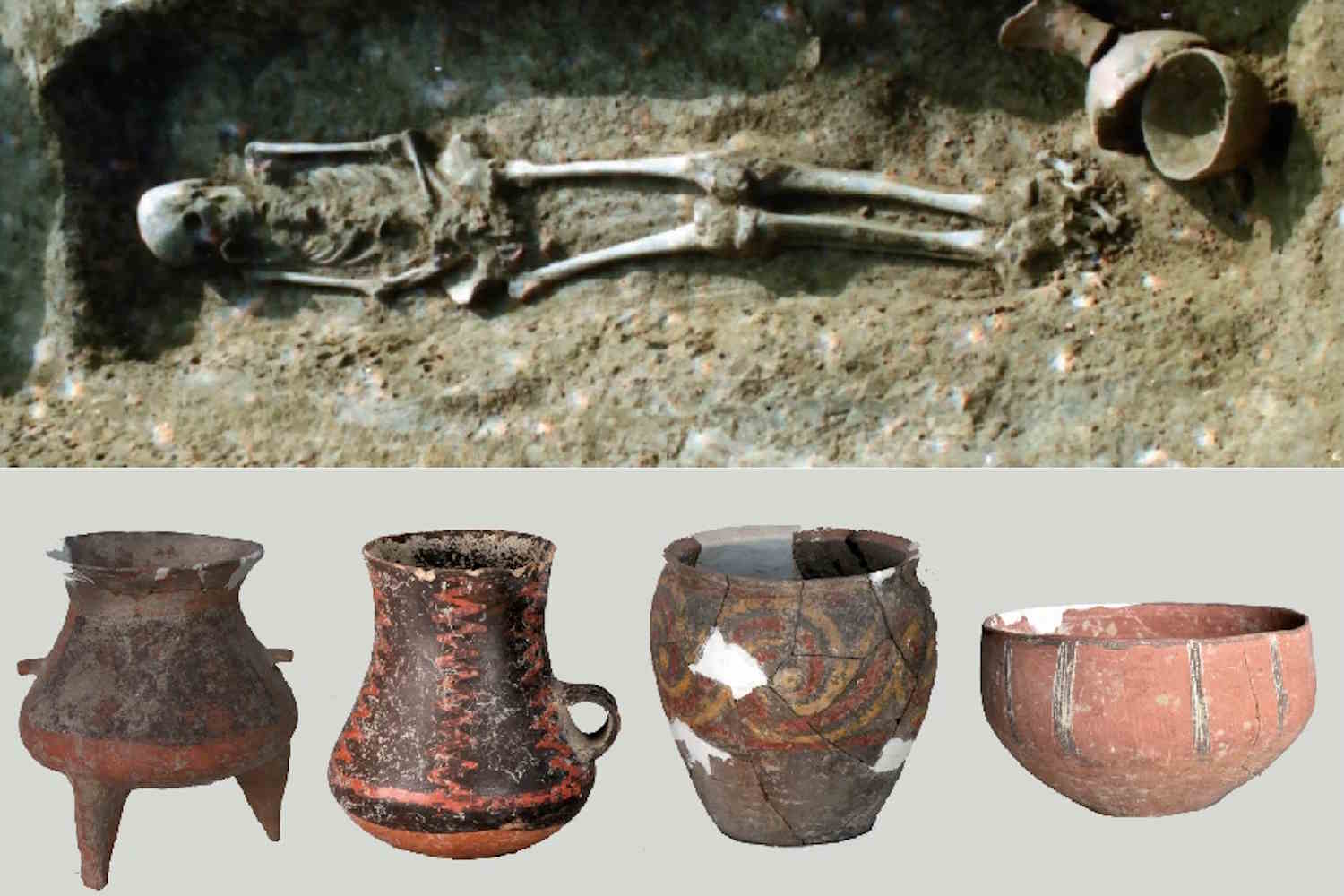
In a secluded corner of the Chinese province of Shandong, between the Tai-Yi mountains and the coast of the Mar Bohai, archaeologists have brought back to light something that could change forever the way we mean the social organization of ancient civilizations. For decades, the dominant narrative in archeology and genetics was that primitive societies were patriarchal. But modern research shows that, at least in some places, it has not always been like this. To the Neolithic website of Fujiadating back to about 4,700 years ago, unequivocal evidence of the existence of a matrilinear society: a social structure in which The descent, family membership and tribal ties were determined through the maternal line.
This does not mean, it is good to clarify it, that it was a company matriarchal. The term “matrilinear” refers in fact to the transmission of the kinshipnot to decision -making power or the social dominance of women. In Fujia, mothers were the genealogical reference pointbut.
Two cemeteries, two maternal clans
Fujia’s website, culturally attributable to the Agricultural civilization of Dawenkoucovers an extension of about 37 hectares and includes over 500 tombs, dated between 2750 and 2500 BC although for years it has been considered a similar settlement to the others in the area, recent genetic studies have revealed a profoundly different social structure.
Researchers from the University of Beijing and the Minzu University, in collaboration with other Chinese institutes, analyzed the Mitochondrial DNA (MTDNA) of 60 individuals buried in two distinct cemeteries: one located in the north and one south of the area. The MTDNA, transmitted exclusively by the mother, allows you to precisely reconstruct the female descent lines.
In the north cemetery, All 14 individuals analyzed shared the same mitochondrial aplogroup, M8A3indicating a common and maternal origin. In the South cemetery, however, 44 out of 46 individuals had a completely different aplogroup, confirming the presence of another large Matrilinear clan. The net contrast with the variety of Y chromosomes – inherited from the fathers – suggests that Men became part of the female community through marriagebut did not transmit their descendants.
The conclusion is clear: People were buried according to the maternal line, regardless of sex or paternal lineageoutlining a matrilinear social model that lasted at least 250 yearsequal to about 10 generations.
A surprising food equality between men and women
In addition to genealogical information, the research team has also obtained precious data on Mobility, nutrition and family structure of the Fujia community. The analysis of the isotopes of Strike in the teeth revealed that almost all individuals lived and died within a radius of 10 kilometerswithout ever moving away. Even the oxygen levels in the remains confirm that The population drank from the same water basinindex of marked geographical insulation.
Genetically, the community was highly endogamicwith strong internal cohesion. The use of advanced genomic techniques made it possible to reconstruct genealogical trees up to the sixth degreeshowing that Family ties were always based on women.
No less interesting is the isotopic analysis of the diet: the remains show a homogeneous diet, based on mile codato And animal proteins deriving from pigsprobably raised with the same cereals. Do not emerge nutritional differences between men and womenan element that could suggest a certain gender equality in daily lifeat least from a food point of view.
Non -matriarchal, but certainly matrilinear: because the distinction is fundamental
In telling this extraordinary discovery, it is essential to use the correct terms. Fujia was not a matriarchal societybecause there is no evidence that women exercised a political or social power superior to men. The appropriate term is matrilinearthat is to say A company where family identity is transmitted to maternal waybut without this automatically implies a system of power dominated by women.
This distinction is also essential to avoid romantic or ideological readings: the strength of the case of Fujia lies in the concreteness of genetic datawho document for the first time in Eastern Asia a long and permanent social organization based on maternity as a genealogical axis.
An ancient precedent than any other known matrilinear society
So far, only a few matrilinear companies had been documented with certainty: among these, the elites of the Chaco Canyon (between 800 and 1300 AD in North America), high classes Celtic in southern Germanyand Durotriges of the Iron Age in Britannia. But Fujia precedes them all of over a millennium, offering the oldest genetic test So far discovery of a formalized matrilinear society.
A discovery that, in addition to rewriting part of the history of anthropology, invites us to reflect on diversity of human coexistence models. The patriarchal society was not the only possible evolutionary outcome: there are still) structures based on maternal identity, on inclusive and community systems. There human story, as Fujia demonstrates, is much more multifaceted of what was thought.
