
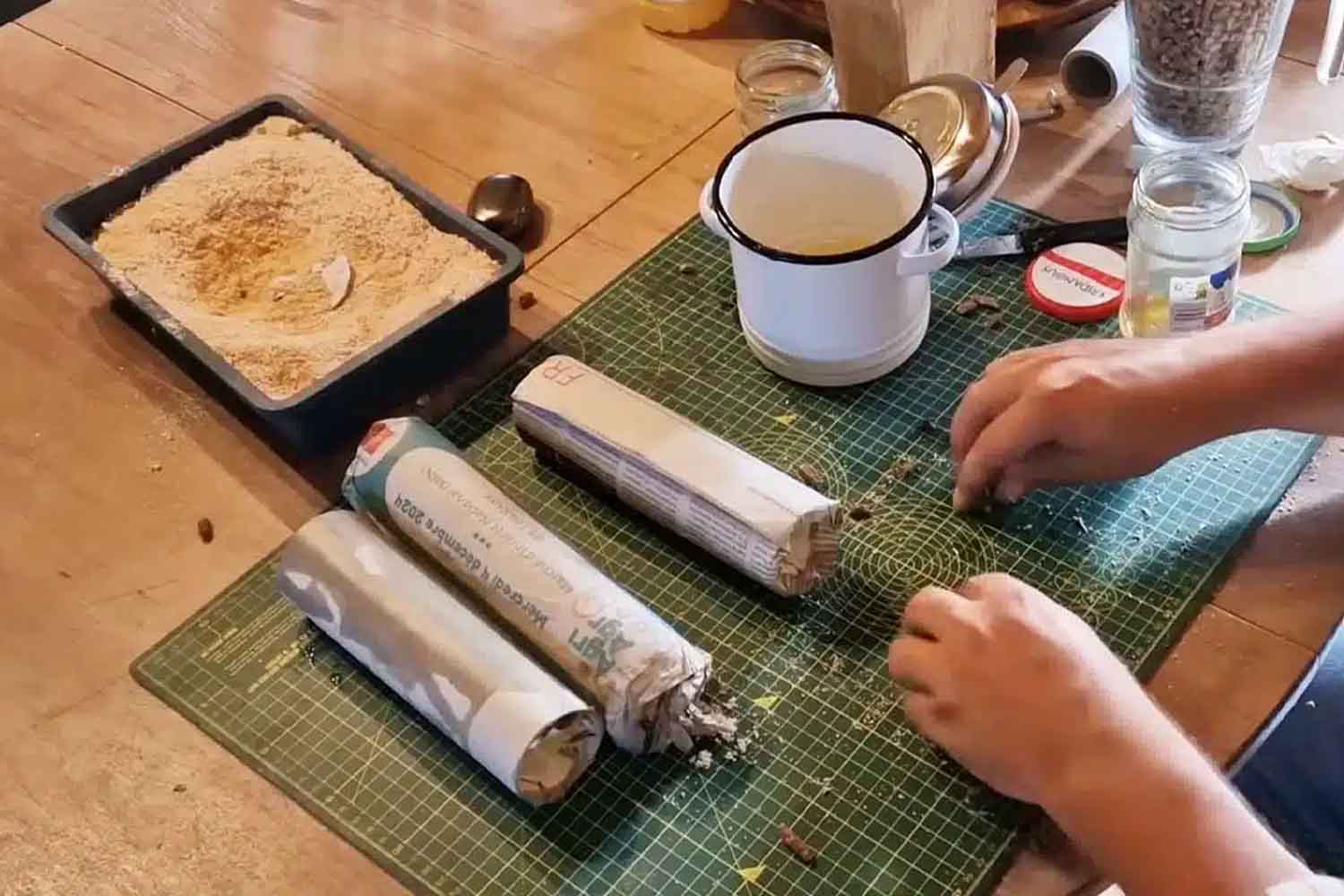
Every winter the topic of home heating returns to have a concrete weight in daily life, between increasingly higher energy costs and a growing attention to reducing waste. The wood fire remains, for many families, a practical and rooted choice, linked to the idea of direct and immediate heat. In this context comes a practice that is arousing curiosity even outside the most experimental environments: the production of fatwood from domestic waste, in particular kitchen waste normally destined for disposal.
This is not an alternative solution to traditional heating, nor a practice to be adopted without awareness. Fatwood should rather be read as a recovery experiment, useful for understanding how much energy potential is wasted on a daily basis and what limits need to be respected.
What is fatwood
The fatwood principle is simple and intuitive. Used food fats, such as frying oil or cooking residues, have a very high calorific value. If absorbed by dry and easily combustible materials, they can transform into an effective support for combustion.
Cardboard, paper, egg containers, sawdust or wood chips are used as an absorbent base. Once impregnated with exhausted fat, these materials become a fuel capable of releasing a quantity of energy comparable to that of a traditional log of wood, despite starting from household waste. In this way, a problematic waste such as used oil is valorised, reducing waste and partially closing the resource cycle.
From an energy point of view, the most cited data is significant: 100 grams of used edible oil corresponds to approximately 1 kWh of energy, the equivalent of the consumption of an electric radiator turned on for an hour. Information that helps to understand the interest in fatwood, but which must not make us forget the critical aspects.
How fatwood is produced and why its use must remain occasional
Making DIY fatwood is accessible, but requires attention. Only fats already used in cooking are used, absolutely avoiding new oils. The absorbent material is compacted or rolled around a cardboard support, creating a structure capable of retaining fat. The used oil is poured in slowly, allowing enough time for it to be absorbed evenly.
After a few hours of rest, the fatwood is dense and ready to be stored in a suitable container, away from humidity. Its use, however, must be limited to a support role, placing it exclusively on a fire that has already started.
The combustion of grease-impregnated materials can in fact generate more smoke and more residues than traditional wood. If used improperly, greasy wood can encourage scale buildup in ducts and increase the risk of harmful emissions. It is for this reason that this practice is advisable only in the presence of fireplaces and stoves that are perfectly clean and subjected to regular maintenance.
The regulations on biomass heating impose controls precisely to limit the environmental impact and risks for home safety. Inserting non-conventional fuels without due precautions can worsen the quality of the air and compromise the correct functioning of the systems.
Fatty wood, therefore, does not represent a definitive solution nor without critical issues. It is rather an interesting idea, which invites us to reflect on how we manage waste and how much potential energy we continue to underestimate in daily life.
You might also be interested in:
