
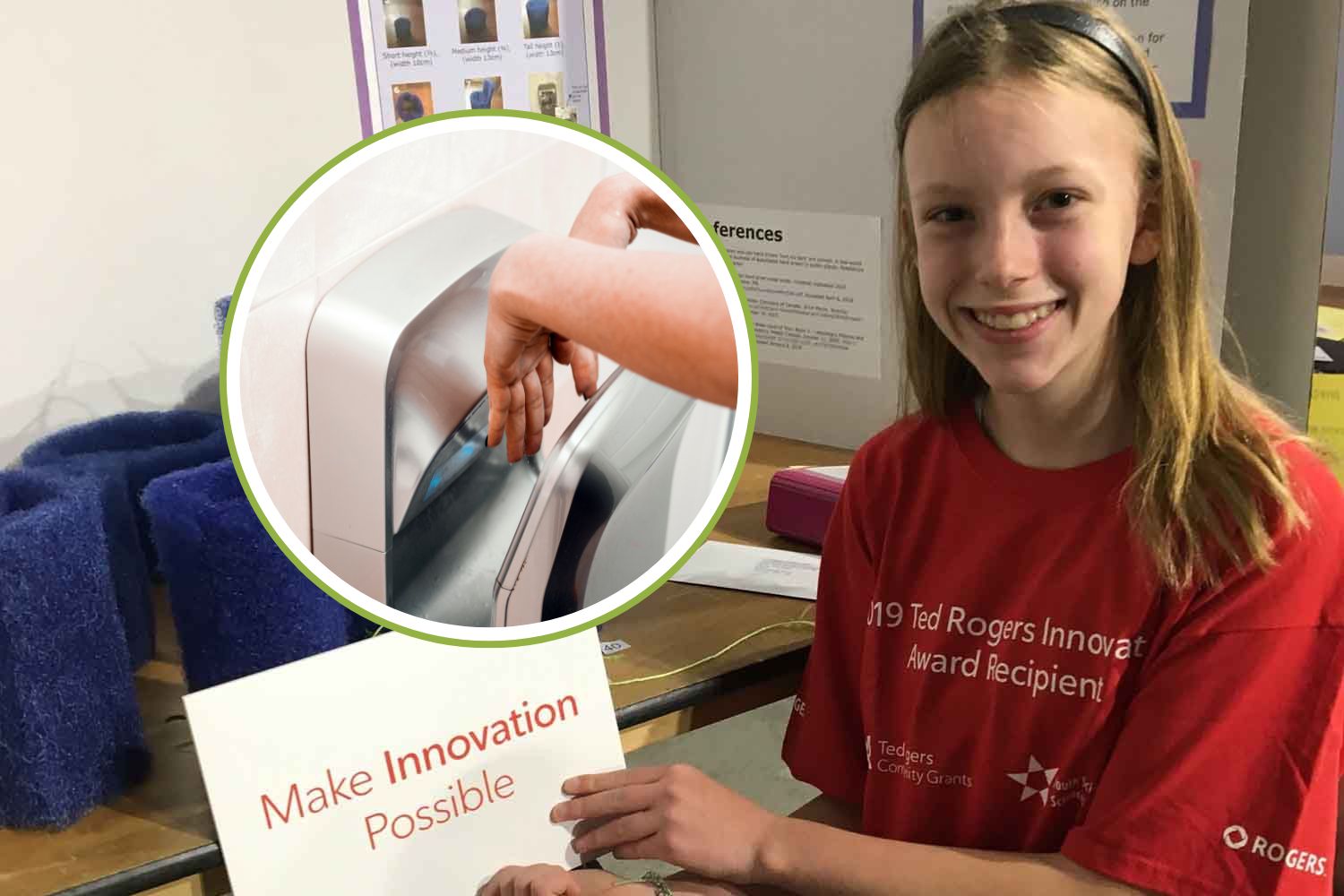
In the bathrooms of shopping centres, airports and restaurants, there is a scene that repeats itself: a child approaches the sink, washes his hands, looks at the hand dryer and freezes. Hands on ears, shoulders raised. Eyes closed waiting for it to end. Many adults smile. They think it’s an exaggeration. Yet, that grimace tells something very concrete.
The story comes from Canada and features Nora Keegan, who was only 9 years old when she started asking herself a specific question: do hand dryers hurt children’s ears? Years later, his research was published in the scientific journal Pediatrics & Child Health.
When a nuisance becomes scientific research
Nora lives in Calgary. It all started from a simple feeling. After using the hand dryers, her ears felt burning. A short, intense pain, difficult to explain. In public bathrooms he observed other children covering their ears in the same way.
He decided to understand and looked for information on how companies measure the noise of their devices. Unfortunately, she found generic statements, so she chose to measure herself. For over a year he visited public toilets frequented by families in his city. For each hand dryer he took 20 measurements. She collected data patiently, accompanied by her father who transformed those outings into small scientific missions.
The results revealed a precise reality. Many devices exceeded 100 dBa. In Canada that threshold represents the maximum limit allowed for toys. At 100 dBa prolonged exposure may pose a hearing risk after approximately 14 minutes. The height of hand dryers installed in public places often coincides with that of children’s ears. The sound arrives direct, powerful, sudden.
Listening to children changes your point of view
As mentioned, in 2019 the study was accepted and published by Pediatrics & Child Health for its clarity and originality. Experts have recognized the value of a young look at a little-explored topic.
Lauren Durinka, a pediatric audiologist at Nationwide Children’s Hospital, highlighted an important point. The companies’ tests take place in controlled environments, but public bathrooms have different acoustics: the walls amplify the sound. The most delicate point concerns childhood hearing loss. Repeated exposure to loud sounds affects hearing over time. Children live in an environment already saturated with sound stimuli. Every additional source weighs.
This story is striking for a reason that goes beyond the numbers. He talks about how often we tend to reduce children’s complaints to tantrums. After four years of work, Nora said that seeing her study published was incredible, especially considering that she started when she was little more than a child: today she dreams of becoming a scientist.
And while a young mind charts the course that could lead to a future full of success, adults can stop to reflect on an important factor: never underestimate a child’s discomfort.
You might also be interested in:
