
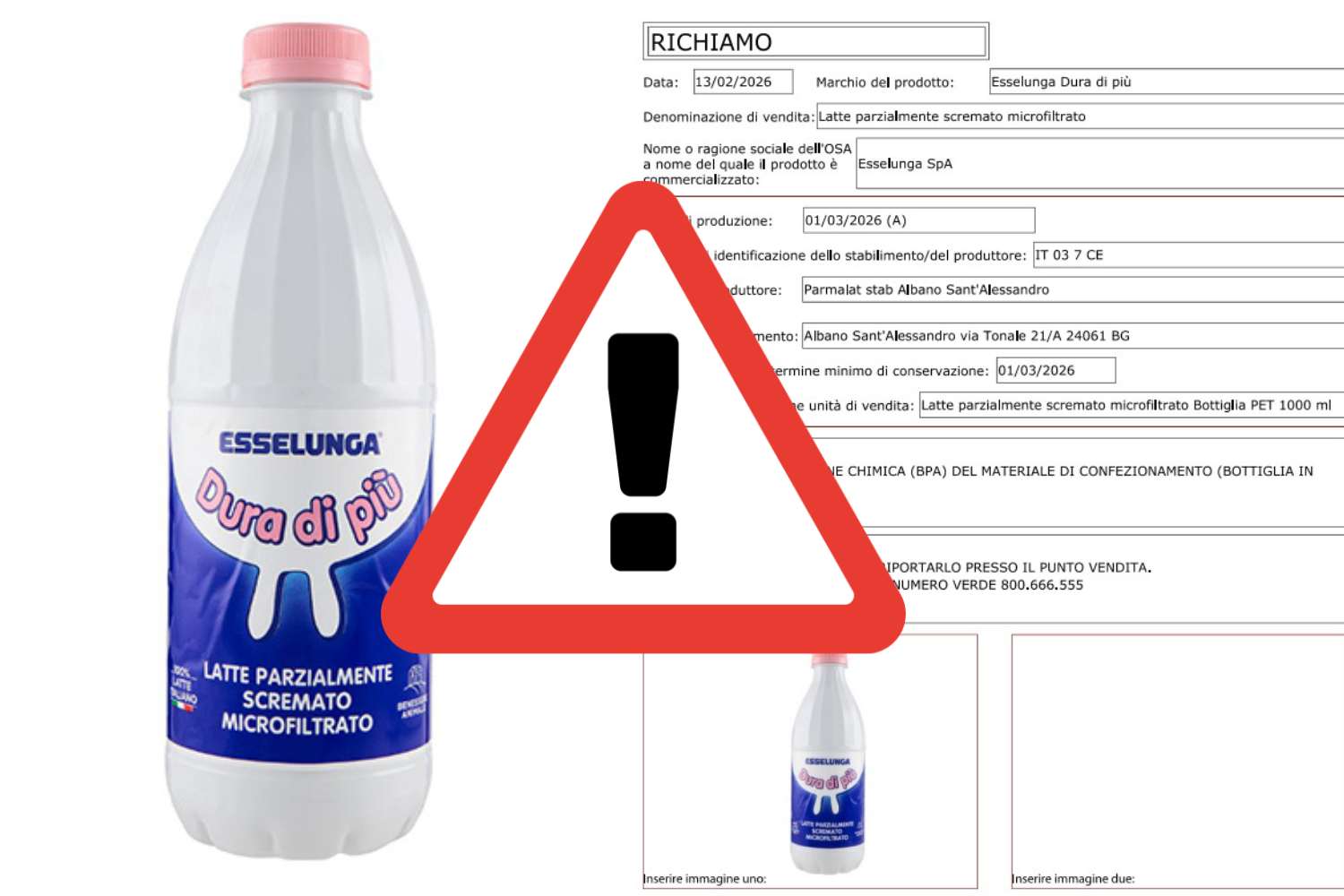
New food recall in Italian supermarkets. The Esselunga chain has announced the withdrawal, as a precaution, of a batch of microfiltered partially skimmed milk under the “Dura di più” brand due to possible chemical contamination linked to the material of the bottle.
The recall concerns 1 liter bottles of partially skimmed microfiltered milk with expiry date 1 March 2026, corresponding to batch 01/03/2026 (A).
The product was made by Parmalat in the Albano Sant’Alessandro plant, in the province of Bergamo (IT 03 7 CE identification mark).
The alert does not concern other batches or other expiration dates of the same product.
The measure is based on the suspicion of the presence of bisphenol A (BPA) in the packaging material, i.e. in the PET bottle.
What is BPA
BPA is a chemical substance belonging to the bisphenol family, used in the past in the production of plastics and resins. For some time at the center of scientific attention due to its possible effects as an endocrine disruptor, it has been progressively limited until it was banned in materials intended for contact with food in the European Union, introduced with Regulation (EU) 2024/3190, fully applicable from 2025.
Precisely in light of this regulatory framework and the precautionary principle, the batch was withdrawn from the market to avoid any potential risk for consumers.
What consumers should do
Anyone who has purchased milk with the indicated batch is invited not to consume it. You can return the bottle to the store where it was purchased to obtain a replacement or refund. For further clarifications, the chain offers the toll-free number 800 666 555.
This episode brings the topic of materials and objects in contact with food (MOCA) back into the spotlight, often underestimated but crucial for food safety. Even when the content complies with standards, any critical issues in the packaging can represent a problem.
In recent years the European Union has strengthened controls and updated legislation to reduce the population’s exposure to potentially harmful substances. The case of Esselunga milk demonstrates how important constant monitoring is along the entire supply chain, from the producer to the supermarket shelf.
