
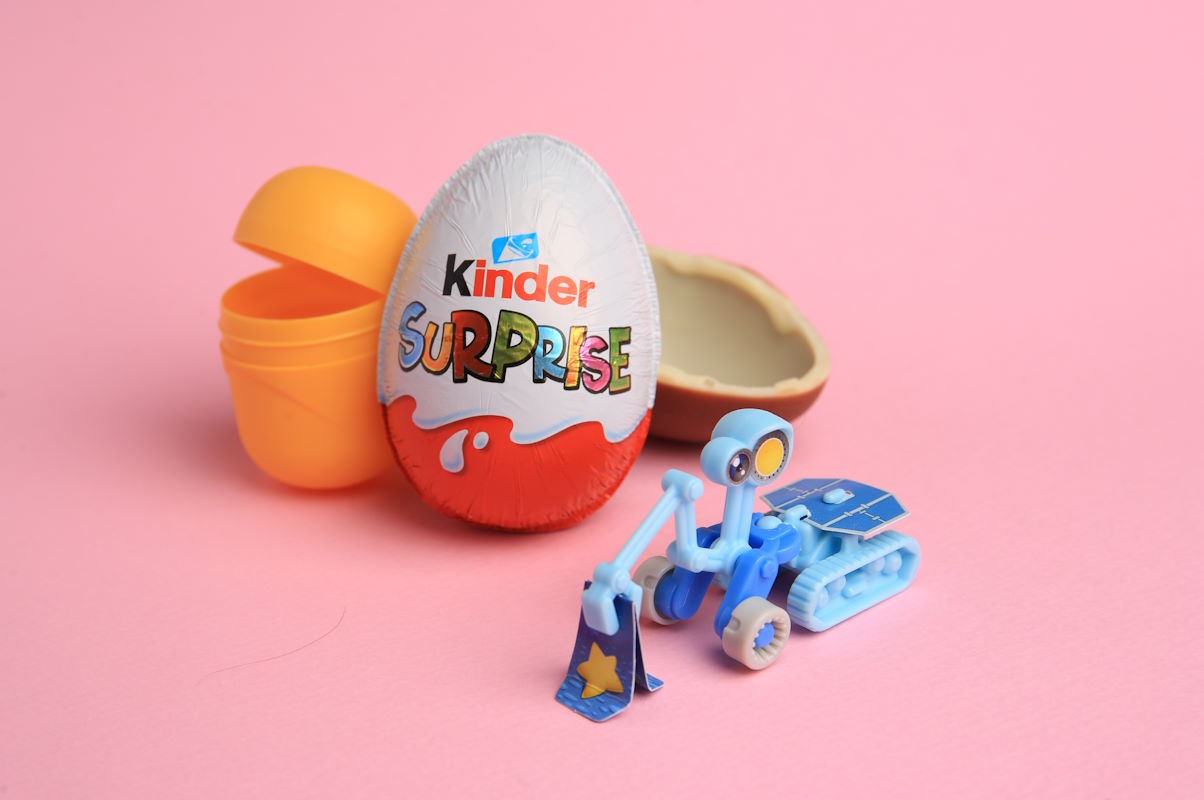
Raise your hand if you don’t know the Kinder egg which, with its sweetness and its nice surprises, has won the hearts of thousands of children (and not only) for years.
But do you know the story behind this small, tasty gift and, above all, have you ever wondered what the plastic cup inside the egg represents (not surprisingly yellow/orange in colour)? Let’s see together.
The origins
The idea of the Kinder Egg was born in 1974 from the mind of Michele Ferrero, patron of “Ferrero” inventor of other famous confectionery products exported all over the world – starting with Nutella.
In just a few years, this product had enormous diffusion. Today it is sold in over 100 countries and represents one of Ferrero’s most successful products.
The idea behind the Kinder egg is very simple: combine a tasty snack (the chocolate egg) with a fun game (the surprise) – all enriched with the joy of breaking a wrapper and the curiosity of discovering what’s inside.
Ferrero’s desire was to bring the joy of Easter to children every day, not just once a year, with a miniature of the classic Easter chocolate egg.
The surprise
The surprise contained in the Kinder egg and, by extension, in the Easter eggs, goes beyond the simple toy. It represents the element of mystery and expectation that characterizes the Easter holiday, a moment of joy and hope. For children, the moment of opening the egg is full of excitement, symbolizing the magic of discovery and imagination. This playful aspect stimulates creativity and interaction, making the Kinder egg and Easter eggs a means of creating happy memories and moments of family sharing.
The first surprises inside the Kinder eggs were very simple: plastic men, animal figurines, colorful puppets.
Over time, however, the variety and complexity of the gadgets has grown enormously, including puzzles, mini-games, cartoon characters and much more.
Over the years, important professional figures such as engineers, graphic designers and creatives have also collaborated in the design and creation of the surprise eggs. An example for everyone is Andrea Princivalli, the creative behind more than 200 surprises.
But have you ever wondered why the container containing the surprise has the shape and color we know? The choice, obviously, is not random.
Both the shape and the orange color of the capsule were chosen to recall the color of the yolk of a real egg.
In fact, if we think about it for a moment, the Kinder egg is the size of a chicken egg, and the surprise it contains also imitates this natural model.
Because it is banned in the United States
Few people know it, but the Kinder egg is still officially banned in the United States today. The reason dates back to a 1938 law that prohibits the sale of sweets containing inedible objects. According to American authorities, the capsule hidden in the chocolate represents a potential choking hazard for younger children. Anyone caught bringing Kinder eggs into the country risks a hefty fine. An all-American paradox, if you consider that on the shelves of American supermarkets you can easily find firearms but not a chocolate egg.
Kinder Joy and Kinder Surprise: what’s the difference?
Precisely to circumvent the American ban, Ferrero created the Kinder Joy, now widespread in many world markets as an alternative to the classic egg. The difference is substantial: while the Kinder Surprise encloses the surprise inside a solid chocolate egg, the Kinder Joy is divided into two separate halves. One contains a milk cream with two balls of crunchy wafers, the other houses the toy clearly visible and separate from the food. A solution that has conquered not only the American market, but also many parents around the world for its practicality.
Rare surprises: a collectible world
What few people know is that around the surprises of Kinder eggs there exists a real universe of passionate collectors, known as kinder-ists. On the main online marketplaces, such as eBay, vintage surprises from the Seventies and Eighties are traded and sold which can reach surprising prices: some rare examples have even been sold for over 100 euros each. The most sought after are the first series from the Seventies, the enamelled metal characters and the limited editions linked to particular events or holidays. A parallel and fascinating world that demonstrates how a small plastic object can become, over time, a museum piece.
Collaborations and special editions
Over the years, Ferrero has transformed the surprise eggs into real pop culture objects, thanks to collaborations with the franchises most loved by children of every generation. From Star Wars to Pokémon, from Paw Patrol to Disney characters, special editions have always driven children and adults alike crazy. These collaborations are not random: each partnership is designed to intercept current trends and continually renew interest in the product. The result is that every generation has its own favorite Kinder egg, with its unrepeatable surprise and unforgettable memory.
We also recommend:
