
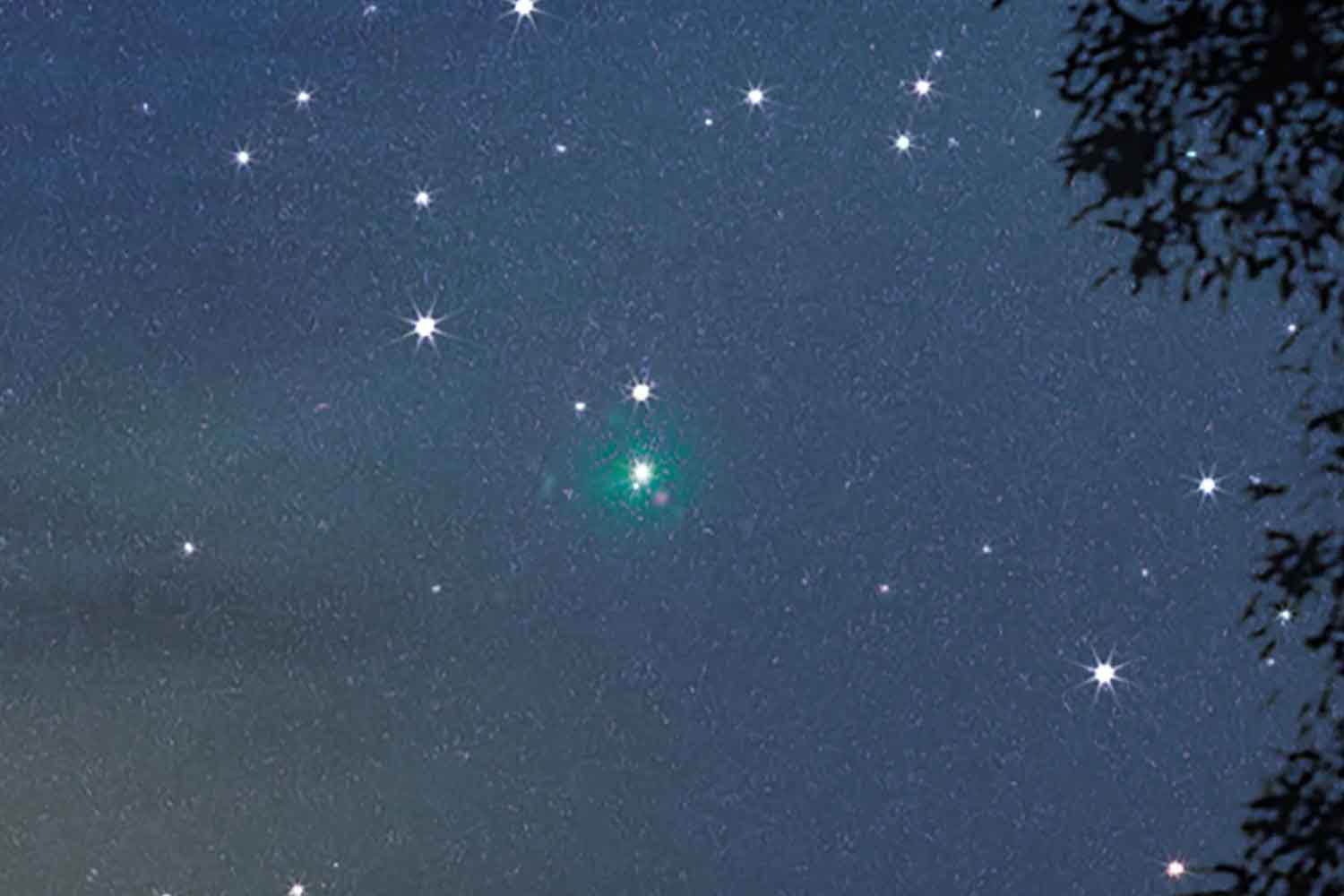
There’s something about comets that fascinates even those who have never pointed a camera at the sky. Maybe they arrive when they want, shine as they want and disappear without saying goodbye. When a bright one appears, the instinct is always the same: “I’ll photograph it”. Then you realize that doing so isn’t exactly like immortalizing a sunset at the sea. Yet, every shot of a comet is a piece of history of the Solar System. It’s one way to look at an object carrying billions of year-old ice and dust. A well-made photo can even become a useful piece for astronomers.
Before understanding as photographing a comet, it’s worth telling what happens when everything falls into place. This is the case of the comet 3I/ATLASwhich reappeared after passing behind the Sun and returned to be seen by the long nights of observers all over the world. This time, however, its return was not recorded by titanic cosmic instruments such as Hubble or James Webb, but by the lens of a photographer who always asks for a little more than necessary at night.
Stellar shots from 3I/ATLAS
We are in the Black Desert of Egypt, a place where even the silence seems ancient and the dark hills have the slow pace of sentinels. This is where Osama Fathi he pointed his Nikon Z6 modified for astrophotography and a RedCat pushed up to an equivalent focal length of about 750 mm. It was dawn on November 29, 2025, one of those moments when the real world seems to take a step back to make room for the spectacle of the sky. The comet floated above the horizon like a mark left by someone we will never see: a green thread, faint but firm, revealing the presence of cyanogen in the coma.
Fathi describes it as a suspended meeting. Three in the morning, the wind still, no artificial light to disturb the still air. Around him, only the breath of the desert and that comet which, from another planetary system, had arrived there, just above his head. To capture every detail of the guest, the photographer constructed the final image by combining sixty one-minute shots and another sixty thirty-second shots at ISO 1500. A painstaking patience that allowed him to expose the hair, the lightest nuances, even the almost imperceptible movement compared to the still sky.
Its winter appearance is so gentle that even those with simple instruments – even new generation “smart” telescopes – can find it in a few minutes. Fathi calls her a passing guest. Older than the Sun, destined to leave without leaving any clues. Yet a photograph is enough to feel part of that journey, even if just for an instant. This is perhaps the truest enchantment of astrophotography: you don’t need a rocket, you just need a little darkness, a camera and the courage to wait.
How to photograph a comet
The most ironic part of photographing a comet is that, while you do everything to eliminate the movement caused by the earth’s rotation with a well-aligned mount, it decides to move on its own, almost as if to say: “Chase me, not the stars”. And this, inevitably, complicates things. A bright comet can be shot with an SLR and a normal lens. If it is weaker, you need a telescope with a more sensitive camera. Nothing impossible: just understand that there is no such thing as perfect equipment, but rather the most suitable combination for the comet of the moment.
The real crux comes with the exhibitions. A single exposure of 30, 60 or 120 seconds is usually enough, because the movement of the comet is not yet so evident. But when you start adding more shots – the famous stacking technique, which is the key to obtaining clean, detail-rich images – you find yourself integrating minutes or even hours of cometary motion. At that point the stars remain still, but she stretches out like a snail of light.
The only way to get out alive is to create two separate images: one processed on the comet, one on the stars. It’s almost like managing two parallel realities that you then, in the end, fit together into a single coherent image. Many software can help you: DeepSkyStacker, PixInsight, Astrometriceven Gimp or Photoshop if you know where to put your hands.
The most delicate moment remains focusing
Nothing is more unforgiving than a fuzzy comet. To avoid this, use the camera’s Live View, magnified to the maximum. You approach the point of fire, you go beyond it, you go back. You recognize it little by little, like when you finally understand what you’re looking at in an old family photo.
And then there is another important detail: the corrections. THE dark frames eliminate thermal noise. THE flat field they clean shadows and optical imperfections. Nothing poetic, but fundamental if you want the comet to remain the protagonist without halos or suspicious spots around it.
When the image becomes scientific data
If you decide to take it a step further, you discover that you are not just photographing: you are measuring. Short exposures, between 30 and 120 seconds, are used to obtain reliable photometric or astrometric data. In these cases you have to choose whether to align yourself with the stars or the comet, already knowing that one of the two elements will be a little difficult. The most advanced techniques even allow you to isolate the comet by eliminating the stars from each frame, and then reconstructing the star field separately. A kind of digital surgery, useful when you want a clean and precise measurement.
If the photograph convinces you, you can send it to British Astronomical Associationformatting the file name rigorously – a kind of image identity card – and indicating scale, orientation and date. Scientists care: comets are very primordial materials, preserved in the cosmic frost from an era when the Solar System was still taking shape. And every observation, even yours, can reveal something about their business.
Here we get technical, but everything remains accessible. To measure the position of the comet, CCD cameras and precise scales are used, calculated with the formula that links focal length and pixel size. Plate solving is carried out, the catalog stars are recognized and the exact point where the nucleus is located is deduced. At that point the software generates the file according to the standards of the Minor Planet Centerthe world archive that collects all measurements of comets and asteroids.
Photometry: understanding how much it shines
Brightness is measured using FITS images aligned in two different ways: one on the coma and one on the stars. The program Comphot it processes the data via a command that seems like something out of an old video game, but it works.
The most used filters are V and R, because they separate the reflected light from that emitted by the gases in the coma. It is an important distinction to understand how the comet evolves and how it behaves in the following hours and days.
And this, ultimately, is the heart of everything: you can approach a comet with the amazement of someone looking at the sky for the first time, or with the patience of someone who wants to follow its breathing. In both cases, photograph a comet it means being present in the exact moment in which a fragment of the remote past decides to show itself. And this is already a good reason to try.
