
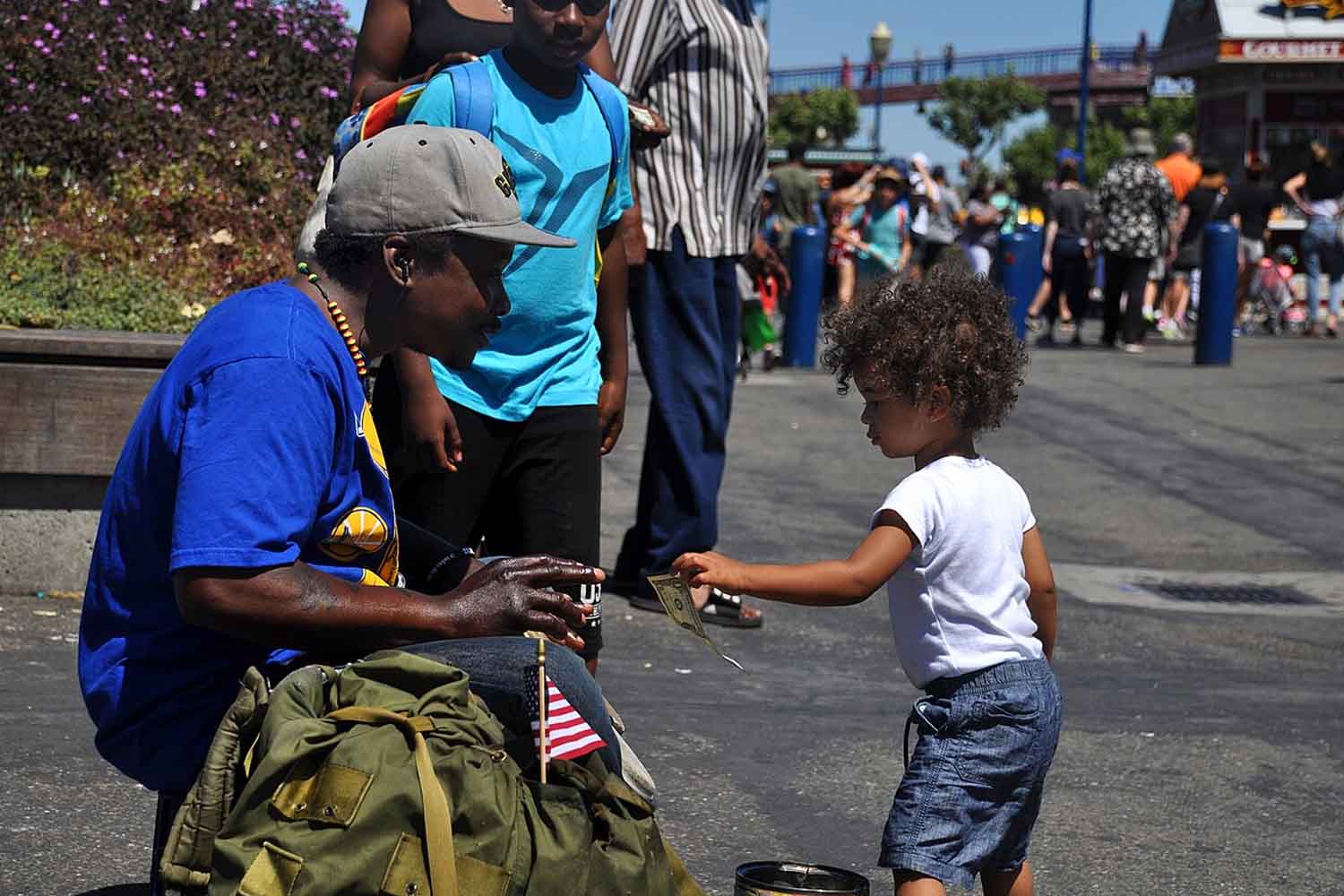
Are we really kind people by nature or do we become so based on the context in which we live? It’s a question that sounds almost provocative. Yet new scientific research forces us to look in the mirror more honestly: scarcity could make us more generous.
A study published in Nature Communications suggests that our willingness to help others is not as stable as we think. Indeed, it seems to vary significantly depending on the environment around us. When “good” opportunities abound, we tend to think more about ourselves. However, when alternatives are scarce, we become surprisingly more altruistic.
A discovery that also says a lot about the society we live in.
When there are few alternatives we are more willing to help
The work, conducted by researchers at the University of Birmingham, involved over 500 people in three different experiments. The idea was simple but powerful: observe how the propensity to help someone changes when the context offers many advantageous opportunities or very few.
Participants were asked to watch a nature documentary while opportunities to earn rewards appeared on the screen. They could choose to focus on their earnings or make physical effort – such as holding a device with their hand – to generate a reward intended for a stranger.
This is where environmental manipulation comes into play. In some conditions high-value rewards were frequent and easily accessible: a “rich” environment. In others they were rare and modest: a “poor” environment. In poor contexts, generosity increased significantly. In rich contexts, however, it decreased. In other words, when we have a “buffet” of opportunities that are interesting to us, we are less inclined to stop for others. However, when alternatives are scarce, helping becomes a more likely choice.
The mechanism resembles that observed in animals: in a habitat rich in food, only the best prey is selected, in a poorer one, what is found is accepted. We too, it seems, apply a similar logic in social relationships. Professor Patricia Lockwood, senior author of the study, explained that this is the first robust demonstration of the impact of the environment on helping decisions. An element that we often underestimate when we talk about altruism.
What do we give up when we decide to help someone
Every kind gesture involves a sacrifice. It’s the so-called opportunity cost: if I stop to help, what am I giving up? Research shows that in poor contexts this perceived cost is lower. If the alternatives are not particularly advantageous, helping weighs less. In rich contexts, however, giving up an interesting opportunity for ourselves becomes more difficult.
Be careful though: the participants still showed a preference for themselves. The so-called self-bias remains present. Helping is never completely neutral. Dr. Todd Vogel, first author of the study, points out that understanding how the environment influences our decisions is critical to understanding how communities function. Because helping behaviors are not a detail: they are the basis of social cohesion.
The role of individual differences is also interesting. Those with higher levels of empathy or utilitarian moral beliefs perceive help as less costly and are more willing to stop what they are doing to support someone else. Anxiety and depression, however, do not seem to have a significant impact.
And then the question becomes inevitable: in a society where we are constantly bombarded by opportunities, stimuli, earning potential and self-fulfillment, how much space is left for spontaneous kindness? Perhaps scarcity is not just an economic condition. It is also a state of mind. And in certain cases it can open unexpected doors to humanity.
You might also be interested in:
