
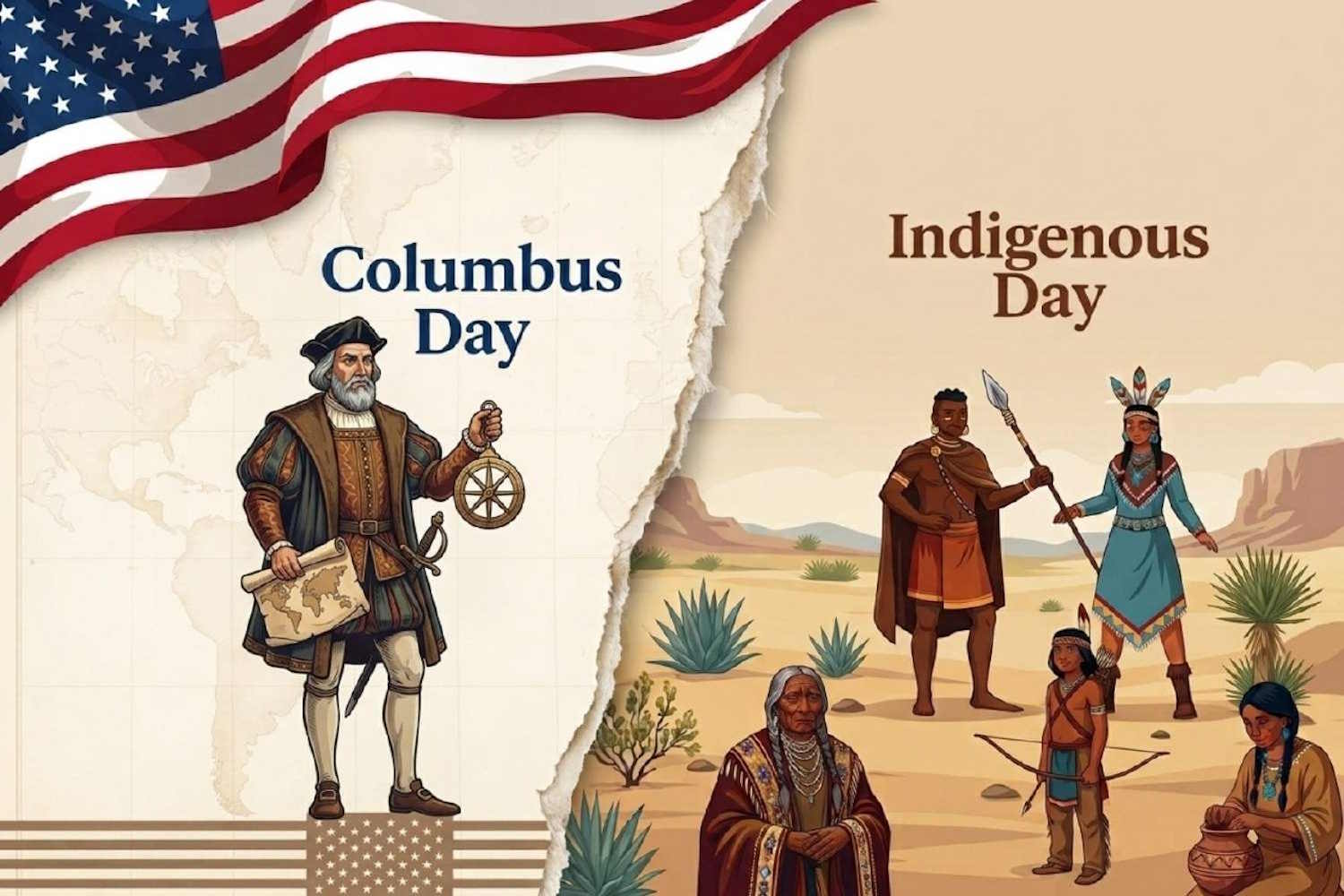
Every October 12th one of the best known dates in the world returns to history books, newspapers and celebrations: the Columbus Dayin honor of the “discovery of America”. It is the day in 1492 when Christopher Columbus reached the Caribbean, starting an encounter that would forever change the history of entire continents.
But there is a question we rarely ask ourselves: can we really “discover” a land where millions of people already live? For Europeans of the 15th century, those reached by Columbus were hitherto unknown lands. For the people who lived there, however, they were home. Places with names, languages, cultures, traditions, knowledge systems and a history that certainly did not wait for the arrival of the caravels to begin.
Let’s try, therefore, to change perspective at least once, because what we are used to calling America also has another name: Abya Yala. An expression that, perhaps, we have never heard of, but which tells much more than a simple geographical question.
What does Abya Yala mean?
Abya Yala is an expression that comes from the language of the Guna people (also Kuna or Cuna), originating from the territories that are now part of Panama and Colombia. In its Abiayala form, it is commonly translated as “land in full maturity”, but there are also interpretations such as “living earth”, “land of lifeblood” or “continent of life”.
They are translations that convey different nuances of a concept deeply linked to the territory and culture from which it comes. The term was then adopted by various indigenous movements to indicate the whole of the Americas, from North to South, and is therefore an expression linked above all to the movements for the rights of indigenous peoples that developed in the twentieth century, a symbol of identity, belonging and self-determination.
Calling those lands Abya Yala means, for those who choose to use this name, looking at them through a perspective that does not begin with the arrival of the Europeans. The purpose? Keep in mind that those territories existed, were inhabited and already had their own history long before 1492.
So why do we call that continent America?
The word Americait is clear, was not chosen by the peoples who inhabited the continent, but appeared in 1507 on a geographical map created by the German cartographer Martin Waldseemüllerwho wanted to pay homage to the Florentine navigator Amerigo Vespucci (who contributed to making Europeans understand that the lands reached across the Atlantic belonged to a continental mass distinct from Asia).
The famous map of 1507, today preserved at Library of Congress in the United States, it is considered the first known cartographic document in which the name appears Americainitially referring to the southern part of the continent. A name destined to establish itself in the following centuries, until it became the one with which the whole world would identify those lands. Ergo: the name with which we today identify an entire continent was born from the gaze of those who arrived there from outside, not from that of those who already lived there.
In short, tell the story Columbus Dayon October 12, 1492, solely as a major exploration undertaking means leaving out a key part of history. The arrival of Columbus indeed represented a turning point for European geographical knowledge and opened a new phase of relations between continents, but it also marked the beginning of a long process of conquest and colonization, accompanied by violence, exploitation, territorial expropriations, cultural impositions and the spread of diseases that caused a devastating collapse of the indigenous populations.
Before the arrival of Europeans, the Americas hosted numerous and profoundly different societies. From the large urban centers of the Mesoamerican and Andean civilizations to the communities of the Amazon, from the Caribbean populations to the peoples of the northern regions, there existed commercial networks, agricultural knowledge, spiritual traditions, languages and systems of social organization. Not an empty continent waiting to be discovered, but a world already inhabited, known and transformed by its people. And it is precisely this awareness that has fueled, especially in recent decades, the request to rethink the way in which October 12th is remembered, so much so that in various places in the Americas, alongside the celebrations linked to Columbus or in place of them, the Day of Indigenous Peoples has established itself, dedicated precisely to their history, cultures and above all to their contemporary presence.
As the Smithsonian National Museum of the American Indian reminds us, the meaning of this anniversary is also to overcome a narrative that relegates native populations exclusively to the past, recognizing the communities that still continue to safeguard, transform and reclaim their traditions today.
Cortes, H. (1524). Map of Mexico City in Nuremberg. @Edward E. Ayer Digital Collection (Newberry Library)
In any case, talking about indigenous peoples of the Americas does not mean talking about a single culture, since each community has its own history, its own language and a specific bond with the territory. In tradition Nahuatlfor example, we find the term Anáhuaclinked to the territory of central Mexico and the cultural world of the Nahua peoples, including i Mexica. In the Andean tradition, Tawantinsuyu was the name of the territorial and political organization of the Inca Empire, while Pindorama it is a term of Tupi origin used to recall the lands of present-day Brazil.
They are different names, born from different worldviews, which remind us of a fundamental thing: there is not a single indigenous voice, but a plurality of peoples who have the right to tell their own story. AND Abya Yala it does not erase this diversity: for many organizations that have adopted it, it instead represents a way to build common ground, without giving up local identities. And not only that: for many indigenous communities, the territory is not just a space delimited by administrative borders or an economic resource to be exploited. It is also the place where knowledge is passed down, relationships are built, memories are preserved and a sense of belonging develops.
This means recognizing that there are different ways of understanding our relationship with the land, which is especially important today, as many indigenous communities find themselves defending their territories from the expansion of extractive activities, deforestation and other economic and environmental pressures. For these populations, defending a forest, a river or a territory also means defending a language, a tradition, a collective memory and the possibility of continuing to live according to their own choices.
Why knowing the word Abya Yala is important on October 12th
Knowing this expression does not mean erasing Christopher Columbus from books, denying the importance of geographical explorations or rewriting the past to adapt it to the present, but – rather – adding to the historical tale the perspectives of people who for centuries have had less space to tell it.
It means understanding that the history of 1492 changes profoundly depending on the point from which we observe it. For those who crossed the Atlantic, it was the arrival in unknown lands. For those who already lived on those lands, it was the beginning of profound, often dramatic transformations, the consequences of which continue to be felt. And it means remembering that indigenous peoples do not only belong to the history of five centuries ago, but exist today, speak living languages, produce culture, defend rights and participate in the debate on the future of the planet.
Ultimately, this is the strength of a word like Abya Yala.
What Mamdani did today
For Columbus Day 2026, the mayor of New York Zohran Mamdani responds to Donald Trump by choosing to celebrate not Christopher Columbus, but Vito Marcantonio, a historic Italian-American deputy committed to the defense of workers and civil rights.
View this post on Instagram
Mamdani also recalled the discrimination and exploitation suffered by Italian immigrants, contrasting their contribution to the city with Trump’s rhetoric in defense of Colombo.
Sources: Harvard University / Hildesheim University – Abya Yala y Latinoamérica: Nombrar para philosofar desde el territories / Temas de Nuestra America – About the name Abya Yala
