
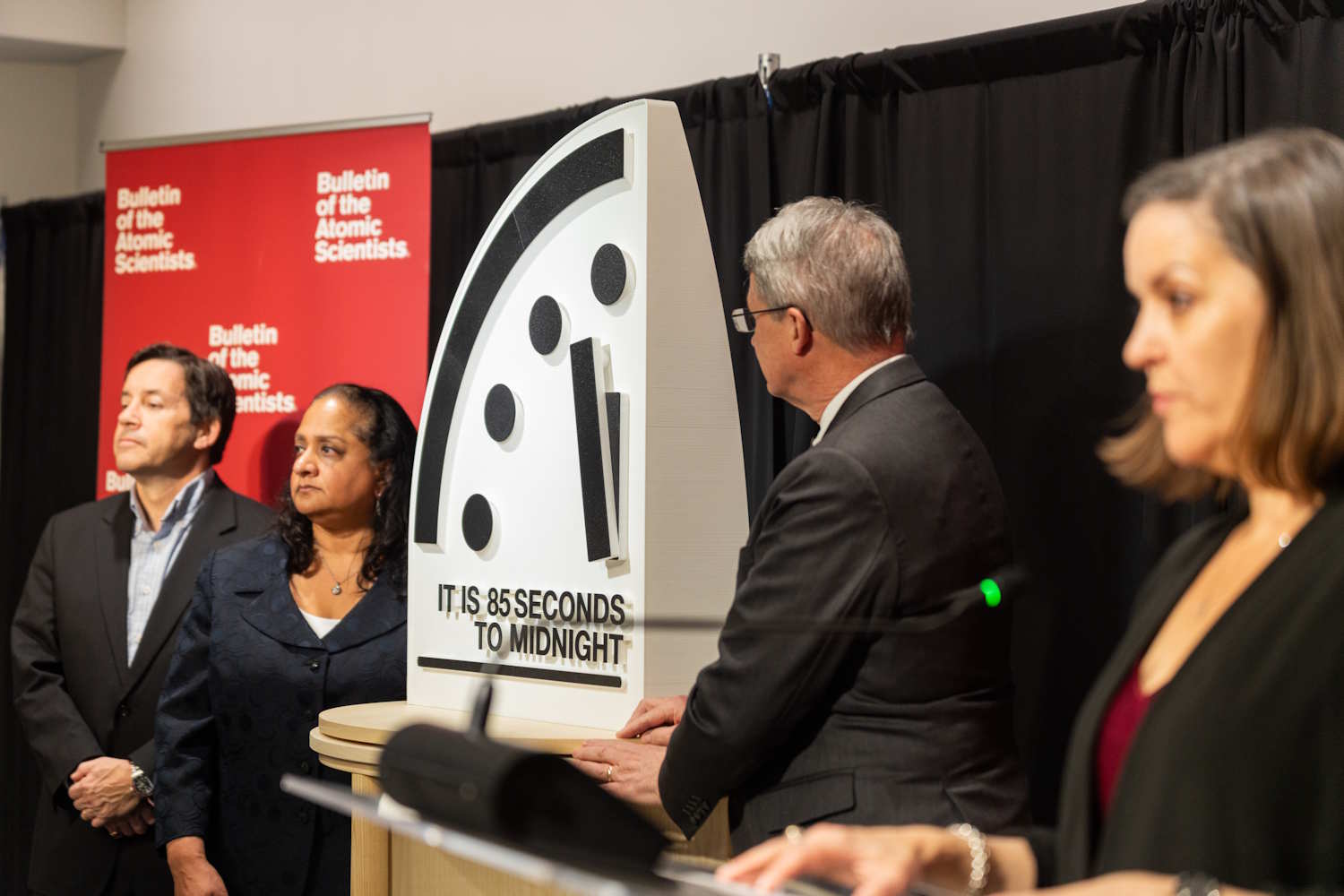
From 100 to 90, from 90 to 89, up to 85: this year there are so many seconds that separate us from the midnight of the world. According to the Doomsday Clockthe Doomsday Clock, in short, global self-destruction is just over a minute away. And whose fault is it? But of Russia, China, the United States – obviously – and other countries that become “increasingly aggressive, adversaries and nationalists”.
The scientists themselves declared this – one year into Trump’s second term Bulletin of the Atomic Scientists‘ Science and Security Board (SASB) which, in consultation with the Board of Sponsors (which includes eight Nobel Prize winners), created the Clock. For 2026, experts cited the risks of nuclear war, the climate crisis, the potential misuse of biotechnology and the increased use of artificial intelligence without adequate controls.
The message of the Doomsday Clock cannot be clearer. Catastrophic risks are rising, cooperation is declining, and time is running out. Change is both necessary and possible, but the global community must demand swift action from its leaders, says Alexandra Bell, president and CEO of Bulletin of the Atomic Scientists.
What is the Bulletin of the Atomic Scientists
Founded in ’45 by Albert Einstein, J. Robert Oppenheimer and scientists from the University of Chicago, it is a council of experts that since 1947 in consultation with its Board of Sponsors (cwhich includes 9 Nobel Prize winners), marks the time remaining until a possible global catastrophe. Theirs is essentially a warning to reflect on the risks we run due to various human threats.
At the end of the Cold War, it was 17 minutes until midnight. In recent years, to address rapid global changes, the group has shifted from counting the minutes until midnight to counting the seconds.
Because the Doomsday Clock was set to 85 seconds from midnight
A year ago, we warned that the world was dangerously close to a global disaster and that any delay in reversal increased the likelihood of catastrophe. Instead of heeding this warning, Russia, China, the United States and other major countries have become increasingly aggressive, adversarial and nationalistic. Hard-won global awareness is collapsing, accelerating great power competition with one another and undermining international cooperation critical to reducing the risks of nuclear war, climate change, the misuse of biotechnology, the potential threat of artificial intelligence, and other apocalyptic dangers, the press release said.
Too many leaders have become complacent and indifferent, in many cases adopting rhetoric and policies that accelerate rather than mitigate these existential risks. Because of this leadership failure, the Bulletin of the Atomic Scientists and Security Board today sets the Doomsday Clock at 85 seconds before midnight, the closest it has ever been to catastrophe.
The result? A more unstable, more dangerous world, more exposed to irreversible errors.
Nuclear: a new arms race
In 2025 it was almost impossible to identify a single aspect in which the nuclear situation had improved, says Jon B. Wolfsthal, director of the Federation of American Scientists (FAS) and member of the SASB.
More and more countries are relying on nuclear weapons not just for deterrence, but as a tool for political pressure. Hundreds of billions of dollars are being invested to modernize and expand nuclear arsenals. And even states that do not possess nuclear weapons are starting to wonder whether they should acquire one. What does it look like? A return to the logic of the Cold War, but without the same rules of containment. And the paradox is enormous: the more you invest in nuclear power, the less safety it produces. Because an arms race cannot be won.
Disruptive technologies
Artificial intelligence, which could be a tool for progress, is becoming another battleground. According to Steve Fetter, PhD, professor of public policy and former dean of the University of Maryland, the political climate in the United States is pushing for AI development without adequate safety guarantees, dismantling rules and limiting the role of universities and independent research.
Climate crisis that continues to be treated as secondary
Inez Fung, professor emerita of Atmospheric Sciences in the Department of Earth and Planetary Sciences and the Department of Environmental Sciences, Policy and Management at the University of California, Berkeley, and SASB member, reminds us of a truth that politicians continue to ignore: without rapidly reducing the use of fossil fuels, climate catastrophe is inevitable.
Renewable technologies are mature, available, economically sustainable. There is no lack of tools, there is no lack of will. And without a science-based climate policy, grounded in shared data and global cooperation, any promise of transition remains propaganda.
Biological threats: between synthetic biology and AI
According to scientists, the capacity to respond to biological emergencies is weakening, while the risks associated with synthetic biology and its integration with artificial intelligence are increasing. We are no longer just talking about natural viruses, but about threats potentially created by man, with unpredictable effects.
The Doomsday Clock is therefore a reminder: disaster is not inevitable. But it becomes likely when political irresponsibility replaces cooperation.
The scientists themselves point to the ways out:
The one indicated by the Clock therefore remains a political and cultural problem. Time is still there, but it keeps getting shorter.
Read also:
