
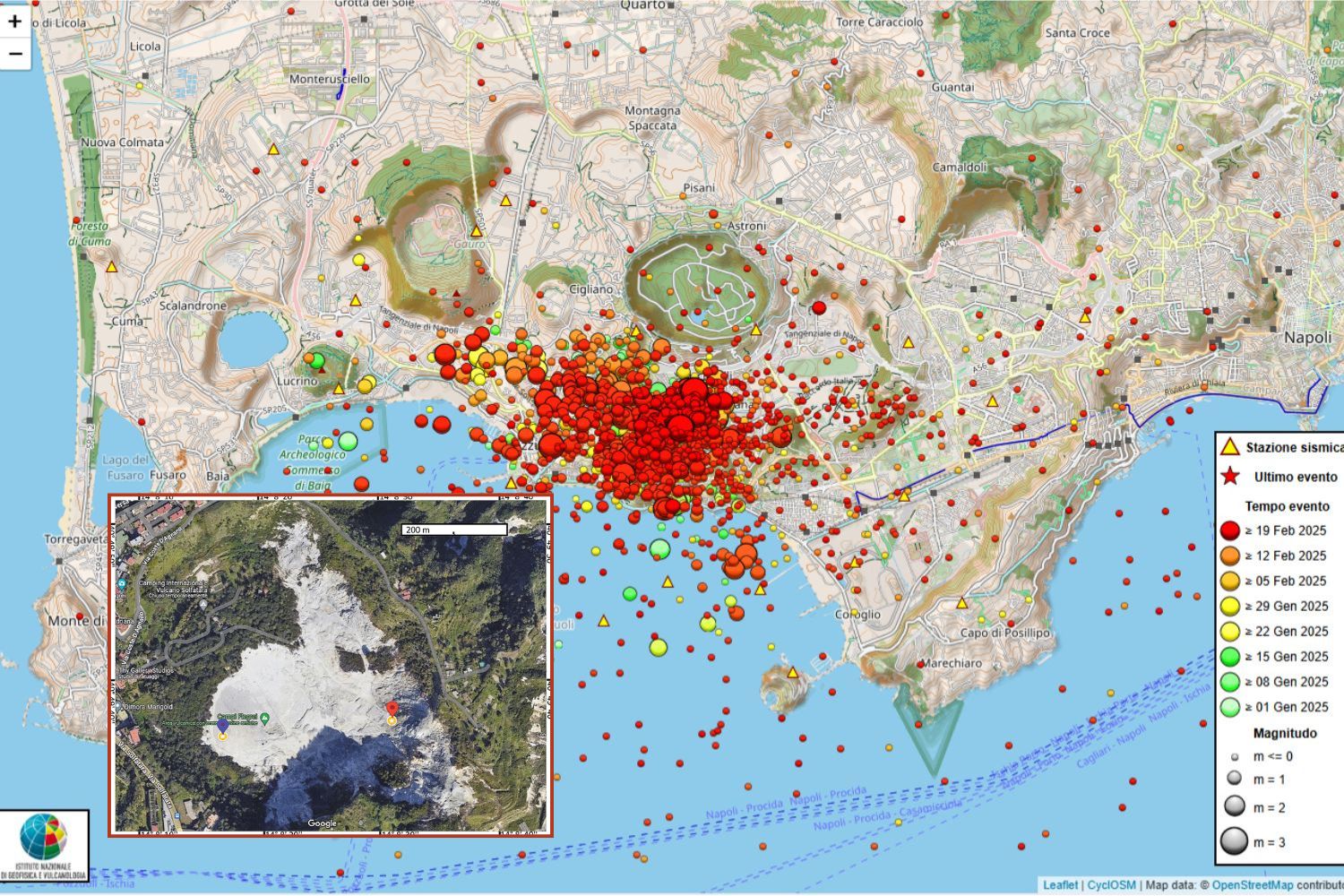
Thermal data of the International Space Station in the Flegrea area to detect the temperature variations that precede the most intense earthquakes.
The new study of the National Institute of Geophysics and Volcanology (Ingv), published on this is based on this Remote Sensing Letterswhich described a method of analysis of the thermal images taken from the International Space Station (ISS).
In particular, the research focuses on the thermal surveys carried out by an instrument installed on the International Space Station, with the aim of improving the alert system for the population, potentially providing a forecast margin for intense seismic shocks.
The study
The main result of the study concerns a phenomenon observed in the days preceding the strongest earthquakes recorded in the Flegrei fields area: the anomalous increase in the temperature at the ground level.
A thermal increase that has been judged significant by scientists, because it seems that the thermal variations detected did not follow natural patterns and they have manifested themselves before Strong earthquakes that hit the area. Although the analysis did not consider the last seismic event, the one recorded on March 13, 2025 with a magnitude of 4.6 (the strongest shock ever recorded in the area), the collected data provide useful indications for understanding geothermal phenomena related to volcanic activity.
The method
The method uses the data collected by the tool Ecostressa NASA-JPL sensor installed on the ISS, which estimates the surface temperature with a spatial resolution of about 70 me frequent steps on the same area around three days. Scientists have generated Two historical temperature series extracted from the thermal images of two areas of the Solfatara between 2021 and 2024. The difference in temperature between the two areas was analyzed with two distinct statistical methods, allowing to compare the anomalies detected with the main seismic events recorded in the area.
We have detected anomalous temperature variations in the emission area of the Solfatara which preceded some earthquakes of greater intensity, with an advance that has been a few days old to a few weeks, explains Alessandro Piscini, Ingv researcher and first author of the article.
On May 17, 2024, for example, an increase in temperature of 5 ° C anticipated the earthquake of magnitude 4.4 by three days. For the magnitude 4.2 event of September 27, 2023, the increase in temperature found on September 21 exceeded 7 ° C. The second statistical method also highlighted temperature anomalies for these two events that appeared respectively on April 12, 2024 and 6 September 2023. Furthermore, the average value of the temperature difference has increased in recent years, consistent with the other signals already observed in the area, such as the raising of soil (bradisism) and the emission of carbon dioxide.
According to the authors of the study, therefore, satellite monitoring could offer a new dimension for monitoring the Flegrei camps, integrating with the current seismic and thermal alert systems. The Caldera, which has always represented one of the most risky areas in Italy for its intense volcanic and seismic activity, could benefit from more accurate surveillance, capable of providing early notices on the most intense potential shocks. Satellite observations, in fact, would allow to obtain more precise data on thermal variations and land deformations, crucial elements to better understand the premonitory behaviors of seismic events.
Sign up for our channels WhatsApp And Telegram
We are also on Google News, Activate the star to insert us among the favorite sources
