

Not only the environment, but also mental health and psyche are affected by the climate crisis. And young people suffer the most, often gripped by feelings of anxiety, distrust and anger towards the future.
This is what emerges from the first survey on eco-anxiety conducted on a large sample of young Italians between 18 and 35 years old, carried out by the European Institute of Psychotraumatology and Stress Management (IEP) on behalf of Greenpeace Italia and ReCommon, with the collaboration of the University Union (UDU) and the Student Network (RdS)
Climate change is not just an environmental problem but has in all respects become an emotional and value crisis that profoundly affects young Italians, impacting the way they imagine the future, daily decisions and even social relationships – explains Rita Erica Fioravanzo, president of the IEP.
The investigation
The data – published in the Journal of Health and Environmental Research – were collected between June and November 2024 with a questionnaire distributed by student associations in Italian schools and universities and online, filled in by 3,607 people.
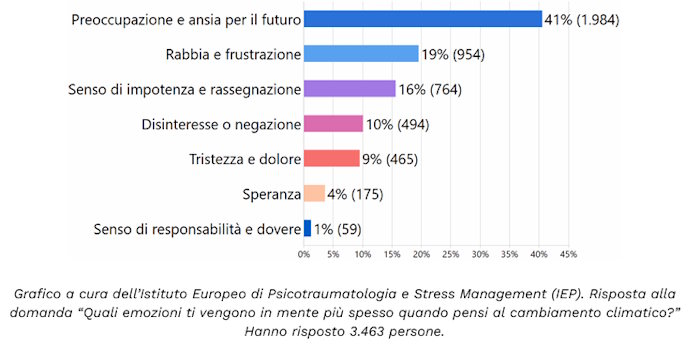
From the answers, it emerges that
The analysis highlights strong links between ecoanxiety and greater general psychological distress, evident not only among young people directly affected by extreme climate events, such as floods and heat waves, but also among those who simply possess an awareness of the climate threat. Young people living in the South and on the Islands are particularly affected, who on average have both more concern about the effects of the climate crisis and, in some cases, more intense psychological symptoms, such as dissatisfaction, rumination and anxiety.
The climate emergency is drastically impacting our lives, with already very visible environmental impacts. This investigation shows that it is also a question of mental health, which we cannot continue to ignore – declares Simona Abbate of the Greenpeace Italia Climate campaign. We ask the government to rekindle hope in the future by acting against the causes of the climate crisis and making its main perpetrators, the gas and oil companies, pay for the damage they are causing with their emissions, as well as guaranteeing concrete support for people’s health, including mental health, threatened by the direct and indirect effects of climate change.
Finally, the analysis shows that the impact of climate change on psychological distress is predominantly indirect and is mediated by three psychological factors: eco-anxiety first and foremost but also pessimism towards the future and, above all, the lack of purpose in life.
Strong distrust, anger and frustration, therefore, characterize the feelings of our children. Isn’t it time we recognized the gravity of their discomfort and addressed it together with the structural causes of climate change?
HERE is the complete document.
