
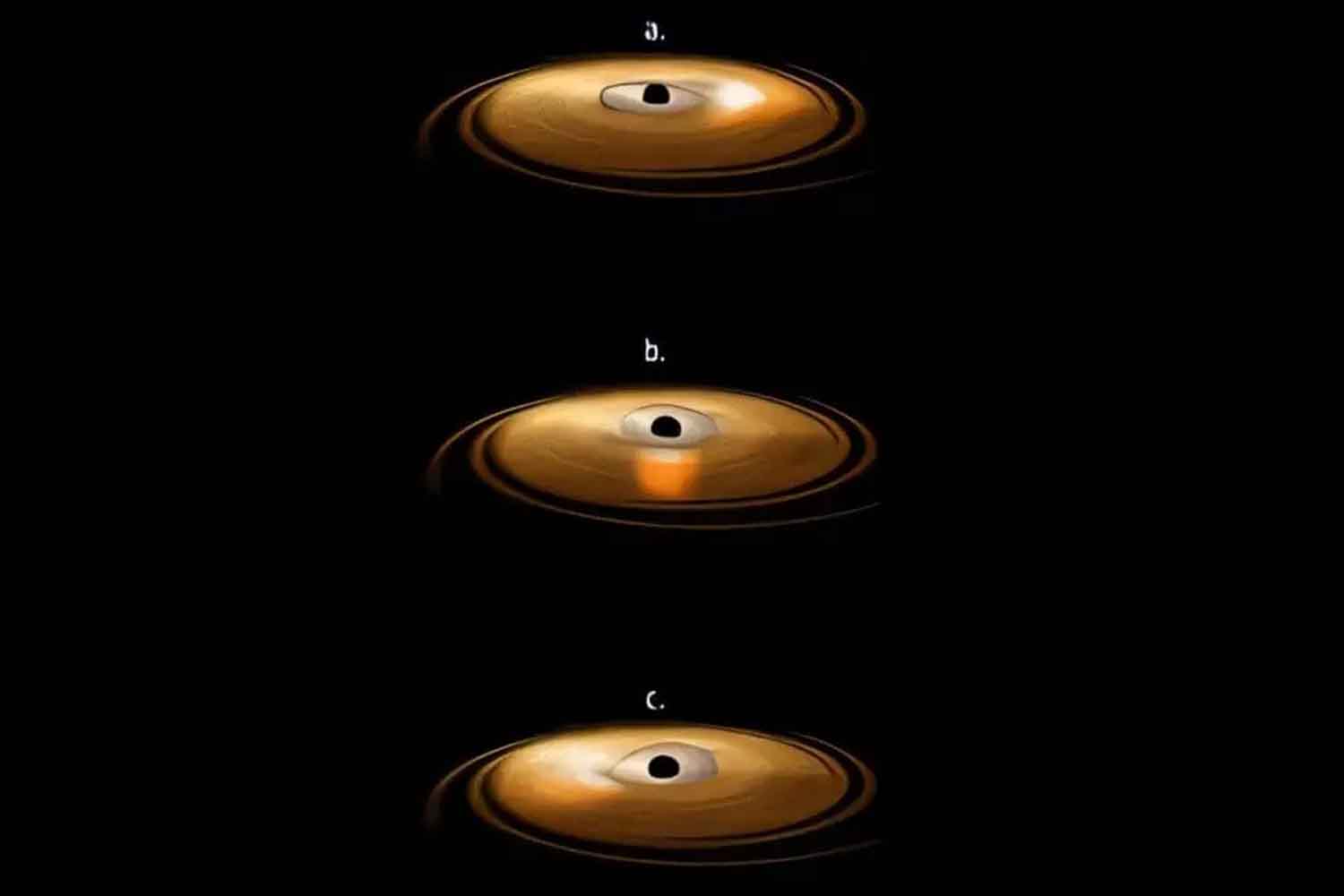
For more than a hundred years it remained only a theoretical certainty, good for physics books and university blackboards. Now, however, it has become a real observation. Astronomers have seen a space-time vortex around a black holeexactly as Albert Einstein predicted. And not thanks to a carefully constructed experiment, but because – or thanks – to the violent end of a star.
It all started when a star got a little too close to a supermassive black hole. It wasn’t a good idea. Gravity stretched it, broke it, and transformed it into a stream of incandescent gas. This type of event also has a specific name: tidal destruction eventin English tidal disruption event. The one observed by astronomers was recorded as AT2020afhd.
After destruction, stellar material does not disappear immediately. Instead, it forms a luminous disk which rotates around the black hole, while some of the matter is ejected into space in the form of very powerful jetsalmost at the speed of light. It is a chaotic, unstable system, but precisely for this reason rich in information.
Scientists have noticed something strange: the light emitted in the X-rays it increased and decreased regularly, on a cycle of approx 19.6 days. Shortly thereafter, radio observations also showed the exact same rhythm. It wasn’t a coincidence. The signals oscillated together, as if the entire system was slowly rocking.
That swing wasn’t just about matter. It was about him space-time.
When a black hole drags space-time and creates an invisible vortex
According to general relativity, a very massive object that rotates on itself does not simply attract its surroundings. It does more: drags space-timedeforming it. This effect is called Lense-Thirring precession and was described mathematically over a century ago, but never observed so clearly near a black hole.
In practice, the black hole acts like a cosmic spinning top. As it rotates, it creates a sort of invisible vortex that forces the disk of gas and jets to slowly change orientation. As the disk tilts, the amount of X-ray light we see from Earth changes. As the jet moves, the radio signal also increases or decreases. Everything follows the same movement, the same rhythm.
Cosimo Inserra, a researcher at Cardiff University and co-author of the study, explained that this observation represents the most convincing evidence ever obtained of the dragging of space-time by a black hole. A gift, he defined it, for physics.
To arrive at this result, the team cross-referenced data from the space telescope NASA Swiftspecialized in X-rays, with those of Very Large Arrayone of the most powerful radio telescopes in the world. In the past, similar events had not been followed long enough on the airwaves, and the phenomenon had simply been missed.
Because this discovery matters, even outside physics books
The value of this observation goes beyond Einstein’s confirmation. By analyzing the data, astronomers discovered that the black hole involved . An important detail, because it calls into question the idea that only the fastest black holes can produce such energetic jets.
Then there is another crucial aspect. The tidal destruction events they last months, not cosmic eras. This means that, for once, we can observe the evolution of a system dominated by a black hole in near real time. According to the researchers, in the future it will be enough to intercept regular oscillations in X-rays to understand when it is worth targeting radio telescopes immediately.
AT2020afhd transformed an abstract prediction into an observed fact. He showed that a black hole can indeed drag space-time around it, as if reality were an elastic substance. And it reminds us that the most important discoveries are often born in moments of chaos, when a star dies and, without wanting to, illuminates one of the deepest secrets of the universe.
The study was published in the scientific journal Science Advances.
