
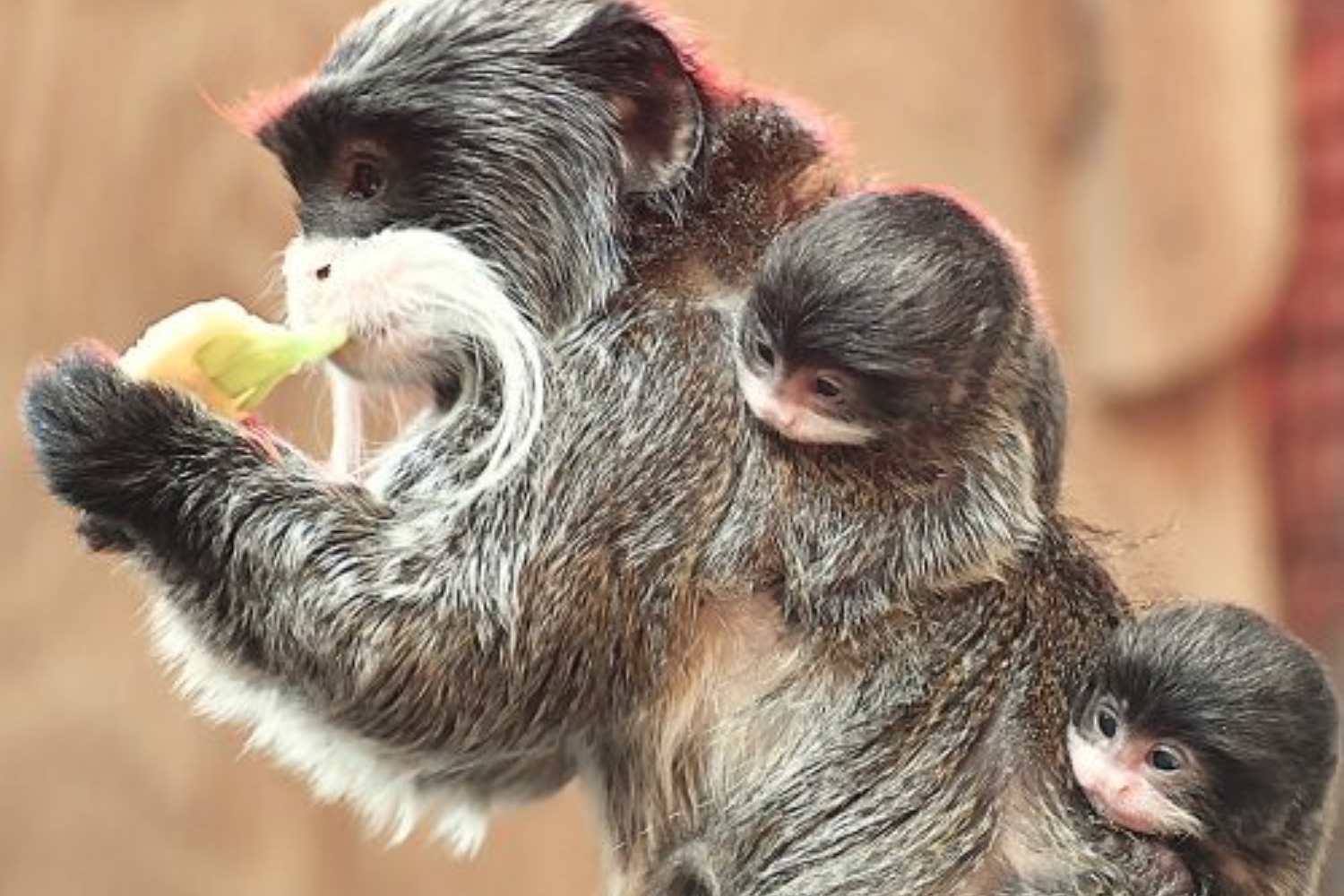
Two emperor tamarin twins were born at the Bioparco in Rome, among the smallest and most curious primates on the planet. The two puppies were born on February 19, but for the moment their sex has not yet been determined. The little ones, the size of a hand, are growing under the watchful eye of their parents Sissi and Franz, while not far away Sofi, the older sister born in 2021 to the same couple, also observes with curiosity. In their enclosed space, newborns spend most of their time clinging to their father’s body, who never lets him out of his sight.
The father who never leaves his children
Among emperor tamarins, the role of the father is surprisingly central. In this species, in fact, the care of the cubs is shared, but the male carries out a decisive task: he carries the cubs on his back for most of the day. Only when the time for breastfeeding arrives does Franz hand the newborns over to the mother. Immediately afterwards he takes them back with him, allowing Sissi to concentrate above all on feeding.
For an animal that weighs about half a kilo, dealing with pregnancy and breastfeeding of twins requires an enormous energy effort. Without the constant support of the male, experts explain, the young would hardly be able to survive.
A rarity in the world of mammals
The behavior of this species tells something fascinating also from a scientific point of view. In mammals, in fact, monogamy and paternal care are extremely rare, present in less than 5% of species.
When the male actively participates in raising children, specific biological mechanisms are activated in the brain that strengthen the family bond. Hormones such as oxytocin and vasopressin come into play, often referred to as “attachment hormones”, which favor the relationship between partner and offspring.
The whiskers that gave the species its name
The emperor tamarin owes its name to a very particular detail: long white mustaches curved upwards, so conspicuous that they recall those of the German emperor Wilhelm II. What initially began as an ironic nickname among zoologists has over time become the official name of the species.
These primates belong to the Callitricidae family, which includes over 40 species widespread in the tropical forests of South America, particularly in north-west Colombia. An ecosystem that is increasingly fragile today due to deforestation and climate change.
But they will live forever far from their habitat
The birth of the two cubs undoubtedly represents a significant event for the conservation of the species. However, one cannot help but look at the other side of the coin: these animals will live forever in captivity. These are specimens born to live in dense tropical forests, moving freely among trees and branches.
Instead, they will now find themselves spending their entire lives in limited spaces and under the gaze of visitors. The birth of these cubs therefore arouses tenderness and wonder, but also invites deeper reflection: truly protecting these species means preserving their natural habitats, not guaranteeing their survival behind the fences of a zoo.
You might also be interested in:
