
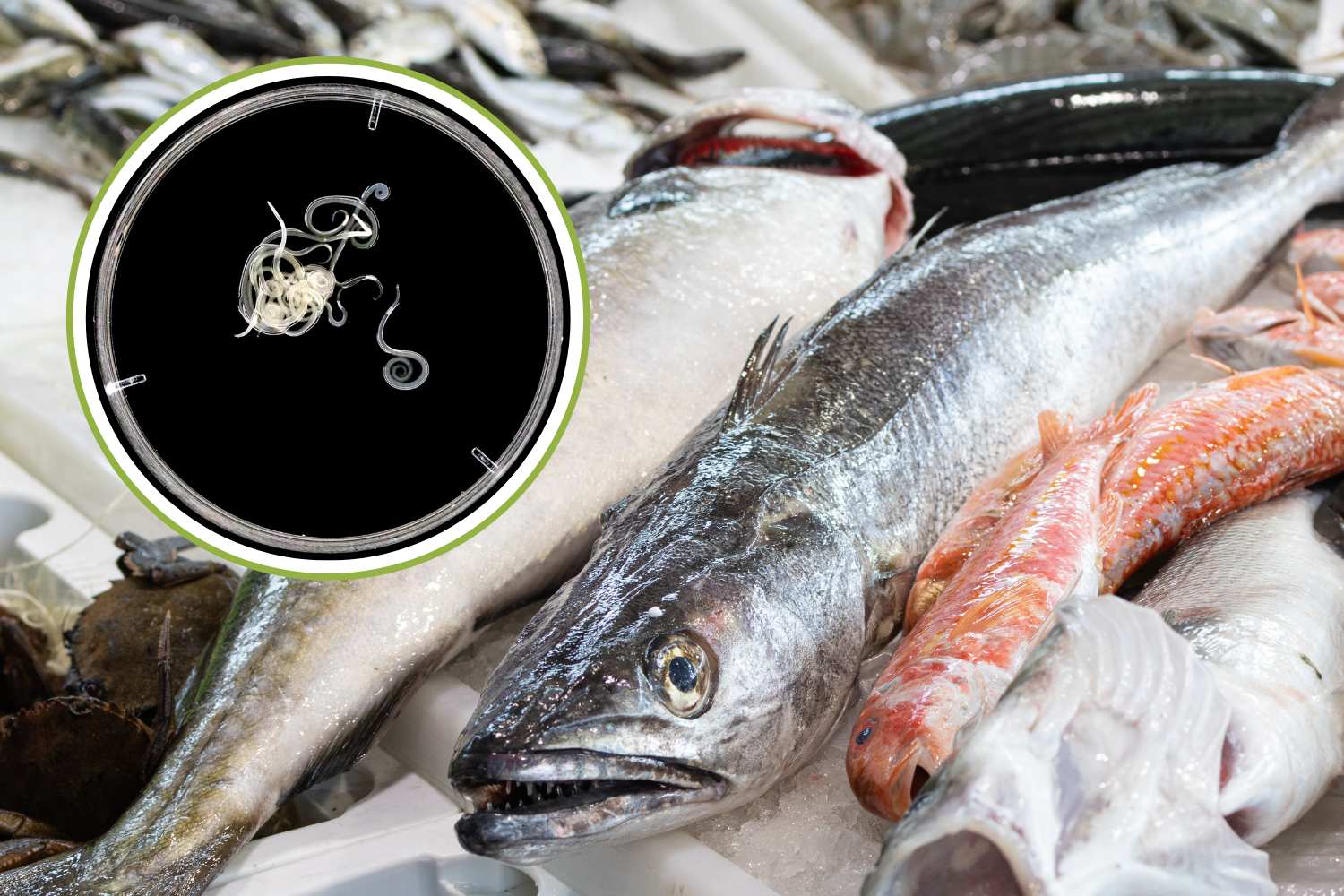
The European hake (Merluccius merluccius) is a highly appreciated fish and among the most recommended for children’s food. Yet, recent research published on Food and Waterborne Parasitology highlights a high risk for food safety (if this food is not treated correctly).
In fact, 100% of the hake analyzed were found to be infested with Anisakis larvae, a potentially dangerous parasite for humans.
The study data
The research, conducted by a team of researchers fromUniversity of Portoanalyzed 15 hake caught in the spring of 2023 off the south-west coast of Ireland. The results were surprising: each single specimen hosted on average 743 Anisakis larvae, with a density of approximately 18 larvae per gram of edible muscle.
Molecular identification confirmed the prevalent presence of Anisakis simplex (88.9% of samples), the most dangerous species for humans and responsible for the majority of cases of anisakidosis recorded in Europe. The presence of a hybrid between A. simplex and A. pegreffii was also detected.
The most interesting aspect of the study concerns the distribution of the larvae in the muscle tissue. Contrary to what one might think, the parasites are not distributed uniformly: the most affected area was found to be the abdominal flap (the anterior ventral part of the fish), which concentrates 83% of the total larvae.
The scientists discovered that, after moving from the visceral cavity, the larvae migrate towards the closest muscular portion – the abdominal flap – and only subsequently towards other regions of the fish. Furthermore, a high concentration of larvae was identified in a small posterior cavity, near the anal opening, which is not normally cleaned during standard evisceration processes.
Why is hake so much infested
Hake is particularly exposed to Anisakis infestation for reasons related to its ecology. As a predator, it feeds on smaller fish (mackerel, herring, etc.) and shrimp, all of which are often already infested by the parasite. The larvae progressively accumulate in the organism throughout the life of the fish.
The cannibalistic behavior observed in hake also contributes to making the situation worse, as they feed on smaller specimens of their own species, further increasing the parasitic load.
Several studies have confirmed that hake fished in the North Atlantic have higher levels of infestation than populations in the Mediterranean Sea.
What is Anisakis and what risks does it entail
Anisakis is a nematode (parasitic worm) that measures 1 to 3 centimeters and completes its life cycle in marine animals. The definitive hosts are marine mammals such as whales, seals and dolphins, which expel the parasite’s eggs through their feces. The larvae go through different stages of development in crustaceans and fish, moving up the food chain and occasionally reaching humans.
When we consume raw or undercooked fish containing live Anisakis larvae, we can contract anisakidosis, an infection that manifests itself with acute gastrointestinal symptoms: intense abdominal pain, nausea, vomiting and diarrhea. In severe cases, the larvae can perforate the intestinal wall causing serious complications. Furthermore, Anisakis can trigger even serious allergic reactions, from hives to anaphylactic shock, even if the larvae are dead (this is why it is important that the fish is tracked and handled correctly).
An aspect that makes the situation even more worrying is that hake is often recommended and administered to young children, already during weaning, for its delicate flavor and its nutritional properties. Although cases of infection are rare when correct food safety procedures are followed, the vulnerability of the little ones requires special attention.
What solutions?
The study demonstrated that the removal of abdominal flaps during fish processing reduced the presence of Anisakis larvae in the final product by 83%. A simple but extremely effective measure that could significantly improve the safety of cod intended for consumption.
The researchers recommend that this practice be adopted systematically during the hake gutting process. Furthermore, they suggest that further research be carried out on methods of handling fish on board fishing boats, to minimize the risk of larvae migrating from the gut to the muscle.
How to protect yourself: the rules to follow
European legislation is clear: all fish products intended for raw or undercooked consumption must be subjected to blast chilling at -20°C for at least 24 hours, a procedure which kills Anisakis larvae.
Having said that, here are the fundamental rules that we as consumers should follow:
