
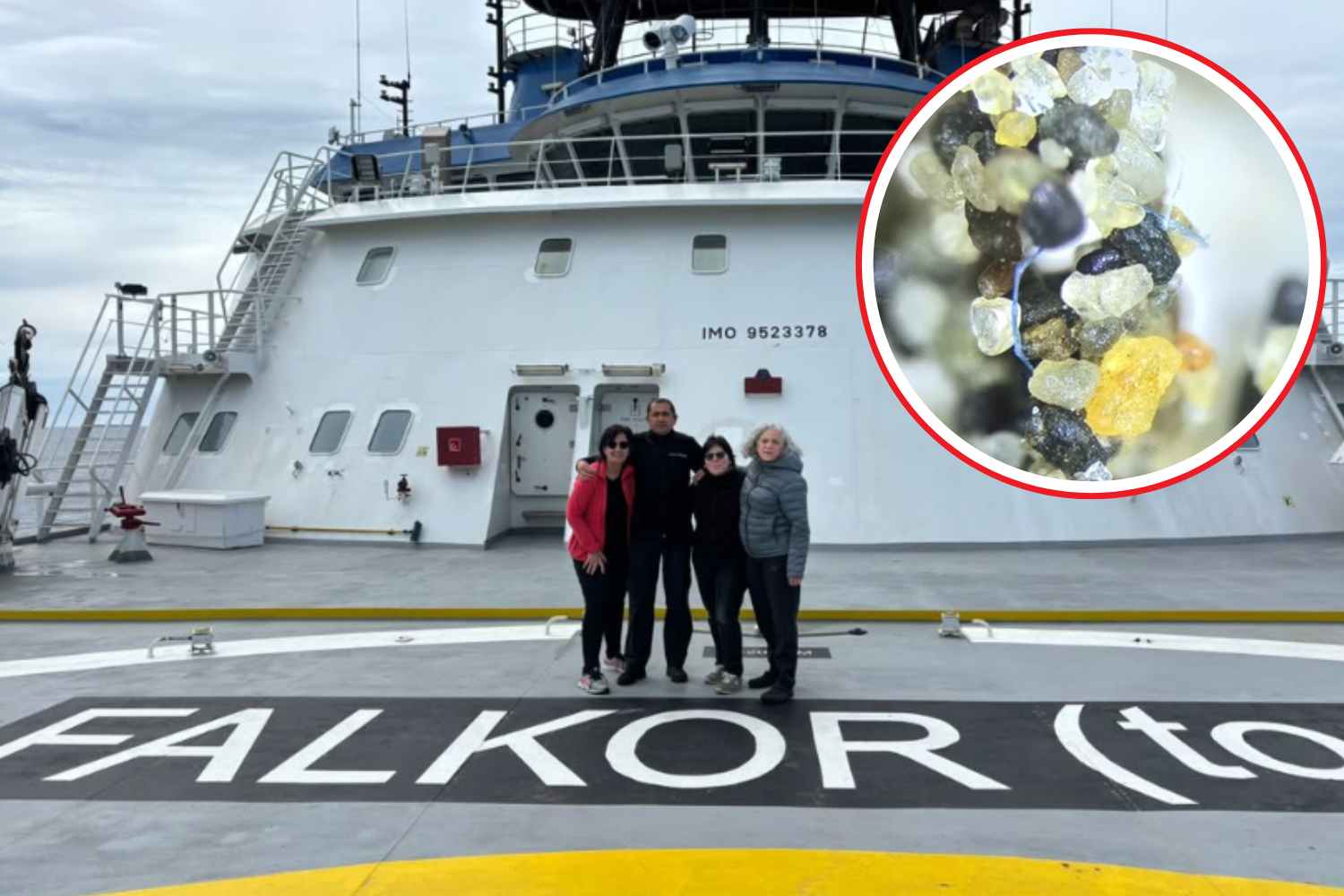
A small fragment of plastic, invisible to the naked eye, tells a great truth: man’s footprint reaches everywhere, even in the most remote places on the planet. This is what Argentine scientists discovered on board the research vessel Falkor (Too) during the “Ecos de 2 Cañones” expedition, which explores the underwater canyons Bahía Blanca and Almirante Brown, off the coast of Patagonia.
View this post on Instagram
At about 300 meters deep, researchers found traces of microplastics in marine sediments, an unmistakable sign of environmental contamination even in ecosystems previously considered pristine. The sample was collected and sent to the Argentine Naval Hydrography Service (SHN), where it will be analyzed to determine the quantity, type and distribution of the particles.
View this post on Instagram
The objective is to understand how the morphology of the seabed influences the accumulation of microplastics: in which areas of the canyon they are concentrated, and where they are less present. The research, coordinated by Silvia Romero of the University of Buenos Aires, involves Argentine oceanographers, biologists and geologists, in collaboration with the Schmidt Ocean Institute and the Fundación Williams.
For the first time, scientists have advanced instruments such as the SuBastian ROV, an autonomous underwater vehicle capable of exploring and mapping the sea depths with high-resolution cameras, CTD sensors and sediment collection probes. Thanks to this technology, it is possible to observe in real time the dynamics of the canyons and the behavior of the currents that shape the seabed.
The expedition also has important ecological value: the cold, nutrient-rich currents of the Malvinas Current fuel the biological productivity of the southwest Atlantic. However, the presence of microplastics could compromise the health of key organisms such as phytoplankton and zooplankton, at the base of the marine food chain.
During the operations, the team of biologists used a “mini bongo” net to sample plankton at different depths, up to 50 meters, along four longitudinal transects. The collected organisms were then preserved for quantitative analyzes of diversity and abundance. This data, together with that of contaminated sediments, will help evaluate the real impact of microplastics on marine biodiversity.
The activities are documented daily on the official Instagram channel @ecosde2caniones and streamed thanks to the technical support of the Schmidt Ocean Institute.
