
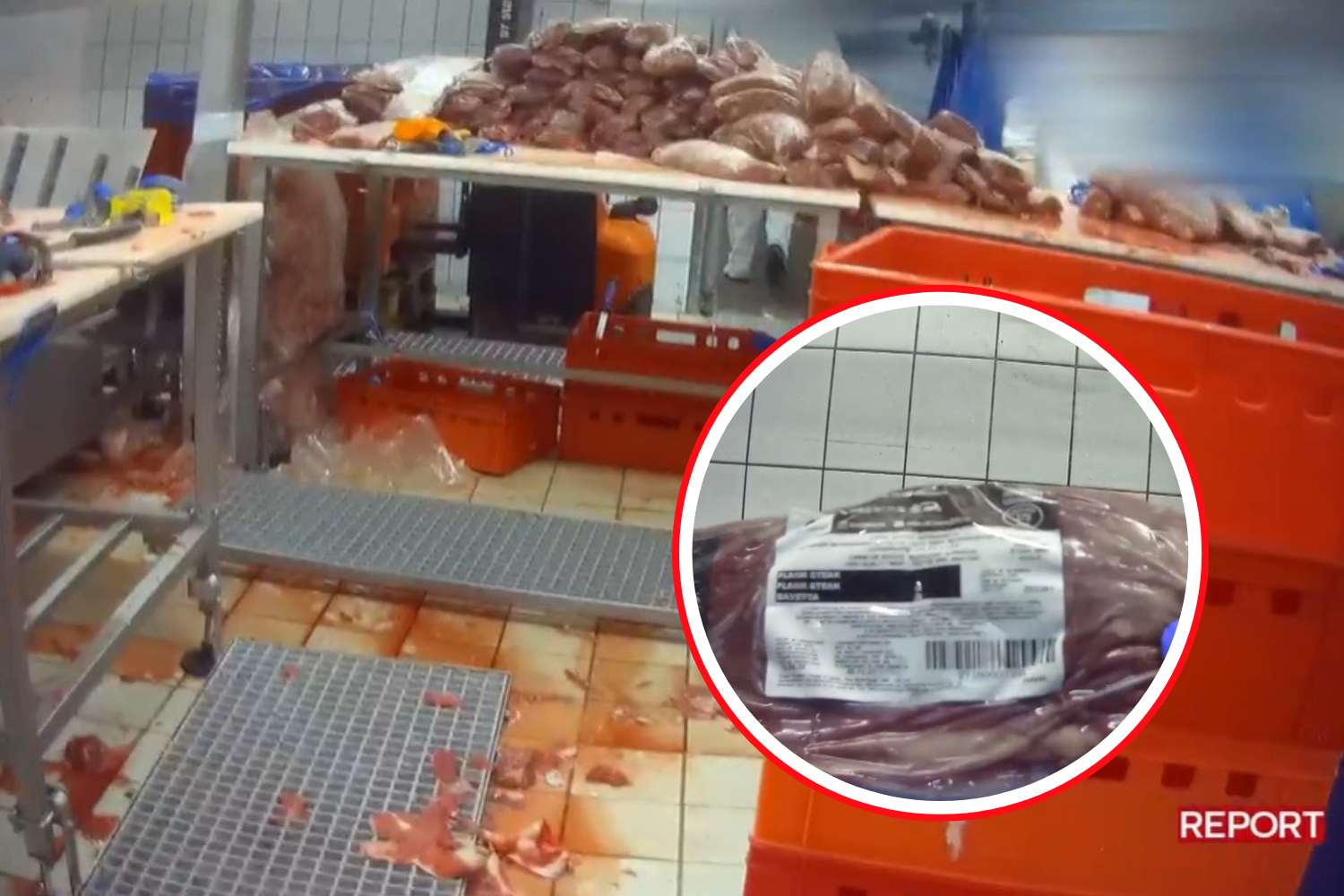
The investigation into expired meat put back on the market by the Bervini Primo Srl slaughterhouse has seen a new chapter with the third episode of the investigation report “Nothing is thrown away“, signed by Giulia Innocenzi. The revelations finally led to the activation of a food alert, extensive checks and a file sent to the prosecutor’s office. But many questions remain open: where did the expired meat really end up? Why did the intervention come so late?
But let’s take a step back for those who haven’t followed the story. In previous episodes of Report it emerged that in the Bervini factory frozen meats that had expired for months were unpackaged, “cleaned” of the darker parts, then processed and repackaged as if they were fresh, with new labels and new expiry dates. After the discovery of what was happening in the plant, confirmed by the testimonies of some workers and by the filming, the journalist Giulia Innocenzi delivered labels and documents to the ATS Valpadana on 15 October, urging immediate intervention to withdraw the potentially dangerous meat from the market.
The food alert and seizures
Only on November 25, the Welfare Councilor of the Lombardy Region Guido Bertolaso finally ordered the recall of expired meat, activating a food alert for batches without evidence of heat treatment before marketing. The intervention led to the seizure of 180 tons of product attributable to the Bervini slaughterhouse.
During the debate in the Regional Council, Bertolaso confirmed that the repackaging of meat was carried out at the plant, with the movement of frozen, unpackaged, sectioned, relabelled meat and partly marketed as fresh.
The councilor also publicly recognized the social usefulness of the work carried out by Report, underlining that further checks are underway following the broadcast of the television report.
The investigations of the Prosecutor’s Office
The Health Authority forwarded the file to the Mantua Public Prosecutor’s Office for fraud crimes in the exercise of trade and sale of non-genuine food substances as genuine. According to what was reconstructed by Bertolaso, the documentation subsequently provided by the company confirmed the thawing and refreezing of part of the meat, with the affixing of new labels and the extension of the expiry date.
Among the documented cases, that of 12 April 2025, when meat from Uruguay that had expired for two or three years was processed, to which a new label was affixed which gave the product another two years of life.
The parliamentary commission on eco-mafias has also taken action: the Honorable Stefano Vaccari has asked for documents regarding the traceability of batches of expired meat, placing emphasis on the central question of the investigation.
The criminal network behind the slaughterhouse
Report’s investigation also revealed that a criminal network was behind the slaughter. Sigfrido Ranucci declared during the broadcast:
The slaughterhouse revolved around Francesco Giordano, a boner from Bitonto who made his fortune in Milan and set up a consortium called Servizi Globali through which he offered labour, workers at low prices, at low cost, to the slaughterhouses of the north because he paid them partly illegally. It was the result of laundering his own escape, according to the magistrates, and also the proceeds of organized crime. The processing of the expired meat was apparently conceived by Francesco Giordano’s brother, Pasquale, also a butcher. And the system would have continued even after Francesco Giordano had definitively entered prison, from which he will be released in 2030. His right-hand man Giorgio Oprea carried it forward through another company, Geocarni.
The “meat” and the final destination
A significant part of the so-called “carnetta” – that meat considered poorer and which would be cooked before ending up on the market – would have been destined for Bolton, the company that produces the famous Simmenthal canned meat. According to data collected by Report, the product coming from Bervini represented approximately 6.6% of the total purchases made by the multinational.
A worker at the slaughterhouse said that the meat was transferred to Salvaterra, in the province of Reggio Emilia, where Bervini has a large cooking plant, while in the past the processing took place in the Trento plant.
From the testimonies collected, it emerges that the meat also ended up in restaurants, especially in Milan.
The consequences on workers and the alleged threats
At the end of the Report article, Sigfrido Ranucci declared:
There are the workers of the Bervini slaughterhouse, who are employed by the Geocarni cooperative, that is, they depend on Giorgio Oprea. They wanted to meet us and tell their point of view but then they thought better of it. They were terrified because they are being blackmailed, for what? Being mostly foreigners with a residence permit. So the master keeps them in his hands. The owner who is convinced that the layoffs will be triggered. Now, since the responsibility for why they don’t work lies with the Bervini slaughterhouse and also with the management of the cooperative, why does the State have to pay, who made a mistake?
The traceability crux
Despite the food alert, the fundamental question remains unresolved: where exactly did the expired meat end up? The slowness of the controls has raised much criticism. From 15 October, when Giulia Innocenzi delivered the labels to the ATS, to 25 November, when the alert was triggered, over a month and a half passed. Really too much! We remind you that the Bervini slaughterhouse had initially refused to provide traceability of the batches, citing IT problems.
As underlined by the host Sigfrido Ranucci in the studio, Is it possible that after a month and a half we still don’t know which batches of meat are dangerous and where were they taken?
The replicas
Bervini
The Bervini slaughterhouse, from the beginning of the affair, had responded by declaring:
Bervini Primo Srl, in reference to the request received from the “Report” broadcast, firmly rejects any accusation of reselling expired meat.
The meat we market has never, under any circumstances, reached its expiry date, much less exceeded it, as the Bervini company has always punctually applied community and national laws and ministerial provisions.
Ministerial regulations and provisions allow the freezing of refrigerated, vacuum-packed fresh meat before the expiry date assigned by the manufacturer is reached.
This operation does not change the status of the fresh meat which changes from “refrigerated fresh meat” to “frozen fresh meat”.
The operations are carried out according to strictly controlled procedures, which guarantee the full healthiness of the product.
Proof of this is that in all these years of activity no food safety problems and no food alerts have ever been generated by the work of the Bervini company.
Our factories are constantly subjected to checks by the State Authorities. The Community and National regulations that support these operations are:– EC Regulation 853/2004
– Law 25/2022
– Ministry of Health note dated 4 April 2022.On the original packages that are subjected to freezing it is mandatory to indicate, pursuant to the law, only the date of freezing. Such frozen meat can be destined for processing by other operators in the food sector.
METRO Italy
With reference to the services broadcast on 23 and 30 November 2025 relating to the company Bervini Primo Srl, METRO Italia writes:
With reference to the services broadcast on 23 and 30 November 2025 relating to the company Bervini Primo Srl, METRO Italia reiterates that it does not have frozen meat from Uruguay in its assortment. However, in light of the serious facts that have emerged, the company has decided to begin the process of ending any commercial relationship with Bervini. It has also decided to withdraw all the goods present in the sales points, with the exception of the meat for which Bervini is a mere importer and on which the latter does not carry out any processing. These latest products will be available while stocks last, so as not to cause damage to customers in a delicate period such as the end of the year. In the meantime, the company has already taken steps to identify alternative suppliers. Regarding the request on cutting non-EU meat at the butcher’s counter, METRO is in possession of the CE stamp necessary to process raw materials of animal origin and offers this service only to selected customers.
Ministry of Health
This is the response from the Ministry of Health:
in reference to the alert notification transmitted by the Lombardy Region to the RASFF (Rapid Alert System for Food and Feed) system on 25 November 2025, relating to frozen beef repackaged at the Bervini Primo Srl plant, the entire marketing chain was limited to the professional B2B (Business to Business) circuit, and did not concern large-scale distribution. This is not, therefore, a case of “recall to the final consumer” and therefore there is no obligation to publish it on the ministerial portal dedicated to recalls.
Please note that the RASFF notification, validated by the European Commission with number 2025.9673, is visible on the public RASFF Window portal. All operators involved were reached by the alert. The products were blocked or withdrawn from distribution, which affected catering and the production of pet food, and further investigations are still underway by the competent territorial health authorities (Emilia-Romagna, Piedmont, Lombardy). The supplies to the catering channel were distributed before the activation of the alert and checks are underway by local health authorities on their effective management. Meat destined for facilities outside the national territory was subject to traceability and preventive segregation, with unused quantities secured.
Bolton Foods
Bolton Food, producer of Simmenthal-brand jellied canned meat, specifies that:
The raw material coming from Bervini Primo Srl represents 6.6% of the total volume of meat purchased in 2025 and which, like all other raw materials used in its production, is subjected to rigorous internal and external control systems, in line with the highest food safety standards, with criteria and frequencies defined on the basis of rigorous internal processes. Each batch of raw material received from suppliers is analyzed with respect to organoleptic and chemical parameters, while the finished product batches are subjected to internal incubation controls and organoleptic checks. As a precaution and pending further clarification on the matter, the company has decided to temporarily suspend the aforementioned supplier in relation to all connected processing plants. Bolton Food acts to guarantee food safety and the quality of its production, always placing consumer protection first.
