
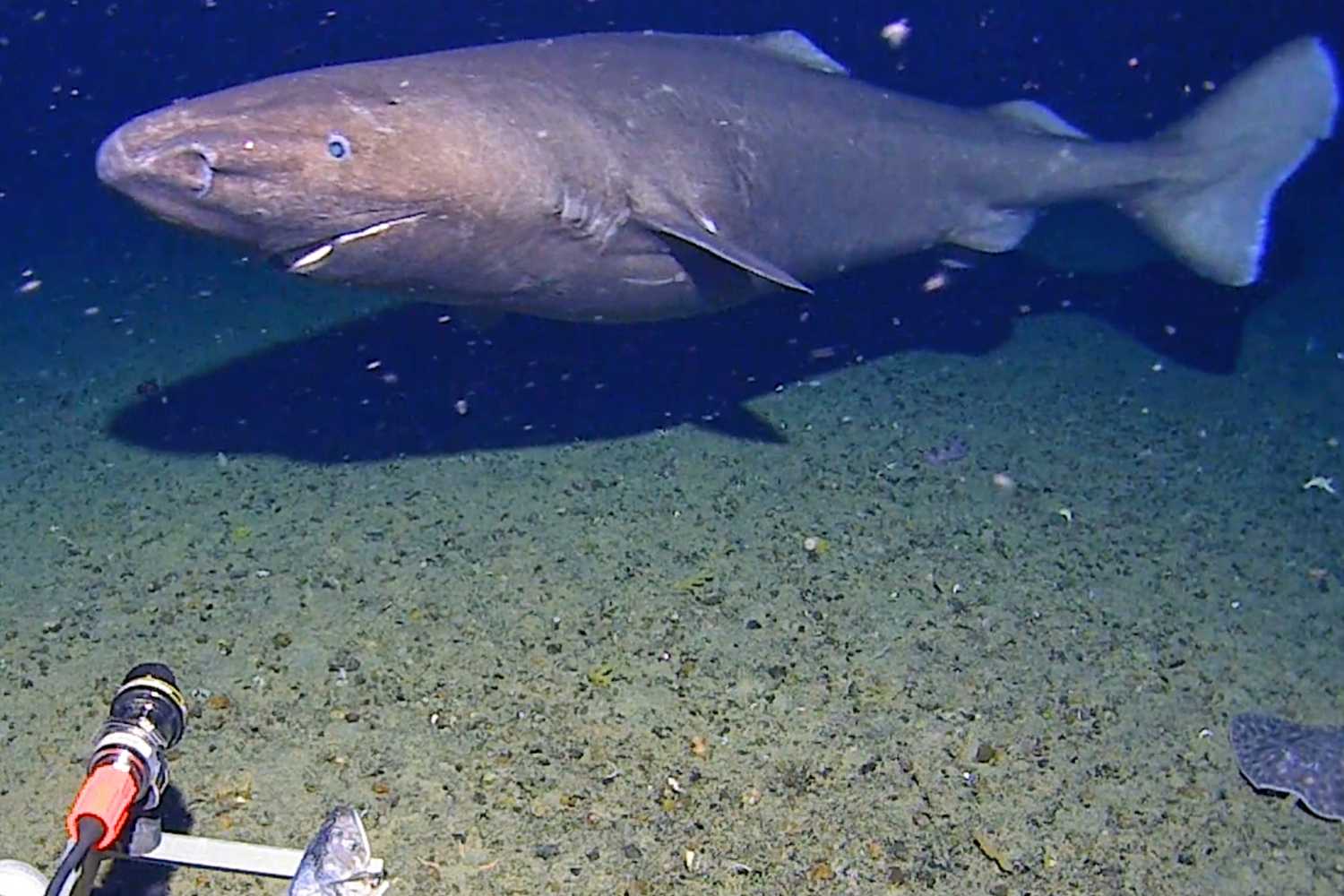
An incredible encounter has caught the attention of scientists: a sleeper shark has been imaged for the first time at near-freezing depths near the South Shetland Islands in the Southern Ocean. The animal, between 3 and 4 meters long, moved slowly on the seabed, a place where sunlight never reaches. The discovery challenges previous beliefs that sharks do not inhabit these extreme waters.
The video that made history
The images, captured by a camera at the Minderoo-UWA Deep-Sea Research Centre, show the shark swimming carefully through layers of stratified water at around 490 meters of water. The temperature was just 1.27 degrees Celsius (34.3°F), almost freezing. Next to the shark, a ray remains motionless on the seabed, apparently indifferent to the passage of the predator, recalling how some species already have adaptations to live at these extreme latitudes.
The center’s founder, Alan Jamieson, stressed that they didn’t expect to find a shark of that size. The episode was described by experts as a “significant” moment for marine research, as there are no documented precedents of sharks this far south. Conservation biologist Peter Kyne also confirmed that this is the first official record of a shark in the Southern Ocean at this latitude.
Possible explanations and implications
Experts hypothesize that climate change and warming oceans may push some shark species to colder southern waters, although data is limited due to the Antarctic’s remote location. Jamieson suggests that these sharks may have been around for a long time, without ever having been observed. Their slow lifestyle and the depth difficult for researchers to reach make their detection a rare event.
The photographed shark was moving around 500 meters, where warmer water layers create a relatively stable environment compared to the overlying and deeper waters. Sleeper sharks may feed primarily on the carcasses of whales, giant squid and other marine animals that sink to the seabed, completing a key role in the Antarctic ecosystem.
This discovery highlights how little is still known about the Southern Ocean. With cameras only operating in the summer months, many mysteries remain hidden during the rest of the year. Antarctic sleeper sharks represent not only a fascinating biological phenomenon, but also a window into the dynamics of Earth’s most extreme ecosystems, ready to reveal new secrets of the underwater world.
You might also be interested in:
