
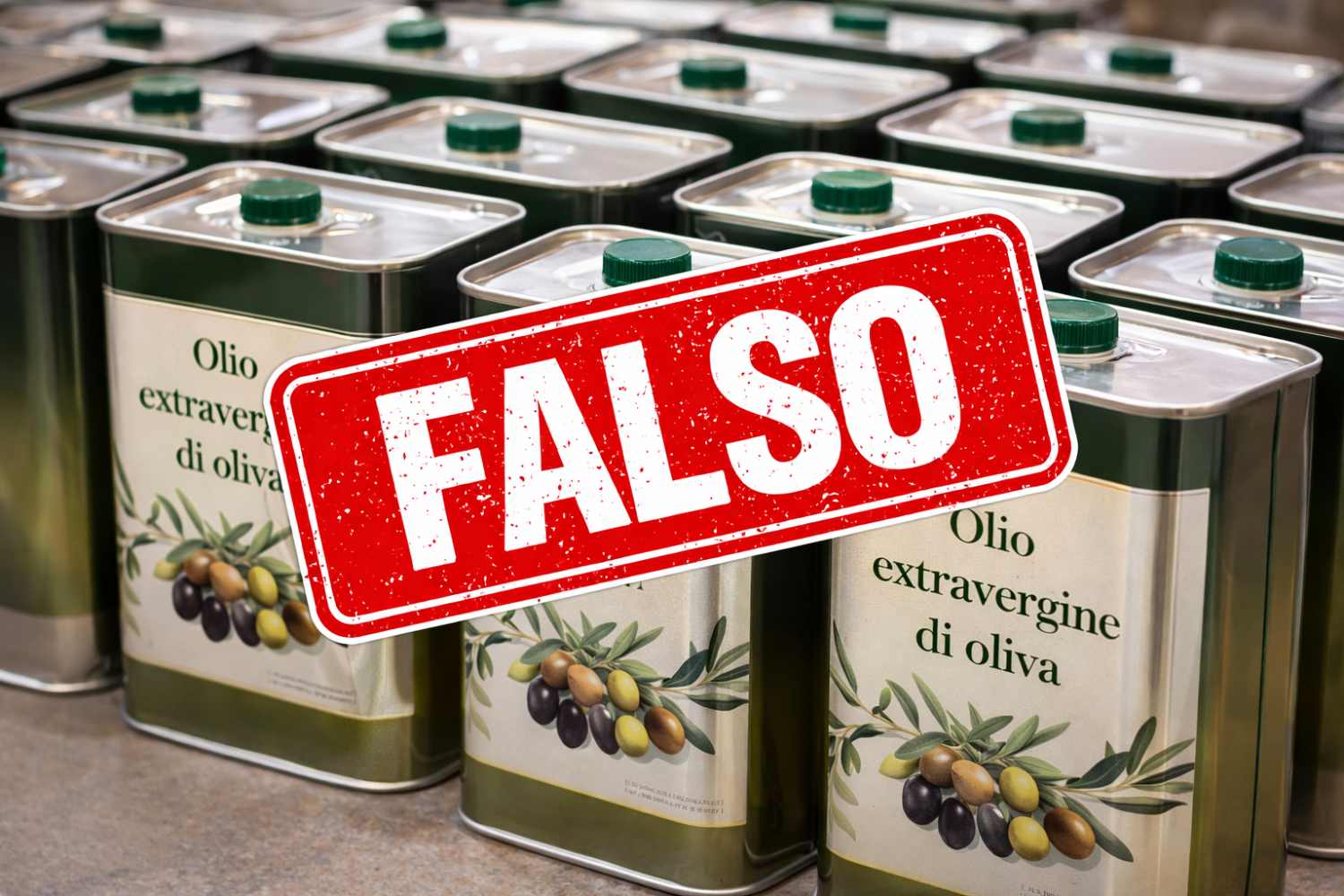
Once again, extra virgin olive oil ends up at the center of an investigation for food fraud. After the recent case in Ravenna, where almost 4 tons of colored seed oil sold on social media as Apulian extra virgin were seized, this time the operation moves to Sicily, with even more worrying dimensions and implications.
This makes us understand how fraud linked to extra virgin olive oil now represents a constant in the panorama of Italian food adulteration. The symbolic product of the Mediterranean diet continues to be the subject of counterfeits which damage honest consumers and producers, undermining the credibility of an entire supply chain.
The companies involved in the investigation in Sicily
This time the theater of the operation is the province of Agrigento, where the Carabinieri of the Agri-Food Protection Department of Messina and the Provincial Command of Agrigento conducted an investigation which brought 24 people and 6 companies in the olive growing sector, based in Palma di Montechiaro, into their sights. At the center of the investigation is not only food counterfeiting, but a real fraudulent system on multiple levels.
The companies that have come under the scrutiny of investigators, as reported by the newspaper La Sicilia, are:
These companies operated in the oil production and marketing sector, with a consolidated presence in the area. According to investigators, they placed sophisticated seed oil with chlorophyll on the market, passing it off as fine extra virgin olive oil.
Sophistication and other accusations
The technique used follows what has already been seen in other investigations: the addition of chlorophyll to common seed oil to simulate the characteristic color of extra virgin olive oil. A system that allows you to drastically reduce production costs by selling a product that has nothing to do with authentic olive oil at competitive prices.
The raid led to the seizure of thousands of liters of seed oil, large quantities of chlorophyll and half a million euros in cash. But there is an element that makes this case even more serious: the so-called “ledger” of parallel accounting, which would testify to the existence of an organized and long-lasting system.
In addition to food counterfeiting, a second equally disturbing line of investigation emerges. According to the investigators, through fictitious invoices and non-existent transactions, a scam was perpetrated against the AGEA (Agriculture Payment Agency) for over 2.5 million euros.
A drain on public funds intended to support Italian agriculture which, if confirmed, would demonstrate how the organization was structured to defraud the State on multiple fronts, taking away resources that should instead go to honest producers.
The seizures also include a significant quantity of irregular diesel fuel. The investigators’ hypothesis is that agricultural fuel with subsidized excise duty was used for commercial and logistical purposes, illicitly reducing transport costs and further increasing the organisation’s profit margins. A detail that highlights how the fraud was not limited to the final product, but involved the entire operational chain.
The seized IT equipment – computers, tablets and cell phones – is now being examined by experts to reconstruct the distribution network. According to investigators, the fake extra virgin olive oil from the Sicilian provinces reached markets throughout Italy and even abroad.
Sources: Carabinieri / Sicily
