

In the world of exotic fruit plants, few manage to surprise how the feijoa. A bite is enough to understand that it is not something ordinary, because The pulp recalls the pungent aroma of the Ananas, but with a sweet hint that recalls the strawberry. An intoxicating mix, delicate and decisive at the same time.
Feijoa is a plant that seems to have come out of a tropical story, which is actually closer to us than we think. Cultivating it in our garden is not a utopia and with some precautions it can also thrive in Italy.
Origins of Feijoa
There Feijoa Sellowianaalso known by the name of ECA SELLOWIANAcomes from the sunny lands of South America: it grows spontaneously between Brazil, Uruguay, Argentina and Colombia. Its history has its roots in the botanical explorations of the eighteenth century, when the Portuguese naturalist João da Silva Feijó – to which the plant owes the name – cataloged new species in the heart of the forests.
Feijoa belongs to the family of Myrtaceaethe same as myrtle, cloves and Guaiava nails, with which it shares some botanical characteristics, even if the fruits are very different.
Description of the feijoa
The feijoa is an evergreen shrub which, in its original environment, can reach i Seven meters high. In Europe, however, it often maintains a more contained, bushy and orderly bearing.
The compact structure and the ability to adapt to climbing climates even not properly tropical have made it an increasingly familiar presence in the temperate gardens, where it prosperous while maintaining an exotic aura.

The leavesof a shiny dark green on the upper and finely hairy page in the lower part, they are elliptical, opposite, leathery. In the face of a contained dimension – about five centimeters in length – they stand out for the thickness and consistency, so much so that, once dried, they are often used to prepare infusions with herbaceous notes.
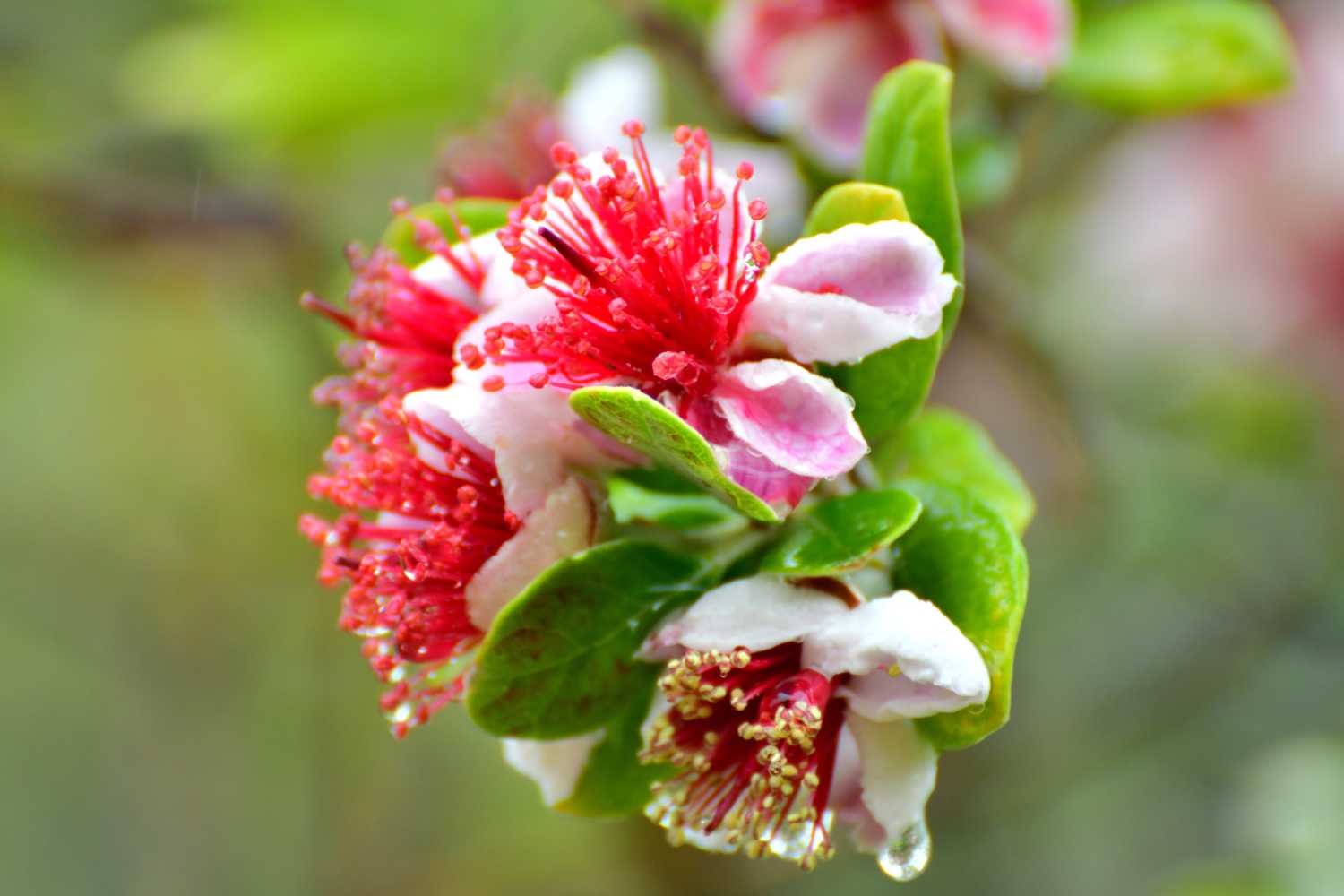
It is during the flowering That Feijoa reveals its most spectacular side: the flowers, medium-small size and often arranged in small groups, are a riot of contrasts and harmonies. The corolla, white with rosaceous shades, is the backdrop to a crown of showy, long and fleshy stamens, of an intense purple red. It is not surprising that, in the places of origin – the southern regions of South America – there are also birds, in addition to insects, to play the role of pollinators, attracted by the brilliance and sugary consistency of the petals, which also lend themselves to a gastronomic use: they can be consumed raw, perhaps added to salads for a decorative and aromatic effect, or simply left to dissolve on the language, offering as an inconsistent with a sensation as an unwanned. pleasant.
When is the time for the fruits? Generally between September and October, with variations due to the seasonal trend.
The feijoas, more or less as big as a plum, take on a form that varies between oval and pyriform; The peel, thick and leathery, bright green in color, contains a whitish or slightly yellowish pulp, gelatinous and translucent, dotted with a multitude of tiny semi -hard. If the edible portion is not particularly abundant, this is widely compensated by the intense perfume and the unusual taste of the pulp, which recalls, as mentioned at the opening, a synthesis between pineapple and strawberry, with tropical acids and aciduli that teases the palate in an elegant way.
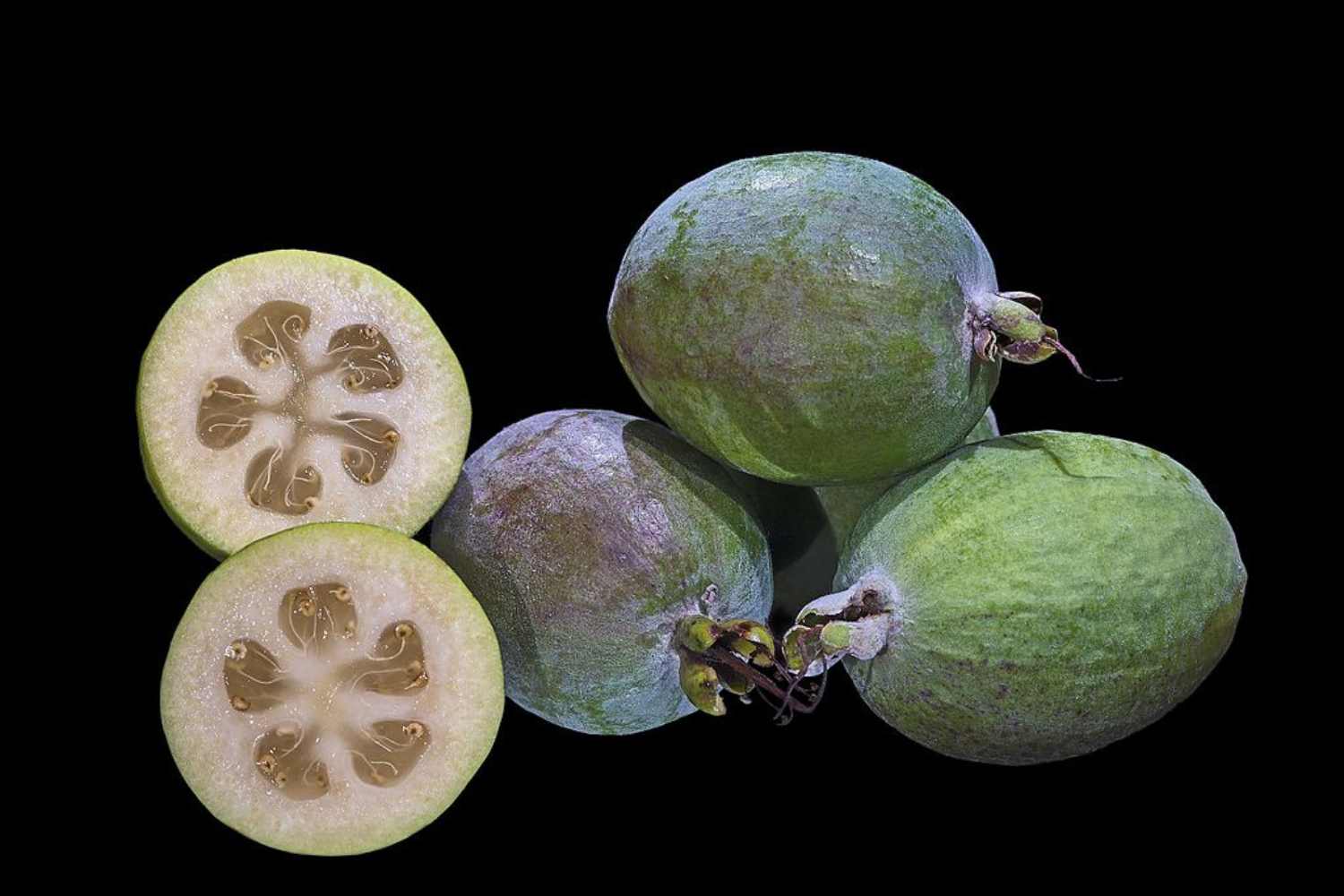
Achieved maturation, The fruits fall spontaneouslyaspect that makes the collection a simple and intuitive operation. They consume fresh, after cutting them in half and extracting the pulp with a teaspoon, or peeling them with a knife. The conservation, however, is limited: five or six days in a fresh environment, just as it happens for bananas. For this reason, those who want to use them in the kitchen – for example for the preparation of jams – will have to act with a certain timeliness. In these cases, it is advisable to combine the gelatinous pulp of the feijoa a component rich in natural pectin, such as non -completely mature apples, capable of giving consistency and balance.
How to cultivate the feijoa
You don’t need to live in the tropics to cultivate Feijoa. Enough A mild climate, a sunny position and some targeted care. In the ground, the plant sets easily. He loves the sun and grows well in well -drained soils, and does not even disdain the coldest regions, since he resists up to -10 ° C, provided he is well repaired by the wind and receives water in the right moments.
The first step is Choose the right place: better an area exposed to the south, bright, but protected by currents. If the wind is a problem, you can resort to a guardian in the first months, to help the plant anchor yourself better.
An important detail: flowering – and therefore also the fruiting – It depends in part on the cold. Plants grown in areas with moderate winters, where temperatures go down without being rigid, tend to produce more flowers.
How to water the feijoa
Let’s forget the excesses, why Feijoa does not like stagnation. We must water it regularly, but always letting the soil dry slightly between one irrigation and another.
During spring and until the beginning of autumn, Water is essential, especially in the hottest monthswhen the drought risk is around the corner. At this stage, a deep – but not daily – makes the difference. A small trick: add a universal liquid fertilizer to the water once every 30 or 40 days, from March to October.
In pots, the question becomes more delicate. The soil dries more quickly and in the days of intense heat it can also serve a double watering. The expert eye will evaluate.
What ground to choose for the feijoa
The ideal substrate for Feijoa is rich in organic, light substance and with a neutral or just acidic pH. The soils too clayey, heavy and compact must be avoided, because they promote stagnation, and with it the radical rot.
To get the best you can improve the soil with the ripe compost before planting. In spring, it is better to use nitrogen and potassium fertilizers., While in the autumn, an addition of well -decomposed manure will help the plant prepare for winter.
Feijoa pot cultivation
For those with little space, Feijoa offers a surprise: it can grow well also in pots. Only one serves a large container – at least 45 cm in diameter – and a quality soil, well drained.
The position, also in this case, is fundamental, therefore direct sun and no currents. For the rest, the treatments are similar: regular irrigations, seasonal fertilizations and some light pruning to eliminate dry branches.
Who wants propagate the plant It can do it by sowing, but also for cutting, choosing the younger and more vigorous branches. Spring is the best season to try the experiment.
Feijoa diseases and parasites
Feijoa, in general, is a robust plant. In the middle of the ground he defends himself well, in the pot, however, it can become more vulnerable. The main enemies are the cochinealthe fruit fly And, in some cases, the Fuligginous mold. The latter looks like a black and sticky patina, caused by the sugary secretions of insects. The best way to keep it away? Intervene in time. There are natural and specific products, many of which are also approved in organic agriculture. In any case, it is better to rely on an expert, if you are not sure to how to proceed.
The symbolic meaning of the feijoa
In the language of flowers, the Feijoa Sellowiana is a subtle but powerful symbol of adaptation and resilience. Her ability to thrive even in non -ideal conditions, flowering and fruiting regularly, gives her an aura of silent, almost stoic force. It is the perfect metaphor for those who cross the changes firmly, remaining faithful to their nature.
In the South American cultures from which it comes, this plant is often associated with concepts such as abundance and prosperitythanks to the generosity of its fruits and the intoxicating scent of the pulp. It is not uncommon for flowers to be used in rituals and ceremonies, where they become representation of authentic purity and beauty, not flaunted.
When and how is the feijoa use?
THE flowers of the Feijoa are not only beautiful to see: thanks to the scenographic form and the ability to attract bees and other pollinators, they prove to be Perfect for ortho-horned purposesespecially in the gardens where we try to encourage biodiversity. The excellent robustness, combined with resistance with environmental conditions, even non -ideal, makes them particularly suitable for anyone who wishes to enrich flower beds and green spaces with an exotic and useful note at the same time.
Even if it is not traditionally linked to canonical holidays or celebrations, Feijoa also lends itself well to the use in ceremonies and special events. The flowers – beautiful, edible and symbolic – can become original decorative elements in weddings, summer parties and gastronomic fittings, where sweetness and crunchiness give a touch of surprise and refinement. Finally, in the kitchen, the petals lend themselves to delicate gaskets and small botanical cooking experiments, for those who love to combine aesthetics and flavor in a single gesture.
