
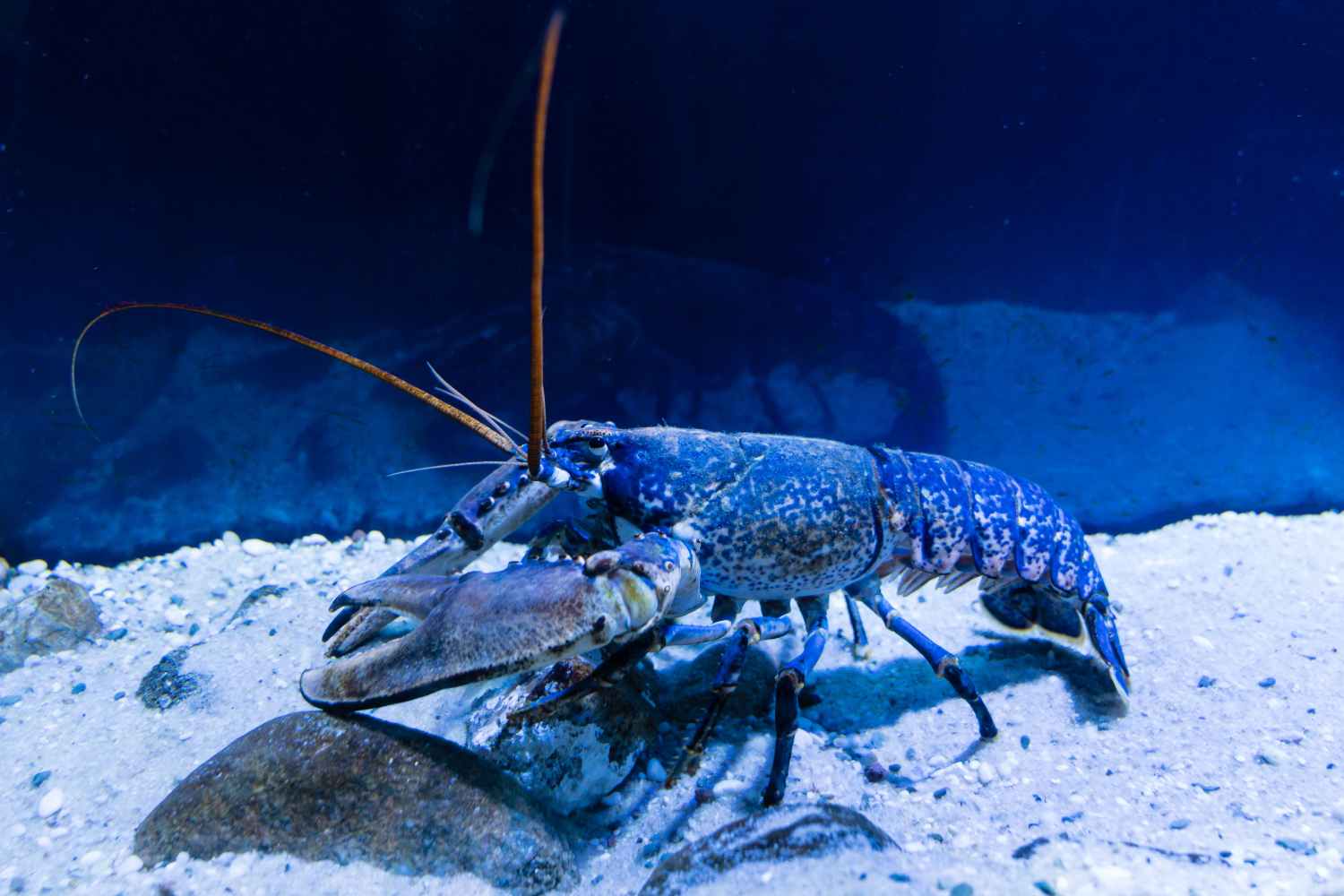
Sometimes, pulling on the Nasse from the ocean backdrop, an authentic surprise happens that has nothing to do with the quantity of the catch. This is what happened to Brad Myslinski, captain of the fishing boat Sophia & Emma off the coast of Salem, in Massachusetts. Last July, among the American lobsters (Homarus Americanus) with a typical brown-greenish color, one whose armor shone with an electric blue, intense and almost unnatural. A meeting whose probability, according to Northeastern University experts, is estimated in one case every two million specimens.
Faced with such a particular creature, the fisherman understood that he has a rarity of the marine world in his hands, which he chose to preserve. Thus, he contacted a teacher of a local high school science, acting as a link for a special donation: that at the Marine Science Center of Northeastern University, in Nahant. Arrived in the center during a summer program, the magnificent crustacean was immediately adopted by the students, who baptized him Neptune, Neptune, a more than appropriate name for an animal that seems to dress the colors of the Roman god of the sea.
View this post on Instagram
The explanation behind its unique color
But what makes Neptune so extraordinarily blue? The answer does not lie in a particular diet or in the environment in which he grew up, but in his DNA. As the researchers explain, the bright blue color is the result of a genetic mutation. This anomaly causes an overproduction of a specific protein which, binding to a red pigment known as Astaxanthin, forms a blue complex called Crustacianina. In fact, this genetic condition prevents the expression of other pigments, such as the yellow and red ones, revealing only blue which, to a lesser extent, is however present in all lobsters. The same genetic variability, in even rarer cases, can give rise to yellow specimens, Calico (spots), albini or even two -tone, in the delicate shades called “Cotton Candy” (cotton candy), between blue and pink.
Today Neptune has a new home and a new life, unfortunately not in nature. It is a male specimen of about seven years, weighs almost two kilos and is in perfect health. He lives in a large tactile tank of the center, a controlled and safe environment he shares with sea urchins, crabs and small fish. To guarantee him the utmost tranquility, he has hiding places and rocks available to take refuge, just as he would do on the ocean seabed (even if, of course, it is not the same). His diet is based on mussels and is settling without problems. “He is adapting very well,” explained the ecologist Neida Villanueva to the Smithsonian Magazine.
Its existence, sheltered from the dangers of fishing and diseases, could be very long: in fact, American lobsters can exceed 70-80 years of life. The story of Neptune, although rare, is not an isolated case. In the same weeks, another massachusetts fisherman captured another blue, smaller, half kilo and 8-9 years of age. Also in this case, the sensitivity of the fisherman prevailed and the animal was donated to the School for Marine Science & Technology of the University of Massachusetts in Dartmouth.
Don’t you want to lose our news?
