
One of the historical knots ofalgebraso far deemed unsolvable in exact form, it could finally have been loose. The merit goes to the mathematician Norman Wildbergerhonorary professor at the University of New South Wales in Sydney, who together with information Dean taps has proposed a new method for face the upper polynomial equationspublished in the magazine The American Mathematical Monthly.
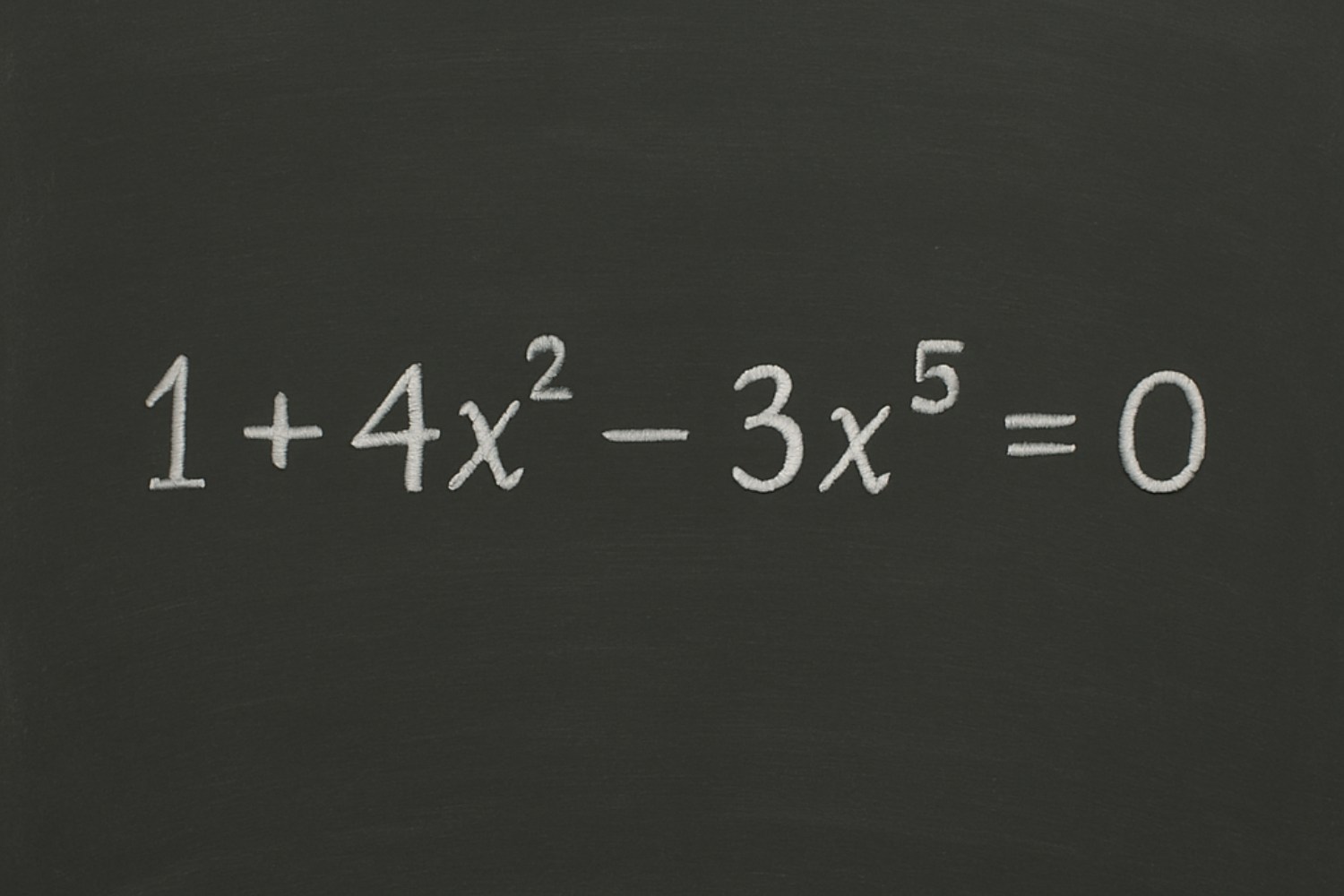
But what does all this mean? Polynomial equations are algebraic expressions in which a variable is elevated to different powers. For example, an equation like 1 + 4x – 3x² = 0 is by second degreewhile those of fifth degree or higherlike 1 + 4x² – 3x⁵ = 0, fall into the category of “superior” equations.
Already from the sixteenth century, thanks to the studies of Italian mathematicians, exact solutions were known for the equations up to fourth degree. But in 1832, the French genius Évariste Galois He showed that higher degree equations cannot be resolved with the same methods. Since then, it has been entrusted to approximate solutions.
The use of the succession of Catalan
The turning point of Wildberger and taps stems from the use of Succession of Catalana sequence of natural numbers well known in combinatorialoften used to calculate the number of ways in which it is possible to divide a polygon into triangles. The revolutionary intuition was that of generalize these numbersextending them from a simple linear structure to one multidimensional matrix. In practice they studied the subdivisions of the polygons not only in triangles, but also in squares, pentagons And more complex figures.
According to Wildberger, this approach has led to a real “Revision” of the algebraallowing you to systematically face the most complex polynomial equations. The method has been tested on various classic equations, including a note cubic equation designed by Wallis In the seventeenth century, and the results were extremely precise.
The potential applications they go beyond pure theory: this method could revolutionize the calculation algorithms used in mathematical softwareoffering a new way to solve problems in the scientific, engineering and IT area. A remarkable step forward that could have a concrete impact on many sectors of the applied mathematics.
