

Hazelnut spreads remain among the most loved foods in Italian and European cuisines. Regular companions for breakfasts, snacks and fillings, over time they have become an iconic product, capable of spanning different generations and eating habits.
Yet, behind their irresistible creaminess lies a nutritional profile that is anything but virtuous. Abundant sugars, vegetable fats and highly industrial recipes characterize most of the products on the shelves. The question arises spontaneously: in such a vast market, are there creams that are really better than others?
A new French test has intervened to try to answer, destined to spark discussion even outside the borders of the Alps.
Comparison of 15 brands
The consumer magazine 60 Millions de Consommateurs has selected 15 hazelnut spreads, some typical of the French market, others also widespread in Italy. The objective was clear: to compare similar products to understand which ones offer a more acceptable balance between taste, composition and quality of raw materials.
The panorama analyzed reflects a continuously growing sector. In France alone there are over 70 variations of hazelnut creams, alongside Ferrero’s giant Nutella and historic brands such as Lindt and Bonne Maman, together with organic, vegan and palm oil-free proposals. In the midst of this variety, the test tried to bring order with scientific criteria.
Sugars and fats: what the nutritional profile says
One of the central aspects of the investigation concerned the nutritional profile. The experts took as a reference a standard portion of 15 grams, approximately three teaspoons of product. According to the World Health Organization, that quantity can cover between 8 and 17% of the daily requirement of free sugars, a sobering fact, especially for those who consume these creams regularly.
Among the sugariest are Nutella, Choco Nussa and Poulain, placed in the high range of the ranking for sugar content. Pierre Hermé shows slightly lower values, while still remaining a sweet product.
On the fat front, the differences are less marked. Some creams reach 8 grams per serving, others stop at around 5 grams. The exception is Funkie Veggie Bio, the only product without added fats.
Once the Nutri-Score is applied, almost all creams end up in class E, the lowest. This score highlights how the entire category is structurally unbalanced towards sugars and lipids.
Ingredients: what really matters
The test was not limited to nutritional values. The French experts also carefully examined the list of ingredients, often underestimated by consumers.
In almost all products, sugar appears first. The exceptions are Pierre Hermé and Funkie Veggie Bio, which adopt different recipes.
The percentage of hazelnuts varies significantly. Pierre Hermé reaches up to 34%, while many other creams stand at around 13%, a decidedly more modest share.
The question of the origin of hazelnuts remains unresolved, because few brands declare it in a transparent way. When indicated, for French producers it is Lot-et-Garonne, in all other cases the most probable origin is Turkey, the world’s main exporter.
Vegetable fats chapter: palm oil is penalized for its environmental impact. The position of brands that use sunflower oil, rapeseed oil or alternative vegetable blends, sometimes with shea butter, is better.
Overall, the experts’ judgment is severe. The recipes for spreadable creams remain, according to the test, “compositions that leave much to be desired”.
Reassuring data on the pesticide front
A further check concerned the possible presence of pesticide residues in hazelnuts: here the results appear largely positive, given that almost all the products were found to be free of contamination. The only exception is Pierre Hermé cream, in which a trace of fluopicolide was detected, a fungicide authorized in the European Union.
A less drastic ranking than expected
Despite starting from less than encouraging nutritional bases, the final ranking of the test did not prove catastrophic, given that the majority of the creams obtained a green score, a signal that, if consumed in strong moderation, they can be considered “acceptable”. Only one product received a red score, stopping at 7.4 points.
An important aspect must be underlined, because if the judgment had been based exclusively on the Nutri-Score, practically all the creams would have been rejected. With the new algorithm that came into force in March 2025, which is more rigorous on sugars, almost all references fall into class E. The only exception remains Funkie Veggie Bio.
The French test instead adopted a more complex evaluation system, which included in the evaluation the percentage of hazelnuts, the use or otherwise of palm oil, the quality of industrial ingredients and the presence or absence of pesticides.
Lindt first in the rankings
In the end, the most interesting result emerges right at the top of the ranking. The best spread according to the test is Lindt, with an overall score of 13.1 out of 20. The product convinces with a relatively better balance between composition, raw materials and overall quality.
In second place we find Rigoni d’Asiago with 12.4 points, a solid result but lower than the leader.
Nutella, while remaining the most famous and consumed, drops lower with 11.4 points, penalized above all by the nutritional profile and the list of ingredients.
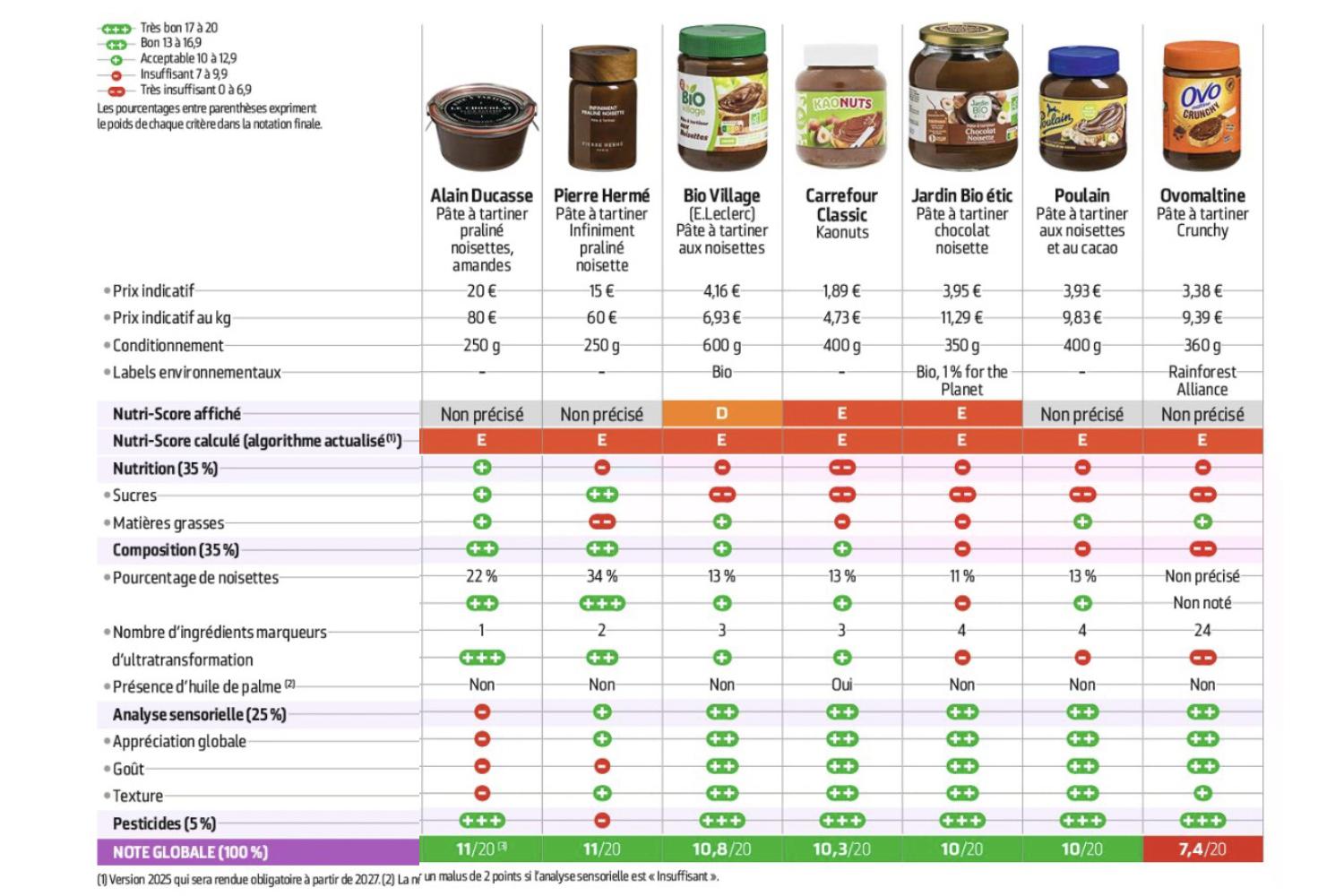
In last position, considered the worst in the text, we find Ovomaltine with only 7.4 points.
