
Headphones have become an extension of our body. We wear them while working, playing sports, falling asleep on the sofa, etc. But what is really in the materials that remain in contact with our skin for so many hours every day? The answer, which emerged from newly published European research, is anything but reassuring.
The ToxFree Life for All project, a consortium of civil society associations in Central Europe, conducted a systematic investigation of 81 headphone models – both over-ear and in-ear – purchased in Austria, the Czech Republic, Hungary, Slovenia and Slovakia, as well as on online marketplaces such as Temu and Shein. The researchers disassembled the products into components (hard plastics, soft plastics and cables) and, in total, analyzed 180 samples for four categories of hazardous chemicals: bisphenols, phthalates, flame retardants and chlorinated paraffins.
The result of the study leaves no room for doubt: not even one model out of 81 was found to be free of problematic substances.
What do the headphones contain?
The most alarming data that emerges from the analysis concerns Bisphenol A (BPA) and its substitutes such as BPS and BPF, detected in 177 samples out of 180. These compounds are used to harden plastics, but belong to the family of endocrine disruptors, substances capable of mimicking estrogen and altering the body’s hormonal balance. It is no coincidence that the European Union already bans its use in baby bottles to protect younger children.
The problem is that body heat and sweat, typical conditions of those who use headphones during physical activity, accelerate the migration of these compounds from the plastic towards the skin.
Approximately 60% of the samples then contained traces of phthalates classified as CMR, i.e. carcinogenic, mutagenic or toxic for reproduction. In a product purchased on Temu, the concentration of DEHP, one of the most studied phthalates for its negative effects on fertility, reached 4,950 mg/kg, a very high value.
Organophosphate flame retardants (OPFRs) were instead detected in 72% of the samples, often in five or more different types within the same product. In many cases these are substances introduced as “substitutes” for compounds already banned, but also suspected of interfering with the endocrine system. TPhP (triphenyl phosphate) has been found above the 0.1% limits in products from established brands such as Marshall and Skullcandy. Maximum RDP concentrations reached 3,514 mg/kg.
Finally, short and medium chain chlorinated paraffins (SCCPs and MCCPs) have been found especially in soft plastics and cables. Average levels were low, but one children’s product recorded concentrations close to the legal limit, reaching 1,299 mg/kg.
One of the most surprising, and in a certain sense most worrying, aspects that emerged from the research is that spending more does not mean buying safer. Toxic substances have been found across the market, regardless of price or manufacturer reputation.
Among the models analyzed are giants such as Apple (AirPods Pro 2, AirPods Max), Sony (WH-1000XM5, WF-1000XM5), Bose, Sennheiser, Samsung, Beats and JBL. In the gaming sector, products from Logitech, Razer, SteelSeries, HyperX and Corsair were tested.
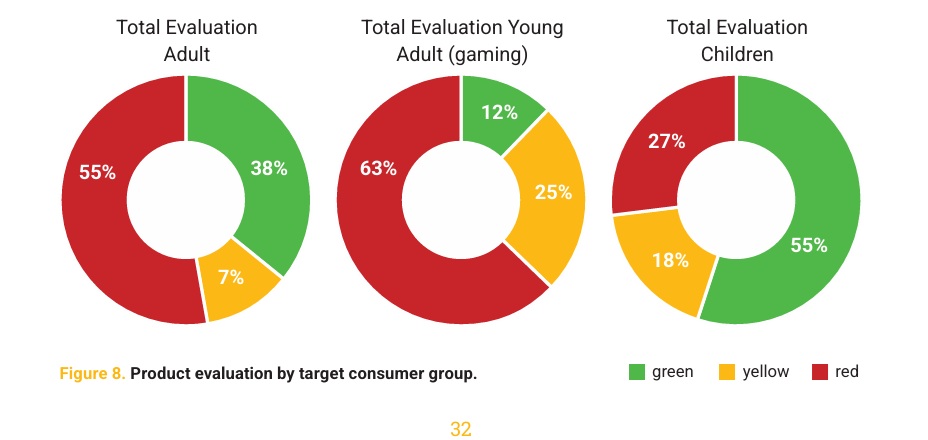
The most paradoxical fact? Approximately 48% of branded products received a “red” rating in the study, while “no-name” products more frequently contained contamination within the less critical thresholds (67% in the “green” range). It is worth clarifying what this means: the green rating does not equate to “safe”, but simply to concentrations below the thresholds of greatest concern set by researchers. No product was found to be free from problematic substances.
Among the premium models that obtained the relatively best result were the Apple AirPods Pro 2, the Sony WH-1000XM5 and the JBL Tune 720BT, not because they were free from contaminants, but because they contained them within the least critical levels of the study.
Who is most at risk
If products specifically designed for children show lower levels of contamination on average, with 55% classified as “green” according to the study’s criteria, the situation is completely reversed for another category: that of teenagers and gamers.
Gaming headphones, often worn for many consecutive hours in heated environments, recorded the highest levels of contamination with around 60% of products ending up in the “red” range. A fact that should give rise to reflection, considering that we are talking about a young audience with a hormonal system still in full development.
The researchers are keen to point out that there is no acute or immediate danger to health. The individual doses recorded for each substance are, in most cases, relatively low. But this is precisely where the crux of the problem lies: what we don’t know enough about are the long-term risks of the cocktail effect.
We are exposed daily to dozens of endocrine disruptors through plastic, cosmetics, food packaging and clothing. Headphones add to this chronic burden. And since these substances are found in so many consumer products, even one additional source is not a negligible factor in the overall balance.
What researchers are asking of Europe
The study does not limit itself to photographing the problem, it also makes concrete proposals to solve it on a structural level. When 100% of the products are contaminated, there is no “safe choice” on the market.
The authors call on the EU to abandon the current approach, which regulates toxic substances one at a time, and move to restrictions for entire chemical classes: banning all bisphenols together, for example, would avoid the perverse mechanism of replacing a banned substance with an equally toxic but still unregulated analogue.
They also call for the introduction of a Digital Product Passport that obliges producers to declare all chemical substances used, and underline that the current situation creates a “toxic legacy” that makes it impossible to safely recycle plastics with a view to the circular economy.
How to protect ourselves
While waiting for an appropriate regulatory response, some practical precautions can help reduce exposure:
