
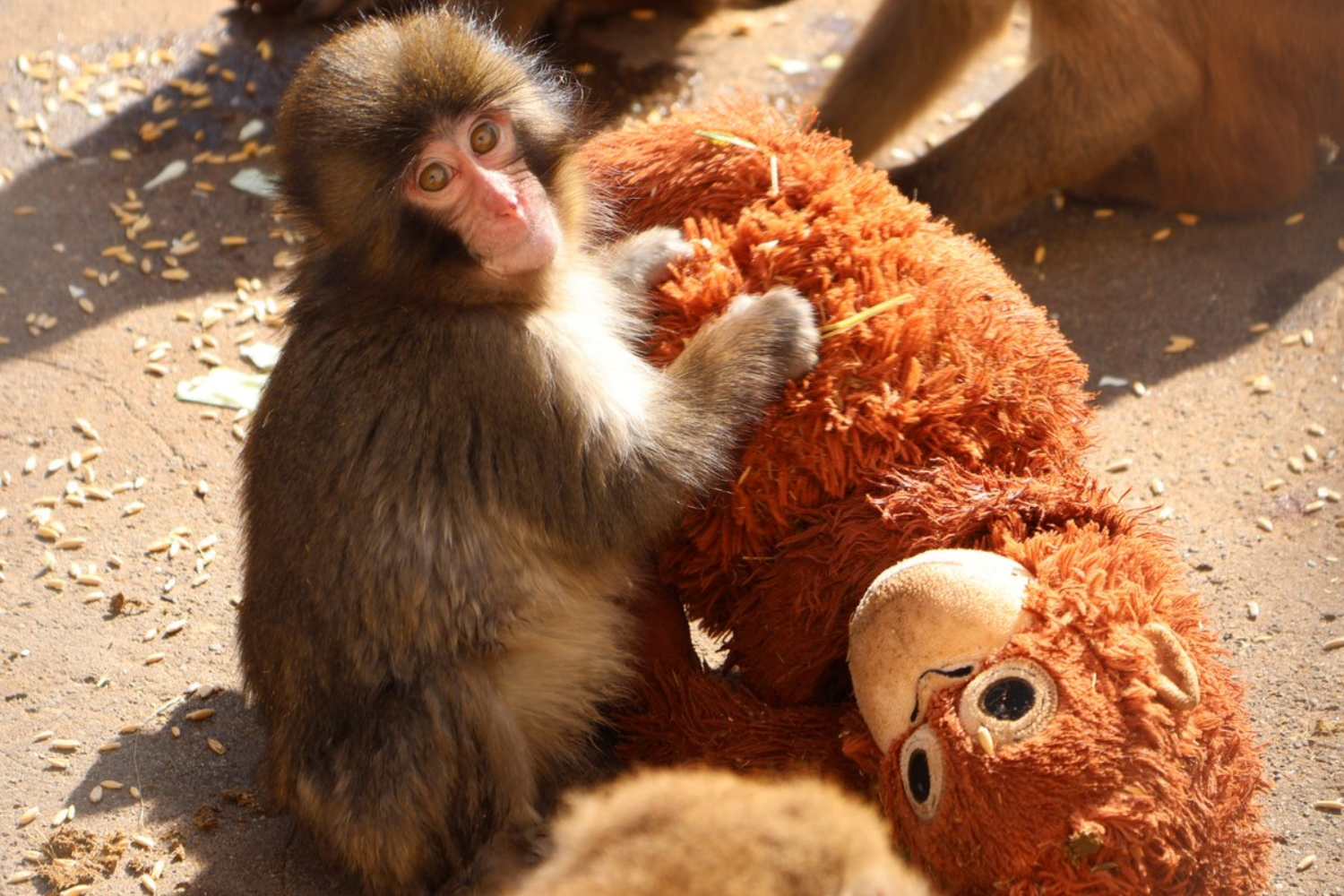
Little Punch, a few-month-old Japanese macaque, has won thousands of hearts online thanks to apparently sweet behavior: holding an orangutan-shaped stuffed animal in his arms to feel safe after not being accepted by the herd at Ichikawa Zoo. The images made the rounds on social media, generating comments of amazement, tenderness and viral shares.
The little animal soon became a media phenomenon, so much so that it was transformed into a symbol of the need for comfort and companionship. Behind the tender facade, however, there is a much more complex reality: Punch is not free, he grew up in captivity and suffered maternal abandonment. Virality has amplified a story that mixes fragility and resilience, but the gentler reading risks obscuring the true nature of its existence in a controlled and artificial zoo.
Captivity and distorted interpretations
Little by little Punch is integrating into the group of macaques. Zoo workers have documented slow but real progress: the little one is learning the social rules of the species and someone is starting to accept him. What has been labeled as “bullying” on social media is in reality the normal socialization process of primates.
Yet the media narrative has transformed this dynamic into entertainment. Thousands of visitors now line up to see Punch, applaud his gesture of affection towards a puppet, and photograph him. The result? A viral story that increases the popularity of the zoo, without considering the true ethological needs of the macaque.
View this post on Instagram
Exploited for merchandising
But it is not the only aspect of this story because the big brands immediately understood how to make it become a marketing product by exploiting the tenderness of an animal already in difficulty for their own gain. IKEA and Crocs, among many, have wasted no time: IKEA’s Djungelskog plush has sold like hotcakes and Punch is about to even have a dedicated Jibbitz (decorative pendant) for the well-known Crocs shoes.
View this post on Instagram
View this post on Instagram
In short, an emotional moment, driven by social media, has translated into tons of sales for many brands. The story has shown a key principle of emotional marketing: a product becomes more powerful when the brand’s culture and identity spontaneously align with a social event. Punch with its plush embodies security, comfort and belonging, elements that consumers unconsciously seek.
View this post on Instagram
An animal that will never be free
Yet let’s always remember: behind the charm of a puppy hugging his stuffed animal lies an animal that will never be free. Virality doesn’t care about its real life, it only serves to create engagement and profit. The message that must shine through is one and only one: we cannot reduce animals to viral content and the tenderness we arouse must go hand in hand with respect and awareness. Punch is tender, his resilience is real, but the risk (and alas it is becoming a certainty) is that his destiny will be obscured by the social narrative and marketing that surrounds him.
You might also be interested in:
