
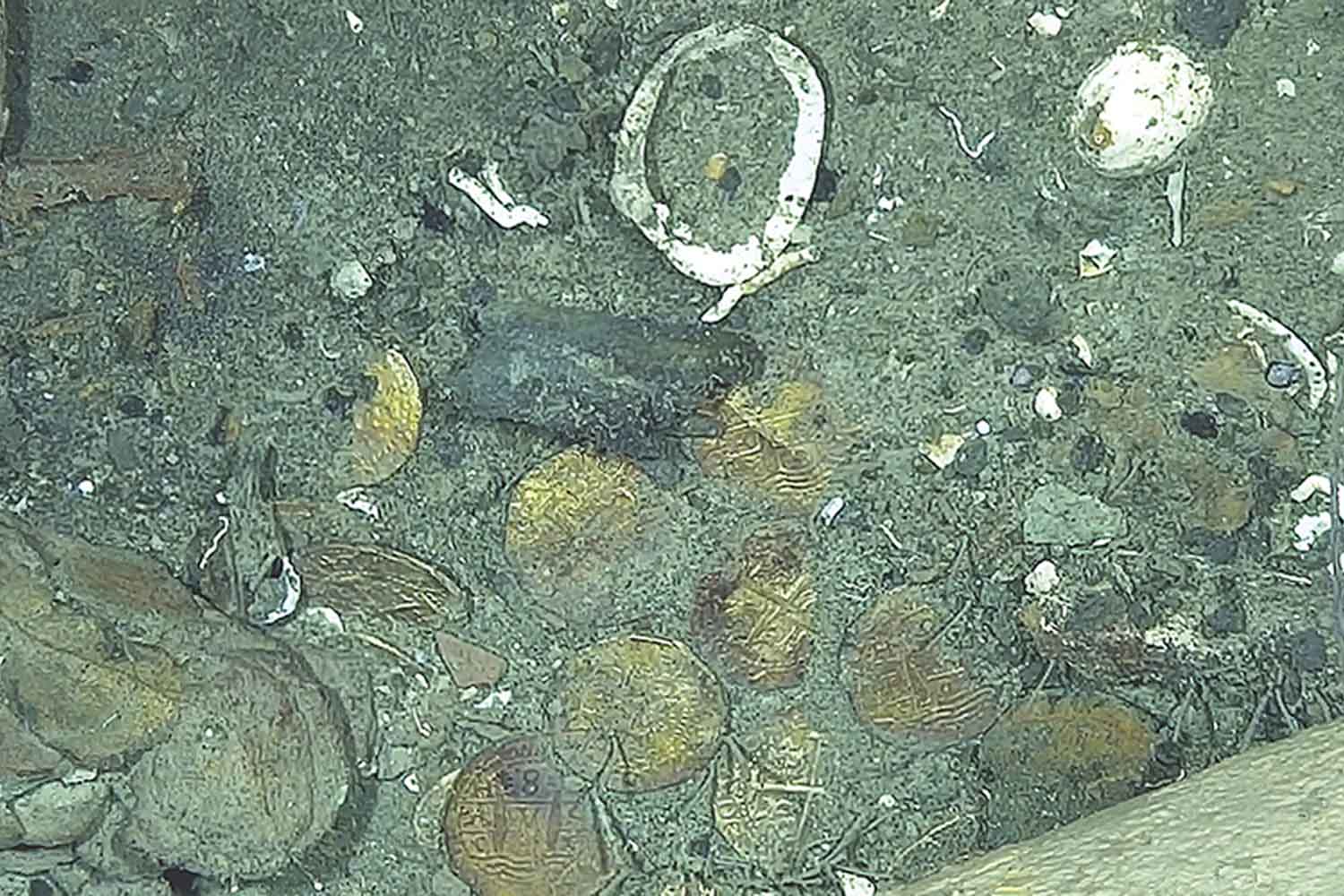
A journey through time, in the Caribbean seabed, where one of the most coveted and mysterious wrecks of history lies: the Galeone San Josésank over three centuries ago, shows itself today with unpublished clarity. The New images obtained from an autonomous underwater vehicle reveal a very precious load: gold coins With crosses, real coats of arms and symbols of the Lima mint. All elements that strengthen the identification of the wreck such as that of the legendary Spanish ship, submerged from 1708 off the coast of Cartagenain Colombia.
The results, published in the magazine Antiquitycome from a joint research work between Colombian archaeologists and marine scientists. Thanks to the use of 3D photogrammetryit was possible to create detailed reconstructions of the coins found on board. The images show one Cross of Jerusalem and the heraldic symbols of the crowns of Castile and Leónemblems of the Spanish monarchist power at the beginning of the eighteenth century.
The coins of 1707 tell the end of the San José and confirm the route of the mainland fleet
According to historical documents, the San José It was part of the famous Mainland fleetwhich in 1707 started from Peru transporting a huge load of Real riches destined for Spain. But the ship never arrived in Europe. Was sunk in 1708 During an assault of the British Navy, a few kilometers from the Colombian coast.
Among the most significant discoveries there are precisely the Irregular gold coins, called “Cobs” in English and “Macuquinas” in Spanishcoined by Lima in Lima in 1707. A fundamental detail, which accurately fixes the chronology of the shipwreck.
“These coins were the most common currency in the Americas for over two centuries,” he explains Daniela Vargas Arizaresearcher of the Colombian Institute of Anthropology and History (Icanh). “The San José held the monopoly of the transport of the treasures of the crown Between South America and Iberian peninsula. It is a crucial discovery to deepen the knowledge of eighteenth -century commercial routes. “
Also the archaeologist Jesús Alberto Aldana Mendozaco -author of the study, underlines the scientific importance of the discovery: “It was exciting to discover these artifacts and be able to analyze them so closely. For the first time, we managed to Connect archaeological data with historical sources in a systematic way. “
Despite the historical and cultural scope of the discovery, the San José treasure It remains imprisoned in the deep depths, hostage to a childish international legal dispute. The Colombian government claims the discovery of the wreck in 2015, which took place with the collaboration of international scientists. But the US company Sea Search-Armana (SSA)already known as Glocca Morra, claims to have identified the site in the 1980s.
SSA brought the case before the Permanent Court of arbitrationclaiming to be entitled to Half of the value of the treasureor about 10 billion dollars. Colombia, for its part, rejects every claim.
While the cards move in the courtrooms, The sea still holds its secretbut now with a more clear face: that of the gold coins that tell a story of power, colonization, war and trade. A heritage that goes beyond the material value, and that today, thanks to technology and archaeological research, finally returns to light.
