
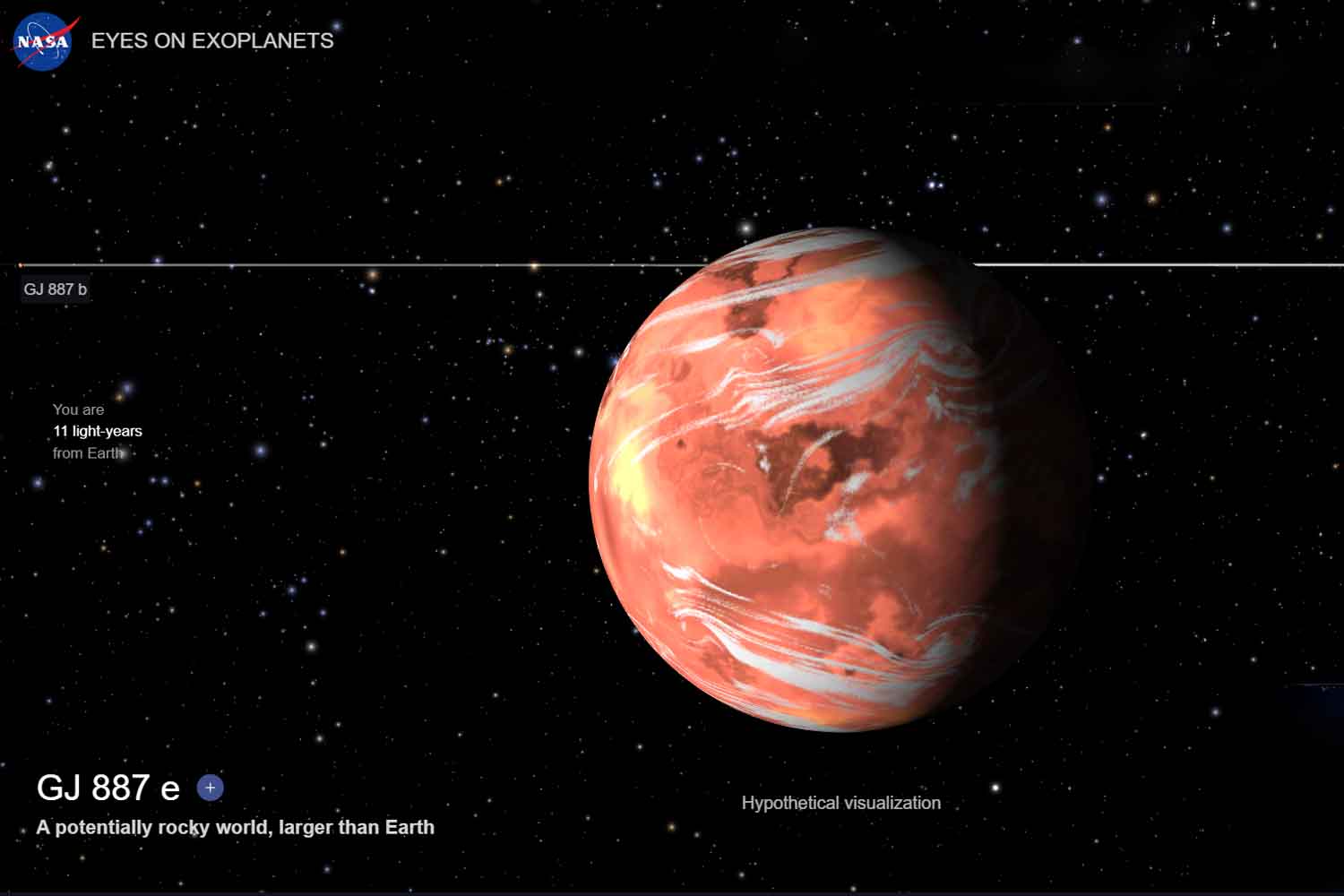
When it comes to new worlds, distance matters almost as much as composition. In the case of GJ 887 ethe most striking detail is precisely its location in the very nearby system GJ 887one star approximately 10.7 light years from Earthclose enough to make it a very interesting target for astronomy in the coming years.
It’s not just about numbers or a new entry in the catalog. Here one of the most accessible star systems ever studied comes into play, and this proximity completely changes the weight of the discovery. Because it means being able to look better, understand more, and perhaps – over time – really get closer to the question that accompanies all space research: how common is a planet similar to ours?
GJ 887 and between size, close orbit and possibility of liquid water
The planet GJ 887 e belongs to the category of the so-called super-Earthsworlds with dimensions and mass greater than those of Earth but still tied to a rocky structure. In this case, the data speaks of a mass equal to 1.46 times that of Eartha value that places it in that intermediate range that scientists observe with particular interest.
Its orbit is extremely rapid: it completes one revolution around its star in just a few seconds 4.4 daysa speed that immediately tells how close it is to its sun. The distance is in fact 0.0417 Astronomical Unitsmuch smaller than that which separates the Earth from the Sun. This detail, taken alone, could suggest an extreme environment, but the context is more complex.
The star around which it orbits, GJ 887it’s one M-type red dwarfsmaller and less luminous than our Sun. This completely changes the rules of the game: very close planets can find themselves in conditions that, at least on paper, allow the presence of liquid waterone of the key elements for any life form as we know it.
And this is precisely where the interest arises. Not a certainty, but a concrete possibility. One of those that push research to move forward, with prudence but also with a certain urgency.
A nearby system that can tell us much more than meets the eye
The real difference, in this case, is the distance. Ten light yearsin astronomical terms, represent almost a home neighborhood. This means that new generation tools will be able to analyze the system with a precision never achieved before for similar objects.
Astronomers are already looking ahead. Projects likeHabitable Worlds Observatory or the program’s interferometers LIFE they were created precisely with this objective: to study the atmospheres of nearby planets, read the composition of gases, look for chemical signals that can tell something deeper than mass and orbit.
Because that’s where the real game is played. The appearance of GJ 887 e everything still remains to be clarified. It could be a rocky planet, or a world dominated by oceans, or even a body much denser and less hospitable than we imagine. The word “habitable” remains suspended, used with caution, almost retained.
There is also another element that deserves attention. The system of GJ 887 it hosts multiple planets and, in the most up-to-date analyses, the one that comes closest to the so-called habitable zone seems to be GJ 887 dWhile GJ 887 e it represents one of the most interesting candidates due to its physical characteristics and ease of observation. A subtle but important distinction, because it helps to read the discovery with greater precision and without superimposing different data.
Yet, beyond the classifications, the point remains one. Every time we find a planet this close, something really changes. It changes the way we plan missions, it changes the type of instruments we decide to build, it also changes the way we imagine the future of space exploration.
GJ 887 e it is not a new Earth. It’s something more interesting, right now: an accessible puzzle. A place close enough to be studied seriously, complex enough to test everything we know. And perhaps this is precisely what makes it so important.
