
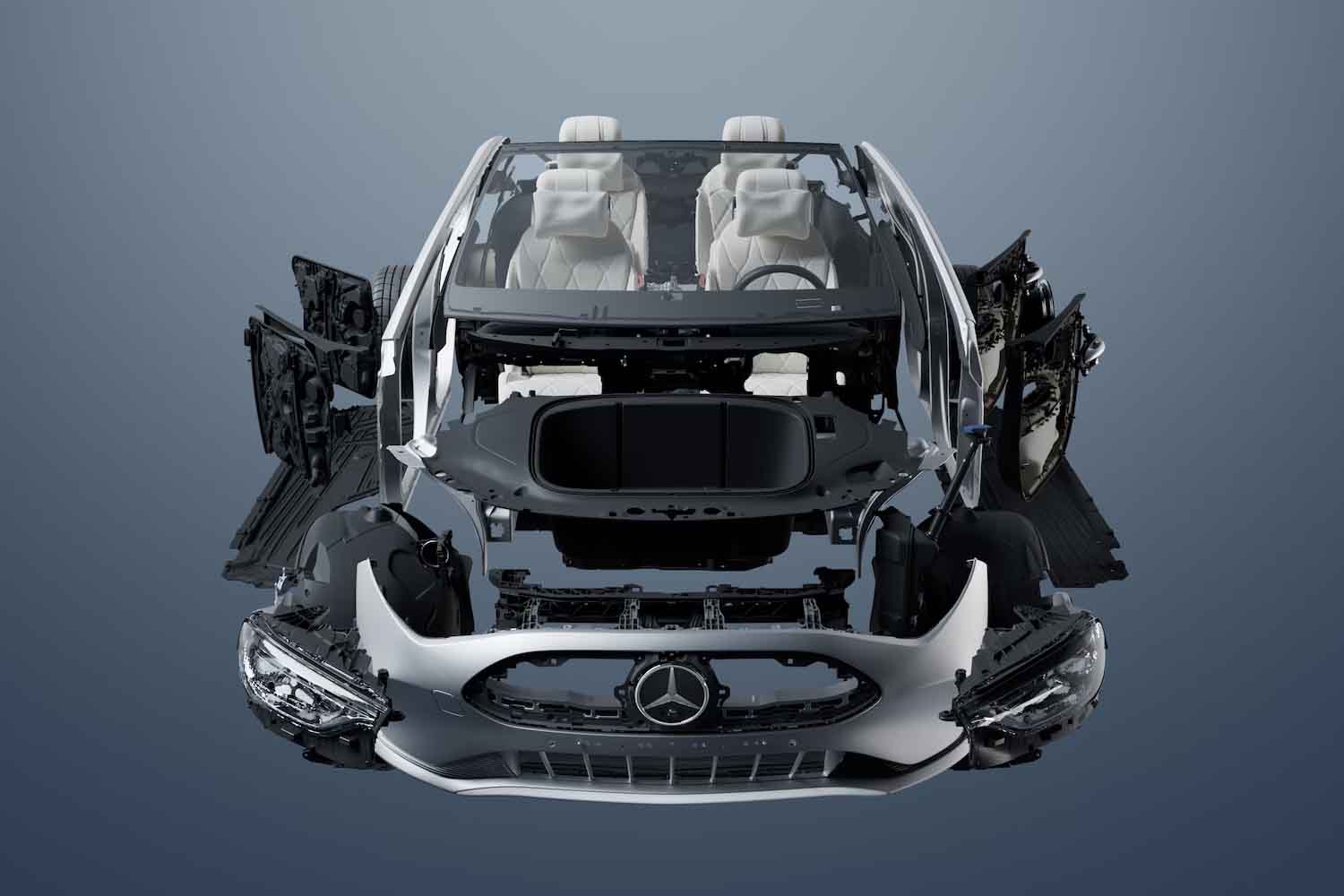
When even a bolt can make the difference. In the debate on sustainable mobility we often talk about electricity, software and new technologies. Much less about industrial design, materials and end-of-life of products. Yet it is precisely there that an important part of the car’s environmental impact takes place. The Mercedes-Benz environmental strategy presented in recent months moves in this direction, bringing attention back to an almost banal topic: how the components of a car are assembled.
The choice to abandon, at least in part, permanent adhesives and bonding to return to removable mechanical systems is not a technological revolution. Rather, it is a course correction from industrial practices that have simplified production but complicated repair and recycling.
The Mercedes-Benz environmental strategy
The Tomorrow XX program, with which the German group frames these choices, aims to integrate the principles of the circular economy already in the design phase. Not only reduce tailpipe emissions, but intervene on resource extraction, assembly and end-of-life of vehicles.
In recent decades, the extensive use of glues and irreversible welding has made many car parts effectively disposable. Minimal damage often results in the complete replacement of a component, with an environmental cost disproportionate to the initial problem. Mercedes-Benz implicitly admits this limit, rethinking some solutions adopted in the past.
Glued headlights: an industrial problem before an environmental one
The case of the front headlights is emblematic. Today, in most vehicles, a damaged lens requires replacement of the entire headlight assembly, even if the failure affects only one part. The result is an increase in complex waste and a greater demand for new components.
Mercedes-Benz’s proposal is simple: replace the glue with screws, making the headlight removable. In this way it is possible to intervene only on the damaged element, extending the life of the component and reducing both waste and emissions linked to the production of spare parts.
According to data provided by the company, this approach would double the share of recycled materials used in headlights and reduce the emissions associated with this specific component by up to 50%. Numbers that should be read with caution, but which indicate a different direction compared to the past.
Simpler materials for less theoretical recycling
Another critical issue addressed by the Mercedes-Benz environmental strategy concerns materials. Many automotive components are made from mixtures that are difficult to separate, making recycling complex or inconvenient.
The new approach favors single-component materials, which are easier to recover once dismantled. This allows us to obtain quality secondary raw materials, reusable without excessively degrading performance. It is not just a question of recycled percentages, but of actual recycling, which is truly part of the production cycle.
From dismantling headlights to car interiors
The “disassemble without destroying” logic is also applied to other parts of the vehicle. In the internal door panels, for example, Mercedes-Benz is evaluating the replacement of ultrasonic welding with removable thermoplastic rivets, which allow the separation of fabrics, plastics and reinforcement structures at the end of their life.
Some solutions have already arrived on series models. The new CLA uses a 100% recycled polypropylene windshield washer fluid reservoir, while the bumpers contain approximately 25% recycled material. At the same time, the group is experimenting with the use of materials recovered from tyres, airbags and other industrial waste, with results still being evaluated.
A change of approach that comes late, but is not irrelevant
It must be said clearly: returning to bolts is not a revolutionary innovation, but a response to problems created by the industry itself in past years. However, recognizing that many “modern” solutions have worsened repairability and recyclability is a necessary step.
The environmental impact of the car does not end with daily use or the type of engine. Manufacturing, logistics and waste management weigh significantly on its overall footprint. In this context, encouraging repair instead of replacement can have concrete effects, including on an economic and employment level.
The Mercedes-Benz environmental strategy does not solve the problems of the automotive industry, but it calls into question some consolidated choices. And, in an industry often oriented more towards marketing than substance, it is not a detail to ignore.
You might also be interested in:
