
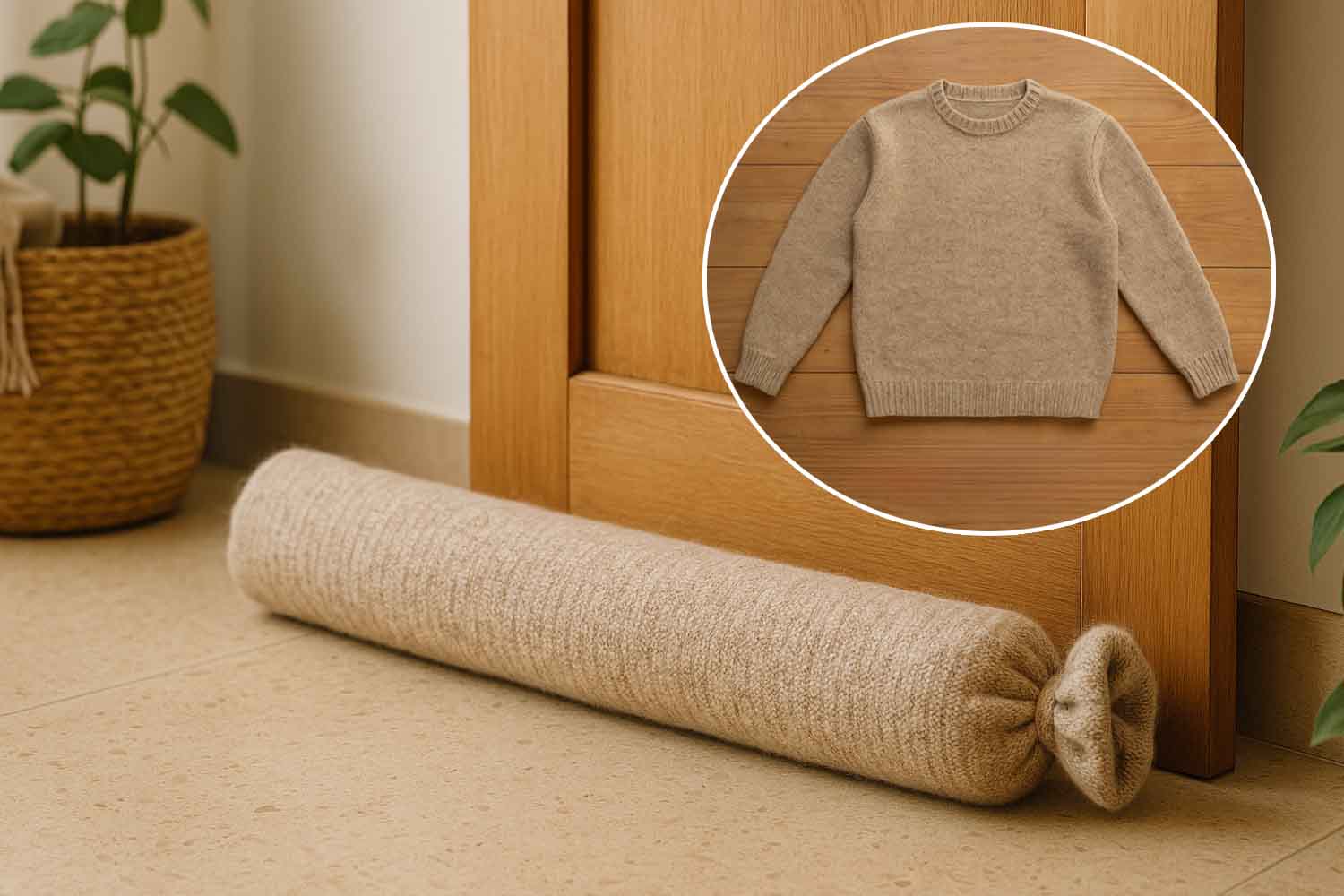
The cold that enters from under doors and windows is not just a seasonal nuisance: it is a silent enemy that drains the heat from the home and inflates the bills. Yet, often the solution is already in our wardrobe, hidden in those felted sweaters that we don’t have the courage to throw away. There is something almost poetic about recovering a forgotten item and transforming it into a useful object. With a little manual skill – and zero needle and thread – they become a draft excluder sausage capable of saving our evenings on the sofa at the last minute.
Transform an old sweater into a draft excluder
The principle is simple: create a heavy, uniform “roll” to place at the base of doors or windows to block freezing air. The interesting part is that this mini-do-it-yourself intervention does not require tailoring skills, just imagination and some forethought.
First you need a sweater that still has thick, durable fabric. The sleeves become precious: they are cylindrical by nature, perfect for hosting the padding. Simply cut them at armpit height and join them together, sliding one inside the other until you obtain a longer and more compact tube. There is no need for stitching: the wool, puffy and elastic, maintains its grip without effort.
For padding, you can use any soft but stable material: rice, old pillow stuffings, scraps of fabric or even rolled socks. The choice depends on the desired weight: the heavier the contents, the more the draft excluder remains in place. Filling the tube is an almost meditative gesture: you proceed little by little, taking care to distribute the contents evenly, so as to avoid “bumps” that could cause it to roll.
Once the ideal length has been reached, each end is closed with a knot, a sturdy elastic band or a decorative tie, which also gives an aesthetic touch. The final effect resembles a long rounded cushion, soft to the eye but surprisingly effective.
It is a tiny, almost domestic gesture, but it brings together several desires that we all have: consume less, heat more, throw away as little as possible. And above all it brings home a feeling of daily competence that we often forget: the ability to make do, to resolve, to transform.
This, after all, is the heart of sustainable living: not giving up, but reinventing.
You might also be interested in:
