
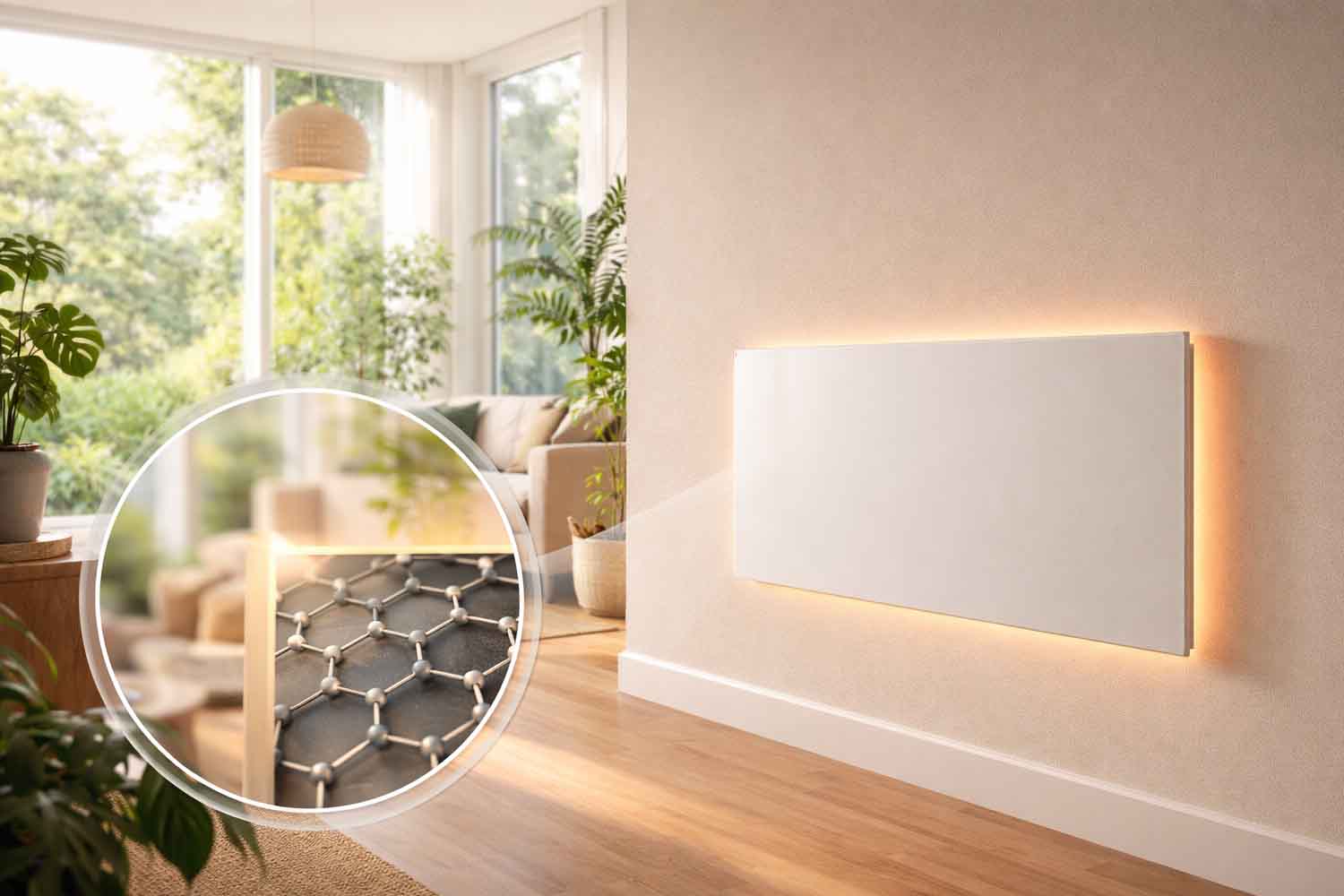
Graphene heating systems are also arriving in Italy and promise a small silent revolution in our homes, offices and even industrial warehouses. Bringing them to the market is the collaboration between Repower Italia and ESA NanoTech, who have announced the distribution of the G-radiant Plug&Play line.
The promise is clear: consume up to 30% less than traditional systems, improving energy efficiency and reducing waste. In a historical moment in which the cost of energy weighs on families and businesses, and the ecological transition can no longer wait, talking about alternative solutions is not only interesting. It is necessary.
Why graphene heating systems can reduce consumption by up to 30%
The heart of these new graphene heating systems is a material that has sparked the interest of scientific research in recent years: graphene. We are talking about a very thin material, but with very high thermal and electrical conductivity. Simply put: it transfers heat quickly, evenly and efficiently.
In G-radiant Plug&Play radiant panels, graphene is used to optimize thermal performance. According to what was declared by the companies involved, this allows a reduction in energy consumption of up to 30% compared to conventional heating systems. This is not just an economic issue, but also an environmental one: less energy consumed means fewer indirect emissions and less impact on the ecosystem.
Another aspect underlined is the absence of electromagnetic emissions. An element that can reassure those who are attentive not only to the environment, but also to the quality of the spaces in which they live and work.
In an era where there is a lot of talk about the energy requalification of buildings and sustainable living comfort, the use of advanced materials such as graphene represents a step that looks forward.
How they work
The G-radiant Plug&Play line was designed to adapt to different contexts. Graphene heating systems are not only intended for homes, but also for offices, shops, public spaces and industrial environments.
Among the solutions proposed we find standard radiant panels, heating platforms for workstations and industrial W-radiant panels designed to integrate into production processes. The idea behind “plug and play” is simple: modular installation, less invasive interventions and greater flexibility.
From a commercial point of view, Repower will deploy its own distribution network, traditionally oriented towards the business sector, in addition to the e-commerce channel. The objective is to encourage the diffusion of this technology, especially in the professional sector, where energy saving can translate into a significant impact on company costs.
ESA NanoTech, on the other hand, focuses its attention on research. The use of graphene would allow us to overcome some limitations of traditional materials, offering greater thermal output with the same – or even lower – consumption.
It is no coincidence that nanotechnologies applied to heating are attracting more and more interest. In recent years, an Italian startup has also developed a graphene heating paint, demonstrating that this material is no longer just a laboratory curiosity, but a concrete opportunity for innovation.
The real question now is another: are we ready to change the way we heat the environments in which we live and work? Graphene heating systems may not be the only and definitive solution, but they undoubtedly represent a strong signal. The energy transition also passes through here, through technological choices that combine efficiency, savings and sustainability.
You might also be interested in:
