
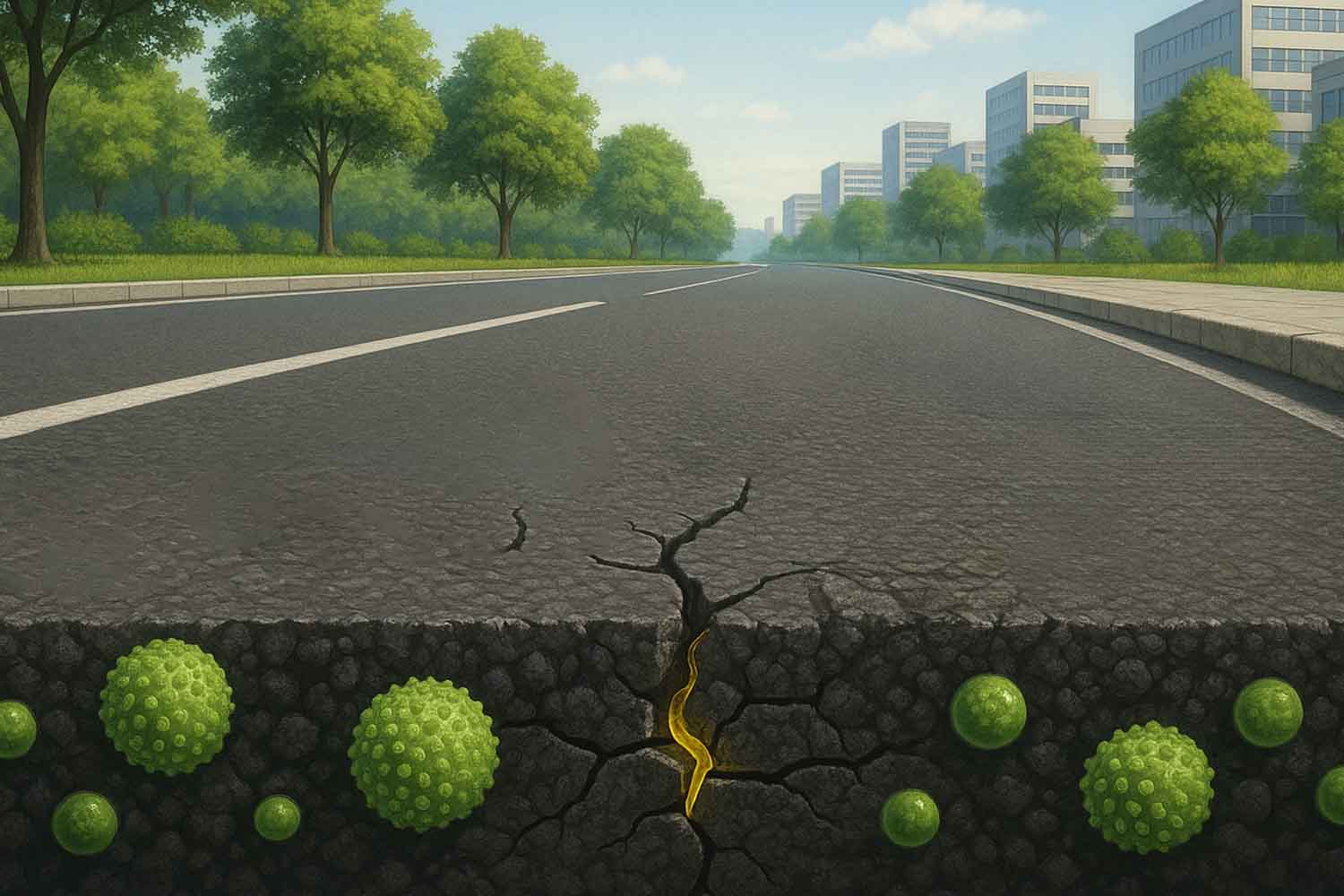
The Road infrastructure they are fundamental for economic and social development, but every year the holes in the asphalt They cause damage, accidents and high maintenance costs. A innovative discovery However, it could revolutionize this scenario. A group of researchers fromUniversity of Swanseaof King’s College London and of theUniversity of Bío-Bío In Chile he developed a self -regulating asphalt capable of repair independently In less than an hour after the formation of the first microfessures.
The project, published in the magazine ACS Applied Materials & Interfacesexploit the spore of a prehistoric plant And sunflower oilcombined with Automatic learning algorithms to prevent the formation of the much feared road holes.
The bitumen regenerates itself thanks to the spores of an ancient fern and sunflower oil
The researchers identified a perfect plant for this purpose: the Licopodio in Massueone perennial herbaceous fern whose spores, once emptied of the reproductive cells, can be filled with sunflower oil through techniques of Uncusual encapsulation and centrifugation.
These vegetable microcapsules They are then mixed with bitumen to create an asphalt capable of actively reacting to stresses. When microfessures are formed, the spores break, releasing the oil That regenerates the damaged materialrestoring the structure of the bitumen without the need for external interventions.
Laboratory tests have shown that self -repair takes place In less than 60 minuteswith a surprising effectiveness in the prevention of holes in the asphaltone of the most popular and expensive problems for public administrations.
An idea that arises from the observation of nature and aims at more sustainable roads
The principle behind this innovation is the bioimitationthat is, the imitation of the healing processes present in nature. As explained by Dr. Francisco Martin-Martinezauthor of the study, “a tree or an animal naturally heals a wound thanks to its biology. With this asphalt we want replicate that natural self -regulatory mechanism».
According to researchers, this technology could prolong the useful life of the roadsdrastically reduce maintenance interventions e halve the environmental impact linked to the continuous production and laying of new layers of bitumen.
The project was also carried out by Dr. José Norambuena-Contreraswhich showed a preview of the mixture obtained, holding the mix of bitumen and vegetable spores. The result promises to radically transform the future of infrastructuresmaking them more resistant, sustainable and economic.
