
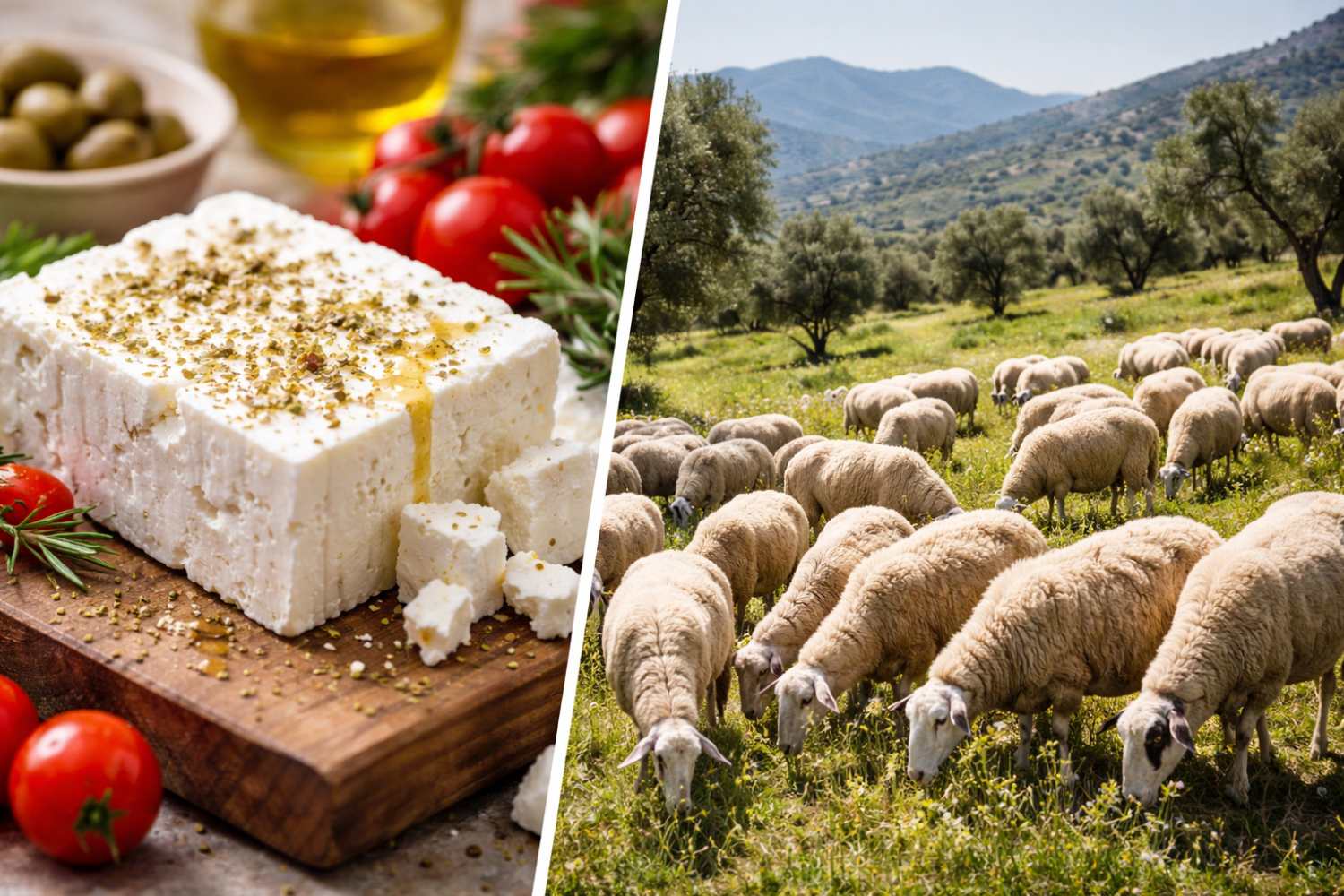
Greek feta lovers may soon find themselves faced with significantly higher prices or smaller portions. The cause is not a whim of the market, but an epidemic that is decimating Greek farms. We are talking about sheep and goat pox, a viral disease that has already led to the slaughter of over 470 thousand animals since its first detection in August 2024.
Greece, the only country in the world where feta with a Protected Designation of Origin (PDO) is produced, is therefore today having to face a health crisis that risks transforming a symbol of local food tradition into a luxury good.
What is sheeppox and the situation in Greece
Sheep and goat pox is a highly contagious viral disease among animals, but – and it is important to underline this – completely harmless to humans. The virus is transmitted mainly through the air and causes ulcers and skin lesions in affected animals. Its ability to resist in the environment is impressive: it can remain viable in rooms and on surfaces for up to six months, making it extremely difficult to control its spread.
Since its first outbreak in August 2024 in the northern region of Greece, the situation has rapidly deteriorated. To date, according to the most recent data from the Greek Ministry of Agriculture, 2,061 cases have been confirmed in 2,559 farms distributed throughout the national territory. The disease continues to spread: between 10 and 18 January alone, 16 new cases were detected in central and northern Greece and in the western Peloponnese.
The most alarming data concerns the number of animals killed, we are talking about 473,000 sheep and goats sacrificed, equal to 5% of the entire national flock. The Thessaly region, the beating heart of Greek dairy production, has been among the hardest hit, with devastating consequences for the supply of milk intended for feta.
Killing versus vaccination
The management of the epidemic has sparked a heated debate between the government, farmers and European institutions. International health regulations require the immediate culling of entire herds upon detection of even a single positive case, a drastic measure that is bringing thousands of Greek farmers to their knees.
The European Commission, through Animal Protection Commissioner Oliver Varhelyi, has offered the vaccines free of charge to Athens, calling vaccination the only additional measure that can stop the emergence of new outbreaks, further limit the spread to the rest of Greece and reduce the number of animals that need to be killed.
However, the Greek government has repeatedly rejected this solution. The official reasons? According to Deputy Agriculture Minister Christos Kellas, there is no vaccine approved by the European Union specifically for this disease. More importantly, vaccinating animals would classify Greece as a country where sheeppox is endemic, putting live exports at risk, although processed dairy products such as feta would be much less affected by such restrictions.
The exasperated farmers blocked national roads for over 40 days in one of the largest demonstrations in recent years. Mass vaccination is one of their key demands, and they have vowed not to leave checkpoints until a vaccination campaign begins.
The impact on feta
Feta is not just any cheese. To obtain the prestigious Protected Designation of Origin (PDO), it must be produced mainly with sheep’s milk – often mixed with a percentage of goat’s milk – and come exclusively from specific areas of Greece. No version made with cow’s milk or produced in other countries can replicate that intense, slightly salty flavour, with a crumbly and creamy texture at the same time that has made feta famous throughout the world.
The situation is now as complex as it is alarming: around 80% of the sheep and goat’s milk produced in Greece is used to make feta. With almost half a million animals killed and over 2,500 farms forced to close, the availability of milk has drastically reduced, causing inevitable drops in production and a consequent increase in prices.
And the effects are already being felt. In Greek restaurants and taverns, irregular supplies force chefs to constantly reorganize menus. Classic Greek salads or baked dishes increasingly come with smaller portions of feta. Even for regular consumers, finding cheese on the shelves is becoming a little more difficult.
Farmers confirm that prices have already increased and the situation is expected to worsen in spring, when shortages become more evident and seasonal demand increases.
The stakes are really high. Feta represents a fundamental economic pillar for Greece: in 2024, exports exceeded 785 million euros, with an annual production of over 97,000 tonnes, of which more than two thirds destined for international markets. Deputy Minister Kellas estimated that the overall value of annual feta exports is around 1 billion euros.
But we’re not just talking about business. Feta is a cultural identity, gastronomic heritage and symbol of the Mediterranean diet in Greece. Its traditional production is in some cases still linked to small family farms and extensive pastures. For this reason, the current crisis must be read not only from an economic perspective, but as a threat to an entire productive and cultural ecosystem.
Sources: BBC / Ekathimerini / Ministry of Rural Development and Food
